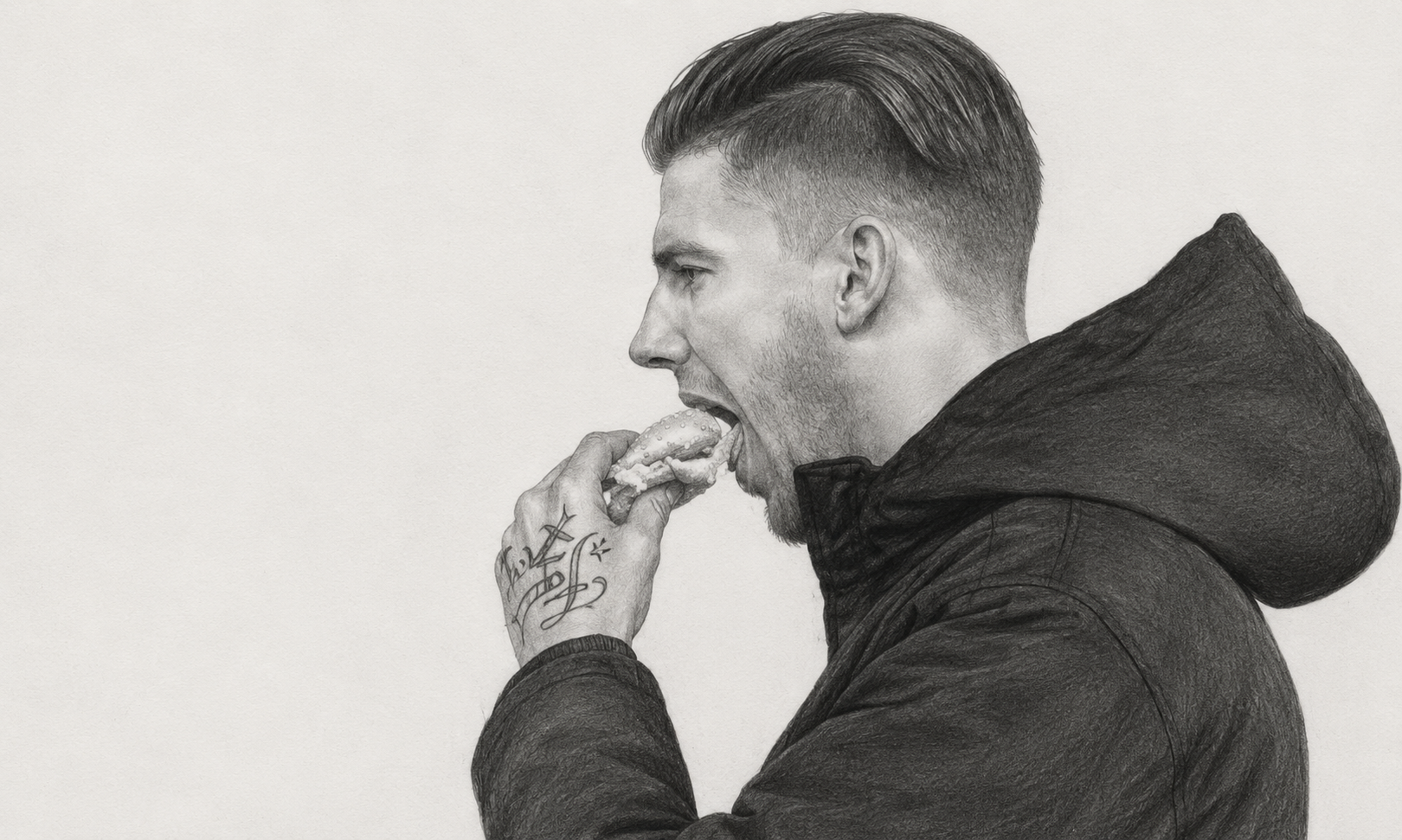
Michiel Kramer
How a croquette sandwich became a striker's legacy
Michiel Kramer and the broodje kroket that became a debate about professionalism and what a single image can say.
Just another lunch
On a Saturday afternoon in The Netherlands, the terraces are packed. Whether you're sitting beside the canals of Utrecht, Groningen or Leiden, the scene rarely changes. Half-litres of Heineken and Hertog Jan disappear almost as quickly as they arrive. Plates of fries covered in mayonnaise, curry ketchup and chopped onions make their way across crowded cafés.
Sooner or later, someone asks the question almost every Dutch person has heard before.
"Anyone fancy a croquette sandwich?"
Nobody looks surprised.
Nobody questions the choice.
A broodje kroket, a deep-fried beef ragout croquette tucked inside a soft white bread roll with mustard, is about as ordinary as Dutch food gets. It's sold in gas stations, football canteens, train stations and cafés. Students eat them. Builders eat them. Office workers eat them. Football supporters eat them before kick-off or during the game.
It's the kind of snack nobody remembers.
Unless a television camera captures it at exactly the wrong moment.
The debate
It happened in full view of the cameras, during the break of Feyenoord's KNVB Cup match against Heracles.
Michiel Kramer was not starting that day, and with Nicolai Jørgensen and Dylan Vente ahead of him in the pecking order, his chances of entering the game were already extremely limited.
So when the television cameras showed him eating a croquette sandwich, the image immediately created a debate.
For many Feyenoord supporters, the reaction was simple: what was the problem?
They defended him.
Feyenoord has always had a unique relationship with its players. The club's identity is built around a working-class mentality where effort matters more than appearance. Niet lullen maar poetsen. No talking. No excuses. Just work.
For those supporters, the standard was clear.
If a player fights for the shirt, gives everything on the pitch and delivers when it matters, what he eats during half-time is irrelevant.
But inside the club, the interpretation was different.
Manager Giovanni van Bronckhorst told Kramer he was not happy and wanted to speak with him the following morning. To Van Bronckhorst, the issue was not simply the food itself. It was what the moment represented. He explained that he had never encountered a situation like this before.
"A professional footballer eating a fried snack during the break of an official match; I had never experienced something like that before. You don't get taught this at the professional football coaching course."
The incident was especially sensitive because Kramer had already found himself in difficult situations at Feyenoord. There had been previous disciplinary issues, including confrontations on the pitch and disagreements over training obligations. To the club, the sandwich did not exist in isolation. It was another moment added to an existing conversation about standards.
Outside the club, the reaction became even sharper.
Analysts Kenneth Perez and Ronald de Boer saw the image as something bigger than a poor food choice. Their argument was that elite football had changed. Clubs were investing more than ever in nutrition, recovery and marginal gains. Every detail was supposed to contribute to becoming a better athlete.
"It almost feels like he is saying: I don't care, I do what I want," Perez said.
De Boer went even further.
"He knows it's not allowed," he said. "He knows he is the third striker. Maybe he is wondering what he is still doing at Feyenoord. It seems like he doesn't care anymore."
And that was the moment the story moved beyond the sandwich.
Because the debate was no longer about what Michiel Kramer was eating.
It was about what people believed it said about him.
To some, it was a sign of disrespect.
It seems like he doesn't care anymore
To others, it was an overreaction to something completely ordinary.
Niet lullen maar poetsen. No talking. No excuses. Just work and deliver.
And in the middle stood a footballer who had suddenly become responsible for explaining not only his performances, but his entire approach to the profession.
Before the sandwich
Long before Michiel Kramer became associated with a croquette sandwich, he was a footballer who had spent his entire career proving people wrong. He was not a product of one of the Netherlands' famous academies. He was not a teenage talent surrounded by expectations, and his career moved slowly.
He had to earn every step, and eventually found his way into professional football with FC Volendam. His game was built around qualities that were difficult to measure: physical presence, persistence, and an ability to make defenders uncomfortable.
He was not the kind of forward who announced himself with elegance.
He imposed himself.
For years, Kramer existed in the space between being underestimated and being impossible to ignore.
At ADO Den Haag, he became a striker people had to take seriously. His goals earned him recognition, and in 2015 Feyenoord signed him, giving him the opportunity he had spent his entire career chasing.
The irony was that the same qualities that had carried him there would later become part of the debate around him.
His personality was always visible.
He was outspoken. He was direct. He did not always fit the carefully controlled image of a modern footballer. At a time when clubs were increasingly investing in media training and carefully managing how players presented themselves, Kramer stood out because he never seemed fully shaped by that process.
But before the sandwich, that was often seen as his appeal.
His interviews were often memorable because they felt unfiltered. His celebrations carried the same character: expressive, sometimes provocative, always noticeable.
And that made him popular with some, frustrating for others.
The move to Feyenoord
Michiel Kramer arrived in Rotterdam as a proven Eredivisie goalscorer.
While playing at ADO Den Haag, he had developed into one of the league's most effective forwards. His value came from his ability to create problems: winning aerial duels, holding up the ball, fighting through physical battles and turning difficult situations into scoring opportunities.
At De Kuip, the expectations were different. Every player wearing the Feyenoord shirt carries a greater weight of attention, and every personality is placed under a larger microscope. But initially, Kramer seemed to fit the environment.
He was a striker with character. A player supporters believed represented the mentality they valued.
A player who could frustrate opponents, connect with supporters and provide something that cannot always be coached: a sense of personality.
In his first season, he repaid the faith placed in him. Kramer finished as Feyenoord's top scorer in the Eredivisie, scoring 11 league goals in a team that was still searching for consistency.
That same season ended with Feyenoord winning the KNVB Cup, their first major trophy in eight years. Kramer was part of the squad that brought a trophy back to De Kuip.
For a moment, the story seemed simple: Feyenoord had found a striker who matched the club's identity.
A player who worked, battled and delivered.
But football rarely stays simple for long.
Super Sub
The arrival of Nicolai Jørgensen changed everything.
The Danish striker quickly became Feyenoord's first choice up front. He offered a different profile: more movement, more combination play, and a style that fitted the way the team wanted to attack.
For Kramer, there was no longer a guaranteed place in the starting eleven.
He became the player Feyenoord turned to when a match needed something different. When defenders were tired. When crosses started flying into the box. When the game became more physical and direct.
A super sub.
A pinch hitter.
A striker called upon to change the rhythm of a match rather than define it from the beginning.
It was not necessarily an unfamiliar role. Football has always had players who become specialists in moments rather than starters across an entire season. But for Kramer, the transition carried a different weight.
He had spent years fighting his way upward, proving that he belonged at every level. Now he found himself having to accept a role where opportunities were limited and patience was required.
And that was where the tension started to grow.
Incidents
During his time at the club, Kramer had found himself involved in several moments that frustrated the leadership. There were disciplinary issues on the pitch, including confrontations that resulted in appearances before the KNVB's disciplinary committee.
One of them involved a training session at De Kuip after a first-team match. Kramer refused to take part because Dirk Kuyt, who had been given an exemption, was not required to do so either. Kramer believed the same rule should apply to him.
Feyenoord saw it differently.
The club viewed it as a refusal to follow expectations. Kramer was temporarily removed from first-team training as a consequence.
From Kramer's perspective, these moments were not evidence of a lack of commitment. They were clashes over fairness, status and his place within the squad.
From the club's perspective, they became signs of a bigger issue.
A pattern.
By the time the cameras showed him eating a croquette sandwich against Heracles, the image did not arrive in isolation. It landed on top of previous frustrations.
The sandwich became powerful because it confirmed a story that had already started forming.
Not about food.
About trust.
The sandwich was not the reason trust disappeared, but it was the moment that existing doubts became visible to everyone.
The damage was done
The damage was not that Michiel Kramer had eaten a croquette sandwich.
The damage was that, from that moment onwards, everything else started to be viewed through the same lens.
A player who celebrates passionately can be seen as someone who cares deeply. The same player, in a different context, can be described as someone who seeks attention.
A player who speaks honestly can be admired for being authentic. The same honesty can later be interpreted as a lack of respect.
Kramer had always been visible.
The difference was that people were no longer only watching him to see what he would do.
They were watching him to confirm what they already believed.
The croquette sandwich became the moment where a footballer's personality started competing with his performances. His goals and his physical presence on the pitch remained part of his story, but they were no longer the only things being discussed.
The question changed.
Not: Can Michiel Kramer help Feyenoord?
But: Does Michiel Kramer belong at Feyenoord?
And once a player reaches that point, the relationship between club and player rarely returns to where it started.
More than a sandwich
Years later, the image remains.
Not the goals.
Not the matches.
Not the moments where Michiel Kramer did what he had built his career on doing: fighting for space, winning battles and finding ways to score.
The croquette sandwich survived.
And that is what makes the story so strange.
He scored 133 goals in Dutch professional football, including 87 in the Eredivisie. He was never a striker who arrived through the traditional route, but one who kept forcing his way into better teams and bigger moments.
Still, his individuality made him most memorable and visible, and impossible to ignore.
Michiel Kramer scored goals that helped clubs survive, compete and win.
But years later, many people remember him for something that never crossed the goal line.
A croquette sandwich.
How it happened
- Match nightKramer is photographed eating a kroket sandwich after a game.
- The next morningThe picture spreads faster than anything he did on the pitch.
- The reactionPundits turn it into a question about a modern professional's diet.
- AfterwardsThe image outlives the goals, and becomes the thing he is remembered for.
Read next
Sources & Further Reading
- Eredivisie and Feyenoord club records
- Dutch press reporting, including Algemeen Dagblad, De Telegraaf and Voetbal International
- ESPN NL broadcast analysis and pundit commentary
- Interviews with Michiel Kramer and former teammates
- Contemporary match reports from the 2015–2017 seasons
Check it yourself
- Michiel Kramer — clubs and career record
- Giovanni van Bronckhorst — the man behind the quote
- Feyenoord — club history and squad records
Last updated
Quotes are attributed to the outlet or interview in which they were originally published. Facts, dates and results were checked against contemporary match reports and official competition records. Spotted something that needs correcting? Email uncut.football0@gmail.com.