How football spent 16 years trying to solve the jabulani problem, only to end up back where it started
FIFA's failed attempts to control the uncontrollable
2010
By the second round of games at the 2010 World Cup in South Africa, the Jabulani had already become more than just a match ball. It had turned into a talking point that overshadowed results, tactics, and performances. Players complained it moved too much in the air. Goalkeepers said it dipped, swerved, floated, sometimes all at once. Coaches searched for explanations.
The confusion wasn't just emotional. It had a physical explanation. Testing by the Sports Aerodynamic Research Centre at RMIT University in Melbourne, led by Dr Firoz Alam, suggested the ball behaved differently under pressure than its predecessors. Wind tunnel experiments showed that small asymmetries in airflow, caused by its panel design and surface ridges, could subtly but significantly alter its trajectory. At higher altitudes in South Africa, where the air was thinner, those effects became even more pronounced. What looked right at the moment of contact did not always stay right in flight.
Diego Forlán
A player who stayed largely outside all the debate was Diego Forlán. Not because he avoided it, but because he seemed to do something others could not: accept its unpredictability without fighting it.
No loud complaints, no theatrical explanations, just goals struck with the same clarity every time. Clean contact, full conviction. And then the ball would leave. Not always where it was aimed. Sometimes it drifted, sometimes it dipped late, sometimes it simply refused to follow expectation. Goalkeepers across the tournament described a similar feeling: not chaos, but hesitation. The sense that clean strikes were no longer guarantees of predictable flight. Opponents did not frame it in technical terms. They framed it in instinct. His shots felt too pure to behave normally.
FIFA Holds Its Ground
Goalkeepers were reacting to the same uncertainty from the other side. Some, like Iker Casillas and Julio César, openly admitted they could not fully read the ball once it left the foot. Yet publicly, FIFA and Adidas maintained a different position: the Jabulani was not flawed, only misunderstood. It was, they argued, the most advanced World Cup ball ever produced, a product of laboratory precision rather than opinion.
After 2010, football did not abandon innovation. It doubled down on it. The Jabulani became a reference point, a warning, and a problem to be solved.
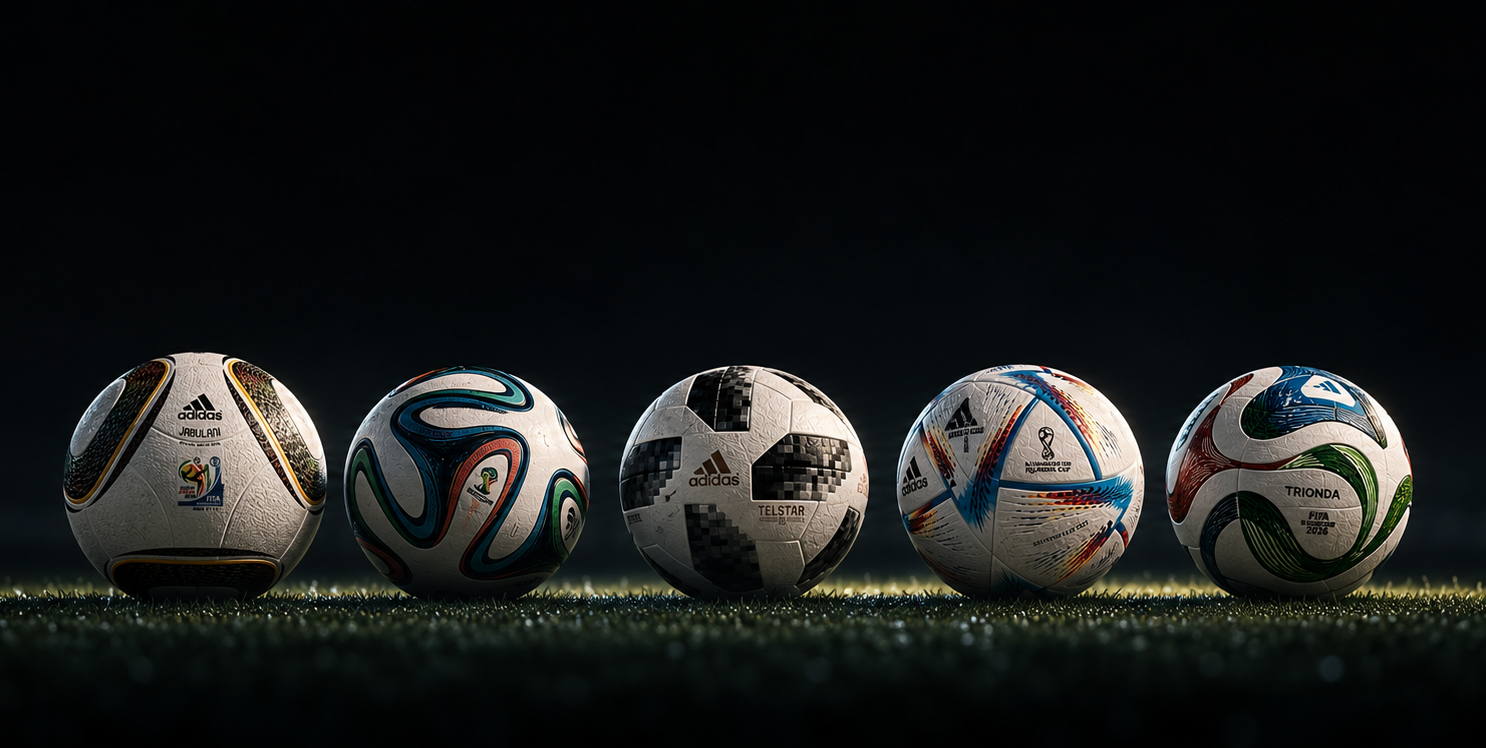
What followed was a decade-long attempt to control what could not fully be controlled. Each new World Cup ball promised greater stability: more consistent flight, more predictable manufacturing, more control over variables that had once produced chaos. The Brazuca leaned into familiarity, designed with player feedback to restore trust in the ball's behaviour. The Telstar 18 refined construction methods to tighten consistency. The Al Rihla pushed further into data-driven design, aiming for precision across every condition.
On paper, each generation moved away from 2010. In practice, something remained unchanged: players still spoke about margins. About small deviations. About moments where expectation and reality did not fully align.
Tracking
The Trionda, used at the 2026 World Cup, takes that evolution one step further. It does not only try to stabilise flight; it tries to record it. With an integrated sensor system embedded in its structure, it registers touch, rotation, and acceleration in real time, transmitting data to the tournament's tracking systems. The ball is no longer only an object in play, but also a source of information about itself. In that sense, football has not only tried to fix the uncertainty. It has started to measure it.
Same Problems
Even in this new layer of precision, some of the same questions persist. Joe Hart has pointed to a recurring pattern among goalkeepers: shots arriving slightly quicker than expected, disrupting timing rather than positioning.
The former England goalkeeper described it as a small but decisive shift in the rhythm between striker and goalkeeper, where the space for reaction is measured in fractions.
It comes onto the goalkeeper a lot faster than they feel it is off the foot.
Uncertainty
The same old tension persists, and the evolution is not a straight line away from the Jabulani. It is a long attempt to control what the game refuses to fully surrender. Each generation of ball has tightened the margins, refined the details, and reduced the extremes. But none have removed the moment itself: the instant after contact where everything is already decided, but not yet known.
The science has advanced. The balls have become more consistent, more controlled, more intelligent. The game has become more measurable than ever before.
And yet the decisive moment has not changed.
A perfectly struck ball still leaves the foot.
And still, for a brief moment, nobody knows what it will do next.
Only now, football doesn't just feel that uncertainty.
We can measure it.
How it happened
- December 2009Adidas launch the Jabulani as the most tested ball ever made.
- June 2010Goalkeepers and strikers alike say it moves in the air.
- 2014The Brazuca arrives with fewer panels and deeper seams.
- 2018–2022Every successor is sold on control rather than speed.
- NowBall design still trades distance against predictability.
Read next
France 2010: The Week French Football Fell Apart
How a generation of stars, a divided dressing room and one extraordinary week brought French football to its lowest point.
Read the storyLegend · 15 minWhat Baggio Was Carrying
Roberto Baggio, Italy, and the five seconds that football remembered — the story of USA '94 and the kick that defined him.
Read the storySources & Further Reading
- FIFA technical reports on match-ball testing and standards
- Adidas product documentation on World Cup match balls
- Published aerodynamics research on football flight and surface design
- BBC Sport and The Guardian coverage of the 2010 World Cup ball debate
- Interviews with goalkeepers and players, including Joe Hart
Check it yourself
- Adidas Jabulani — construction and the criticism it drew
- Adidas Brazuca — the 2014 answer to the Jabulani
- 2010 World Cup — the tournament it was made for
Last updated
Quotes are attributed to the outlet or interview in which they were originally published. Facts, dates and results were checked against contemporary match reports and official competition records. Spotted something that needs correcting? Email uncut.football0@gmail.com.