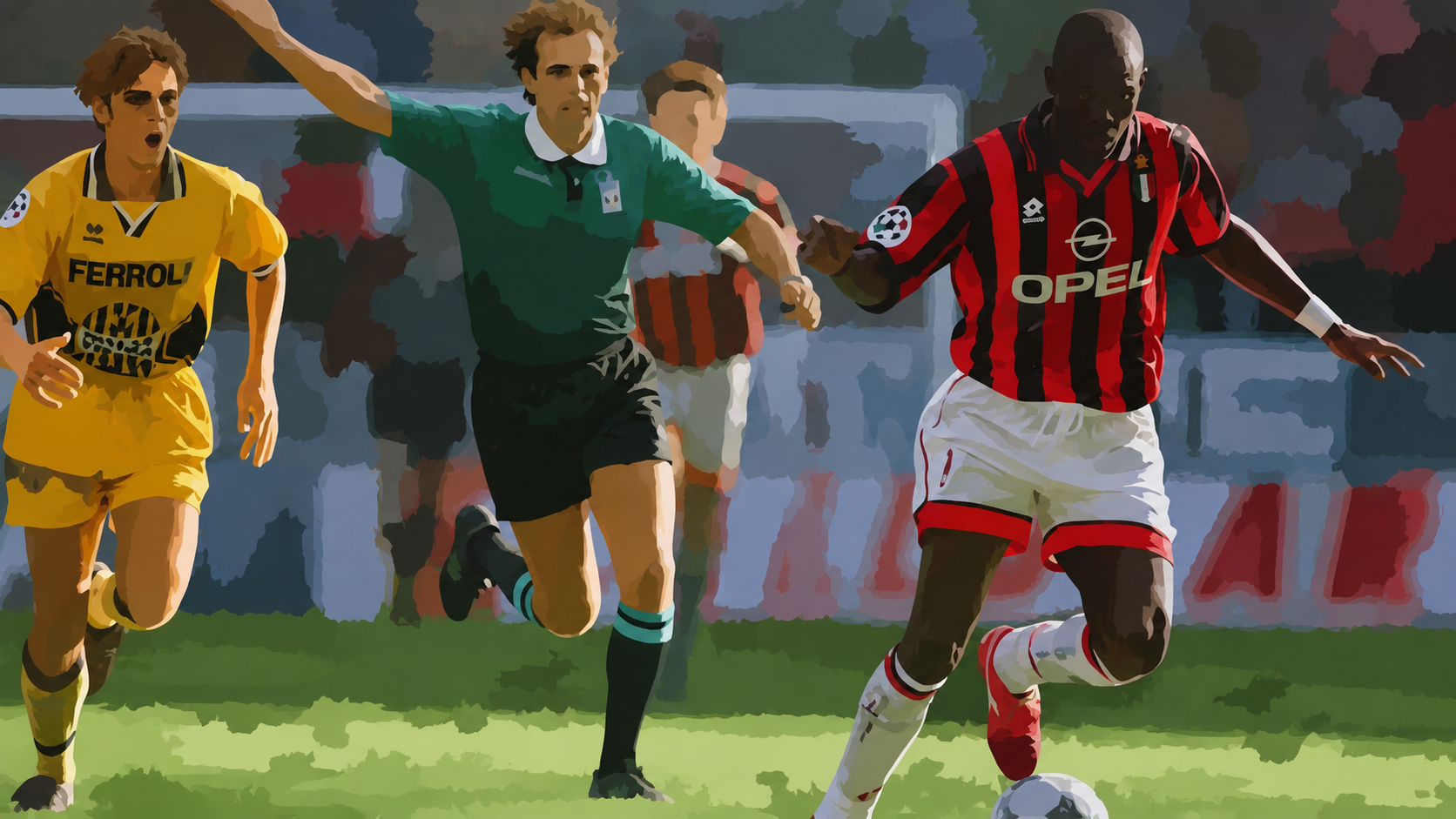
AC Milan vs Verona, 08.09.1996.
The stadium wasn't full that day. Not even close.
San Siro has a way of making emptiness feel louder than it should. Rows of green seats stretched across the stands, the colour almost exaggerated by the gaps between spectators. Every empty space stood out. Every missing Rossoneri supporter was visible.
Verona didn't bring enough fans to hide the emptiness either.
El Diavolo was not at its peak anymore. Still Milan, still heavy with history, but lighter in presence, less certain in dominance.
When a corner for the visitors came in, it landed in a stadium that felt unusually quiet for a place that should have been loud. It didn't feel like the start of anything—just another ball returning to the pitch.
It was a bad corner. Overhit.
George Weah was standing in his own penalty area. He was usually there when the opposition won a set piece. Not as a striker pulled into an unfamiliar duty, but as a physical presence Milan trusted in moments like this because of his height and strength. He was part of the structure. One of the players expected to clear danger, not create it.
Nothing about this phase of play suggested anything different.
The corner drifted into the box. Harmless, past the second post. As if it had already been abandoned mid-flight.
Weah took it.
For a moment, the game behaved normally again. A defensive phase resetting itself. A striker doing a defender's job because that was where he happened to be standing.
Then he started running.
Before Milan, there was Monrovia
There was nothing in Monrovia, Liberia that suggested a straight line to San Siro.
No system that connected the two places. No visible path that could be followed step by step. No academy structure that turned potential into profession.
Just a city where football existed the way everything else did; without expectation, and without anyone imagining it could lead somewhere else.
George Weah was born into that reality.
Not into a footballing pipeline. Not into visibility. Into a place where talent didn't announce itself early because there was nobody to notice it.
Moments of brilliance disappeared because there was nowhere for them to be stored.
Football was not an escape route. It was something that happened around everything else. On uneven ground, in heat, in noise that didn't separate the game from the rest of life. And even there, it didn't feel like promise at first.
Because promise implies someone is listening. Most of the time, no one was. What mattered was that you kept playing anyway.
Weah did.
Games played, stopped, started again. There were no guarantees for what life would bring, beyond the next match and the next group of people who happened to be there.
But something about him kept reappearing in those moments.
Not as recognition.
As persistence.
The kind that doesn't yet know what it is building toward.
Le Professeur
By the late 1980s, George Weah had become one of the most talked-about players in Liberian football. His pace and physical strength stood out immediately, but there was also a technical quality to his game that made him difficult to categorize. He could score goals, create them, carry the ball over long distances and dominate defenders in several different ways.
Those qualities eventually caught the attention of Arsène Wenger, then manager of Monaco.
At the time, there was no established route from Liberian football to Europe's elite. European clubs had few scouting networks in West Africa, African leagues received little international attention, and many decision-makers still viewed African players through a narrow lens. The talent was there, opportunities weren't.
Wenger saw an opportunity where others saw uncertainty.
After watching Weah play for the Cameroonian club Tonnerre Yaoundé, Le Professeur became convinced that the Liberian could succeed in Europe. In 1988, Monaco signed him, giving the 22-year-old his first opportunity outside Africa.
It was a move that changed the course of his life. But it did not make things easier overnight.
Playing in France's Ligue 1 brought a new language, a new culture and a level of tactical organization unlike anything Weah had experienced before. For the first time, he was competing in an environment where every weakness was exposed and every strength was tested against players who had spent their entire lives inside Europe's professional system.
The transition was demanding, even if the numbers suggested otherwise.
In his first league season, Weah opened his account with 14 goals in 23 appearances for Monaco, immediately rewarding Wenger's faith.
More importantly, he continued to develop. Five goals followed in an injury-affected second season before he reached double figures again in 1990–91 and then exploded for 18 league goals in 1991–92, establishing himself as one of the most feared forwards in France.
By then, Wenger's gamble no longer looked like a gamble. One of the world's biggest clubs had found one of the game's most complete attackers.
The First African Superstar
At Paris Saint-Germain, George Weah was no longer part of a development story. He arrived in a club with higher visibility, higher pressure, and less patience for adaptation. There was no longer curiosity about what he might become. Only judgment about what he delivered.
By that stage, defenders already knew him. That knowledge did not reduce his impact. His physical presence was understood and still not contained.
When he arrived in Milan, he had become a forward who guaranteed goals at the highest level.
Serie A was built on discipline and control, a league where space was carefully managed and matches were often decided as much by structure as by individual moments. It remained to be seen how that would translate to a player whose game depended so heavily on acceleration and direct impact in transition.
What followed did not feel like adaptation.
It felt like exposure of a league that had never fully dealt with a player like him.
In Italy, Weah did not change what he was. He forced the game to deal with him in real time. Chances became rare, space became controlled, and attacking moments had to be created inside conditions designed to prevent them. Even in that environment, he kept producing actions that did not fit the logic of how defending was supposed to hold.
In 1995, that tension reached a point the game could not frame in its usual language.
George Weah (29) became the first player born in Africa to win the Ballon d'Or.
It was not a confirmation of status. It was a break in how football had been defining its own hierarchy up to that point.
For the first time, recognition did not follow the categories the sport had used to understand itself.
It happened outside them.
And yet even that kind of shift did not mean the pressures stopped.
Not all resistance came from defenders, and it certainly did not end where the pitch ended.
Through it all
In Europe at the time, racism was a constant presence in stadiums and in the culture around the game. Some careers bent under it. Some never fully escaped its framing.
Weah did not adjust his trajectory to it.
He moved through it without allowing it to become the defining structure of his career. The noise never became the story. The story stayed on the pitch, in the space between defenders, in the moments where nothing external could influence what happened next.
That resilience extended beyond football.
After his playing career, he eventually stepped into politics in Liberia, first as a figure of national hope, and later as president. It was another transition across systems, another environment where reputation, perception and resistance mattered. But the pattern remained the same: movement without interruption, direction without reversal.
Because what had defined him was never the setting.
It was the act of continuing.
And then, for a moment, everything compresses back into one afternoon.
A stadium in Milan with too many empty green seats.
A corner drifting long past the second post.
A defensive phase that should have ended already.
And a player who did not wait for the game to finish behaving the way it was supposed to.
How it happened
- 1988Arsène Wenger signs him from Cameroon for Monaco.
- 1994–95Champions League top scorer with Paris Saint-Germain.
- 1995Wins the Ballon d'Or, FIFA World Player and African Player of the Year.
- 8 September 1996Carries the ball the length of the pitch to score against Verona.
- 2018Sworn in as President of Liberia.
Read next
Jay-Jay Okocha: So Good They Had to Name Him Twice
So good they had to name him twice. How Jay-Jay Okocha became the player defenders could only admire.
Read the storyLegend · 9 minThe Emperor Who Never Really Disappeared
The story of Adriano, a footballer powerful enough to dominate Europe, and the loss that made football feel smaller than the life waiting outside it.
Read the storySources & Further Reading
- Serie A and AC Milan club archives
- Ballon d'Or and FIFA World Player of the Year records
- Contemporary reporting from BBC Sport, The Guardian and Gazzetta dello Sport
- Liberian Football Association and public-record material on George Weah
- Interviews and documentary material featuring George Weah
Check it yourself
- George Weah — clubs, honours and political career
- 1995 Ballon d'Or — the vote he won
- RSSSF — Serie A results archive
Last updated
Quotes are attributed to the outlet or interview in which they were originally published. Facts, dates and results were checked against contemporary match reports and official competition records. Spotted something that needs correcting? Email uncut.football0@gmail.com.