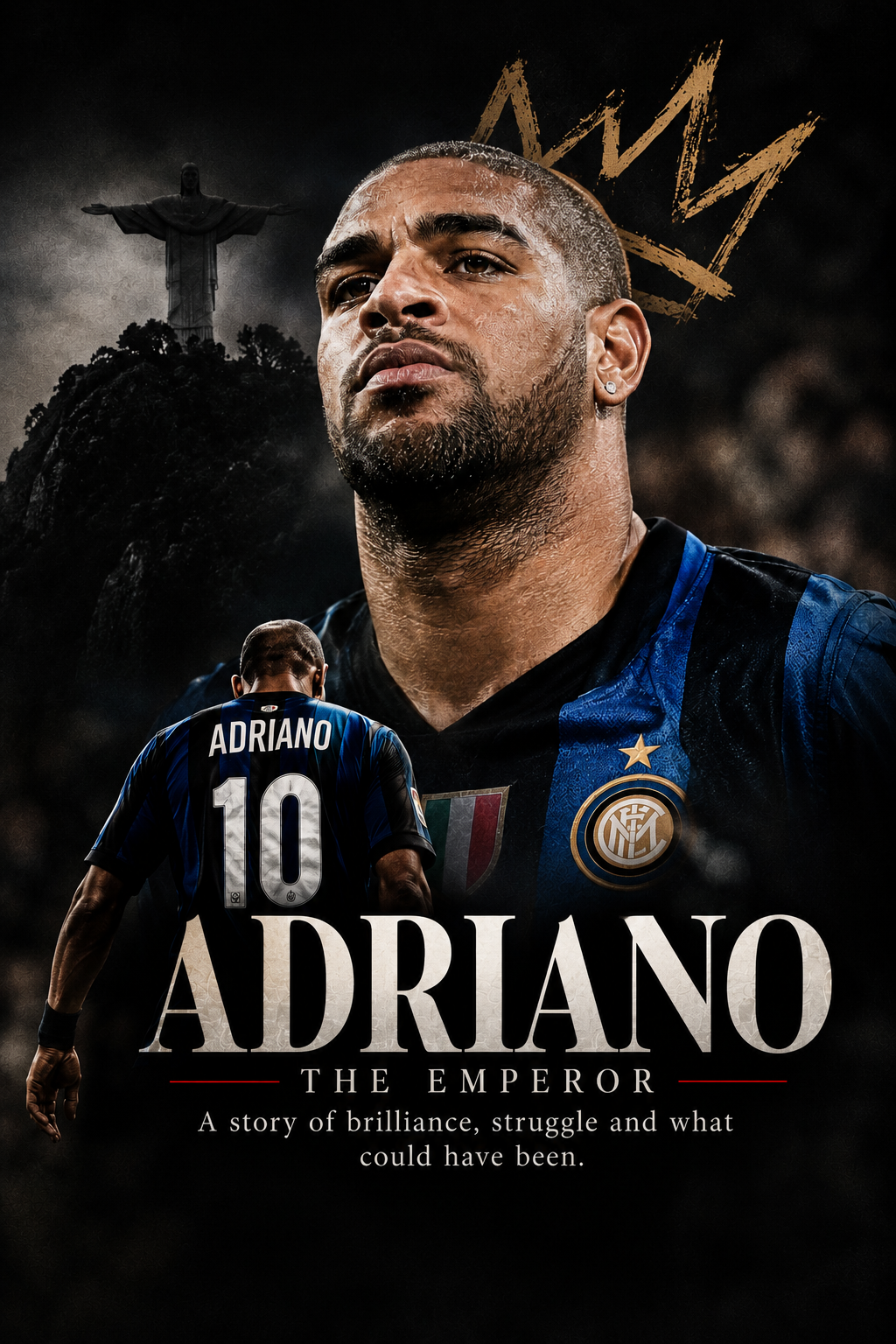
Inter Milan vs Udinese, 17.10.2004.
There was no real reason to shoot when Adriano received the ball outside the penalty area, slightly to the left of goal and still far enough away for Udinese to believe the situation was under control.
A defender stood directly in front of him, another waited several metres deeper, and the space between Adriano and the goal seemed too crowded for anything particularly dangerous to develop. Udinese had numbers around him and, for the moment at least, they had done everything a defending team was supposed to do.
Then Adriano started moving.
He pushed the ball onto his left foot and accelerated towards the first defender, who stepped across to close the space before the Brazilian could build any momentum. Against most strikers, the challenge would probably have been enough to slow the attack and force the ball backwards.
Against Adriano, it barely seemed to register.
There was something unusual about watching him during those years because his physical appearance suggested one type of forward while his movement belonged to another. He had the shoulders and strength of a traditional centre-forward, yet he could carry the ball at speed, change direction and attack defenders in a way that players of his size were not supposed to be able to do.
The first challenge failed to stop him, and by the time another defender moved across, Adriano was already entering the penalty area.
There was almost nowhere left to go. White shirts surrounded him, the angle towards goal was narrowing, and the move appeared to have reached the point where strength and acceleration could no longer create another opening.
A few seconds later, the ball was in the net.
San Siro erupted as Adriano ran towards the corner and opened his arms, his teammates chasing behind him while another apparently impossible piece of football became part of what Inter supporters were beginning to consider normal.
That was perhaps the most remarkable thing about Adriano at the time. There was a period when he seemed capable of producing moments like this so regularly that people stopped treating them as exceptions.
He was only 22 years old, yet Europe was already beginning to understand why Inter supporters had given him a name that seemed appropriate for a player who could overwhelm almost anyone placed in front of him.
They called him L'Imperatore.
The Emperor.
Looking back now, the nickname carries a weight that nobody could have understood when it was first given to him, because emperors are supposed to build something permanent.
Adriano never got the chance to.
Before the Emperor, there was Vila Cruzeiro
Long before Milan, there was Vila Cruzeiro, the neighbourhood in Rio de Janeiro's North Zone where Adriano grew up and where, decades later, he would eventually return.
It sits far away from the version of Rio presented through postcards and tourist photographs. Houses are packed closely together as the neighbourhood rises into the hills, while narrow streets disappear between buildings and football forms part of everyday life rather than something separated from it.
This was Adriano's world, and at the centre of it was his father, Almir.
Football arrived early, but there was no carefully constructed plan behind it and no obvious reason to believe that the boy playing in Vila Cruzeiro was beginning a journey that would eventually lead to one of Europe's most famous stadiums.
At first, it was simply football.
Eventually, Flamengo noticed that the boy playing it was different.
Adriano entered the club's youth system and gradually developed into a forward who became increasingly difficult to overlook. Even as a teenager, there was something contradictory about the way he played because his body suggested power while his feet offered far more than that.
He was strong enough to occupy centre-backs, quick enough to escape them and technically gifted enough to carry the ball into areas where a player of his size should have needed someone else to create the opportunity for him.
Then there was his left foot.
It would eventually become the feature everyone remembered most, not simply because Adriano could strike the ball hard, but because there was something violent about the way it left his boot. Free kicks seemed to accelerate rather than slow down, while shots from distances that normally offered defenders some sense of security suddenly became legitimate chances.
It did not take long for Europe to notice.
In 2001, Inter brought him to Italy at the age of 19.
There were glimpses almost immediately of what they had found.
During a pre-season friendly against Real Madrid, Adriano stepped forward to take a free kick with Roberto Carlos, Luís Figo, Zinedine Zidane and some of the most recognizable footballers in the world sharing the pitch with him.
Adriano struck the ball and watched it fly into the goal.
It was only a friendly, and he was still a teenager who had achieved almost nothing in European football, but sometimes the game offers a brief image of what is coming before the statistics have had time to confirm it.
Inter already had Ronaldo, Christian Vieri and Álvaro Recoba, which meant there was little space for another young forward who needed matches more than he needed patience.
Adriano had arrived in Europe, but he would have to leave Inter before he could become important enough to return.
Becoming Adriano
The first stop was Fiorentina, followed by Parma, and it was there that the outline of the player Inter believed they had signed finally became complete.
Alongside Adrian Mutu, Adriano developed into one of Serie A's most difficult forwards to defend because almost every conventional solution created a different problem.
If a centre-back stayed tight to him, Adriano could use his strength to protect the ball before turning into space. If defenders dropped deeper to prevent him from running behind, they gave his left foot enough room to threaten from distance. If they forced him wide, he was comfortable carrying the ball from there, and if they tried to confront him physically, they discovered that this was usually the contest he wanted.
There was no comfortable distance from which to defend him.
By January 2004, Inter had seen enough and brought him back to Milan.
This time he did not return as an interesting Brazilian prospect who might eventually develop into an important player. He returned as one of the most dangerous young forwards in Italy, capable of deciding matches without waiting for the team around him to create perfect conditions.
The timing mattered because Inter had spent years searching for something that could carry the weight of what the club believed it should be.
They were searching for a league title, searching for stability and searching for a player around whom supporters could build the belief that another era was beginning.
Adriano arrived at exactly the moment they needed someone onto whom those expectations could be placed.
For a while, he carried them remarkably well.
L'Imperatore
The summer of 2004 changed the way the rest of the football world saw him.
Brazil travelled to Peru for the Copa América without several of the players who had defined the national team in the previous years. Ronaldo was absent, Ronaldinho was absent, and the tournament offered Adriano the opportunity to move from promising striker to central figure.
He took it.
The goals came throughout the tournament, but the moment that remained happened against Argentina in the final.
Brazil were losing 2–1 when the match entered stoppage time, and with almost nothing left on the clock, the ball reached Adriano inside the penalty area.
There was a defender tight to him and barely enough space to control the ball, let alone create a clean shot.
Adriano found a way.
He brought the ball under control, turned under pressure and struck with his left foot before Argentina could close the space.
The ball went in.
Brazil had equalized with virtually the final action of the match, and they eventually won the tournament on penalties.
Adriano finished as the Copa América's top scorer and was named its best player.
A year later, he dominated another international tournament at the Confederations Cup, scoring five goals as Brazil won the competition. In the final against Argentina, a match Brazil won 4–1, Adriano scored twice and once again finished the tournament with both the Golden Boot and the award for its best player.
The same transformation was happening at club level.
During the 2004–05 season, Adriano scored 28 goals in all competitions for Inter. These were no longer the numbers of a young player whose potential needed to be projected several years into the future. They were the numbers of a striker already operating at the highest level.
He was 23 years old.
This is usually the point where a footballer's story becomes straightforward.
The difficult beginning has been survived, the potential has been fulfilled, and the player has reached an age where everything that follows appears to be a question of accumulation.
More goals.
More trophies.
Champions League nights.
Ballon d'Or nominations.
A decade spent somewhere near the top of the game.
Football had already written the outline of Adriano's future, and all he appeared to have to do was continue following it.
But life had already changed the story.
The phone call
In August 2004, Adriano learned that his father had died.
He was 22 years old.
Years later, when people tried to explain what happened to Adriano's career, they often began with football. They talked about his weight, his training habits, the nights out, the missed sessions and the gradual decline in his performances.
Adriano himself has consistently pointed somewhere else.
He points back to his father.
Almir had been a constant presence throughout his son's journey from Vila Cruzeiro to Flamengo and eventually Europe. Years earlier, he had survived being shot in the head, with a bullet remaining lodged in his skull.
Adriano had grown up with him, depended on him and carried him into the new life football had created.
Then suddenly he was gone.
Javier Zanetti would later recall the moment Adriano received the phone call telling him what had happened. What remained in Zanetti's memory was not a conversation about football or a player quietly leaving the dressing room.
It was Adriano's scream.
Something had entered his life that neither Inter nor football could solve.
The important thing is that Adriano continued playing, because his decline did not begin with a neat moment where the goals suddenly stopped and the player everyone knew disappeared.
In many ways, the opposite happened.
Some of the best football of his career came after his father's death. He continued scoring for Inter, continued representing Brazil and continued producing performances that suggested nothing fundamental had changed.
From the outside, the machine still worked.
Inside it, Adriano later explained, almost everything felt different.
When football stopped being enough
Adriano has spoken openly about what followed, including the drinking and the periods when he would arrive at training in no condition to take part.
Inter tried to protect him.
There were times when explanations were created for his absence because the reality was more difficult to communicate. An injury could be announced, a physical problem could be understood, and supporters knew what it meant when a footballer's body prevented him from playing.
Grief offered no such clarity.
There was no scan that could show Inter how long Adriano needed before he felt normal again, and there was no rehabilitation programme capable of guaranteeing that the person who eventually returned would be the same one who had left.
This is where the story of Adriano is often reduced to something much simpler than it actually was.
The gifted footballer lost discipline.
He drank.
He gained weight.
He wasted his talent.
It creates an easy sequence in which talent is given, responsibility is ignored and the consequences arrive exactly as expected.
Real lives rarely organize themselves that cleanly.
What made Adriano's following years particularly difficult to understand was that the extraordinary footballer never disappeared completely.
There would be matches when the old power returned, when a defender bounced away from him or a shot left his left foot with the same frightening speed it had always possessed.
For a few minutes, sometimes for several matches, it looked as though everything was beginning again.
Then he would disappear from view once more.
Inter sent him back to Brazil in late 2007, where São Paulo offered both football and distance from the pressures that had surrounded him in Milan.
He scored goals there.
He returned to Inter.
He scored there too.
But the relationship between Adriano and European football had become something that neither side seemed capable of repairing for very long.
Going home
In 2009, after returning to Brazil for international duty, Adriano did not immediately travel back to Italy.
For a period, nobody seemed entirely certain what he intended to do.
Eventually, he explained that he needed to stop.
He had lost the happiness required to continue living the life European football demanded from him.
That sentence probably explains more about Adriano than any statistic from the decline of his career.
He was only 27, an age when many strikers are entering the most complete period of their careers, but Adriano walked away from Inter and returned to Rio de Janeiro.
The football world interpreted it as another stage in the collapse.
Back home, something else happened.
Adriano signed for Flamengo in 2009, returning to the club where his professional career had begun and to a city where the person he had been before becoming L'Imperatore still existed.
The language was familiar, his family was nearby and Vila Cruzeiro was no longer an ocean away.
He started scoring again.
By the end of the season, Adriano had scored 19 league goals and finished as the Campeonato Brasileiro's joint top scorer, while Flamengo won the Brazilian championship.
There were photographs of him smiling again.
For anyone in Europe still waiting for the old story to restart, it looked like the beginning of the comeback everyone wanted.
Perhaps Adriano had simply needed to return home before trying again.
Roma offered that opportunity in 2010.
It did not work.
Neither did Corinthians, and later attempts to continue playing never developed into anything resembling the career that once seemed inevitable.
His body had changed, his rhythm had changed and, perhaps most importantly, his relationship with football had changed.
Eventually, the comeback stories stopped being comeback stories.
Adriano became a former footballer.
The career that was supposed to happen
This is where Adriano's story becomes filled with questions that can never be answered.
What if his father had lived?
What if he had remained at Inter throughout his twenties?
What if the player who dominated the Copa América and Confederations Cup had remained at that level for another five years?
How many goals would he have scored?
How many trophies would he have won?
Could he have won the Ballon d'Or?
There is no end to those questions because, at his best, Adriano possessed almost everything required to become one of the defining centre-forwards of his generation.
He was fast enough to attack space, strong enough to dominate defenders, technical enough to create chances for himself and powerful enough to score from positions where most strikers would not even consider shooting.
At 22 and 23, he was not waiting to become an elite footballer.
He already was one.
That is why the sense of loss surrounding his career remains so strong. People did not have to imagine what Adriano might look like at the highest level because they had already seen it.
They simply expected to see it for much longer.
It is also why the phrase most commonly attached to him feels increasingly inadequate.
A wasted talent.
The description is memorable because it turns an enormously complicated life into something that can be understood in three words.
It is also incomplete.
It assumes football should have remained the most important thing in Adriano's life simply because he happened to be extraordinarily good at it.
It assumes that because millions of people wanted to watch him play, continuing to play should automatically have been enough to make him happy.
Adriano never made that promise.
The rest of football made it for him.
The Emperor at home
Years after his European career ended, photographs of Adriano began appearing regularly from Vila Cruzeiro.
They were not photographs from San Siro or from some carefully constructed world designed to remind people that he had once been one of football's biggest stars.
They were photographs of Adriano with friends, walking through the neighbourhood, attending parties or simply spending time in the place where his life had begun before football transformed it.
Whenever those images circulated internationally, they were often accompanied by some variation of the same question.
What happened to Adriano?
The question assumed that he had disappeared.
He hadn't.
People were simply looking for him in the places where they expected a football star to remain.
Football prefers endings that happen inside stadiums because they are easier to understand. There is supposed to be a final match, a farewell, a standing ovation and a moment when everyone involved recognizes that the story has reached its conclusion.
Adriano's ending offered none of that.
He simply went home.
Perhaps that is the part of his story that remains most uncomfortable for football supporters because we tend to measure careers according to how much could have been extracted from them.
We look at Adriano and see the Champions League nights that never happened, the additional goals that were never scored, the Ballon d'Or he never won and the version of his thirties that never existed.
From that perspective, the career inevitably feels incomplete.
Adriano appears to have found value somewhere else.
He has spoken repeatedly about Vila Cruzeiro, his family and the people around him, as well as the sense of belonging he found there that money and European football could never reproduce.
Perhaps there does not need to be a choice between those interpretations.
Football can have lost an extraordinary player too early while Adriano simultaneously found something outside the game that he needed more than another decade inside it.
Both things can be true.
17 October 2004
Which brings everything back to San Siro.
Adriano receives the ball outside the penalty area with Udinese defenders positioned between him and the goal. There is no obvious route through them and no reason for the situation to become one of the defining images of his early years at Inter.
Then he begins to run.
The first defender cannot stop him, the second arrives too late, and for a few seconds every quality that made Adriano extraordinary appears inside the same piece of football.
There is the strength that allowed him to survive contact, the acceleration that made his size almost impossible to understand, the close control that kept the ball attached to him through the challenges and, finally, the left foot that turned difficult situations into goals.
Then the ball hits the net.
San Siro rises around him as his teammates begin running in his direction.
Adriano turns towards the corner.
He is 22 years old, playing for Inter and Brazil, already established as one of the most dangerous forwards in Europe, with an entire career apparently waiting in front of him.
Watching the footage now, it is difficult not to bring everything that happened afterward into those few seconds.
We know that the peak will not last as long as everyone expected. We know that there will be difficult years, returns to Brazil, attempted comebacks and eventually a life away from the European football that once seemed certain to belong to him.
That knowledge changes the way the goal looks.
It makes every stride feel temporary and every glimpse of his brilliance seem connected to something that should have lasted longer.
But perhaps that is the wrong way to remember Adriano.
Perhaps his career does not need to be measured exclusively against the footballer he might have become.
For several extraordinary years, there was no hypothetical version of Adriano required.
The real one was enough.
He terrified defenders in Serie A, carried Brazil through international tournaments, filled San Siro with the belief that Inter had found the player around whom its future could be built, and produced moments that remain difficult to explain even when watched two decades later.
The tragedy is not that none of it happened.
The tragedy, if there is one, is that everyone assumed it had to last forever before it could mean something.
Adriano was L'Imperatore.
Not because of the career people imagined for him.
Not because of the trophies he might have won or the player he could have become.
He was the Emperor because, for a brief period, defenders knew exactly what was coming and still could not stop it.
The reign was shorter than anyone expected.
It was real all the same.
More from this archive: Brazilian football stories
How it happened
- 2001Leaves Flamengo for Inter as a teenager.
- July 2004Copa América final: equalises in the last minute, Brazil win on penalties.
- August 2004His father dies. Adriano later says football stopped mattering.
- 2005Confederations Cup: top scorer and player of the tournament.
- 2009Back at Flamengo, he wins the Brazilian title and then drifts away again.
Read next
The Second Ronaldo
The story of Ronaldo Nazario, told through the injury that nearly ended everything and the World Cup that made his return impossible to forget.
Read the storyLegend · 9 minJay-Jay Okocha: So Good They Had to Name Him Twice
So good they had to name him twice. How Jay-Jay Okocha became the player defenders could only admire.
Read the storySources & Further Reading
- Serie A and Inter Milan match and squad archives
- Brazilian press reporting, including Globo Esporte and Folha de S.Paulo
- BBC Sport and The Guardian long-form features on Adriano
- Interviews given by Adriano and former teammates
- Contemporary match reports from the 2004–2006 seasons
Check it yourself
- Adriano — clubs, caps and honours
- 2004 Copa América — the final he equalised in
- RSSSF — Brazilian championship archives
Last updated
Quotes are attributed to the outlet or interview in which they were originally published. Facts, dates and results were checked against contemporary match reports and official competition records. Spotted something that needs correcting? Email uncut.football0@gmail.com.