A Club Waiting for Its Turn
Liverpool had spent most of the 2010s living in the shadow of its own past. The trophies were still there, in the cabinets and in the songs: five European Cups and a run of league titles in the seventies and eighties. Above the tunnel at Anfield, a sign still reminded visiting teams exactly where they were. But the last league title had come in 1990, before the Premier League even existed, and every year without another made the history feel heavier.
The club knew how close it could come. In 2014, Liverpool chased Manchester City for the title until the final weeks, only to lose it after a slip by Steven Gerrard against Chelsea. Nine years earlier, Istanbul had shown what this club could do on a European night. What Liverpool lacked was not great moments, but a team that could produce them season after season.
That was the question hanging over Anfield. Was the past a foundation to build on, or a standard no one could meet? For a generation of supporters, the second answer had started to feel more likely than the first. Then, in October 2015, a German manager walked in and began to change the conversation.
Kloppo
Jürgen Klopp was appointed on 8 October 2015, and his first press conference set the tone. He called himself "the Normal One", a gentle dig at the self-styled Special One, who was in charge of Chelsea at the time, and had promised to turn doubters into believers. It sounded like a line, but he spent the next four years proving he meant it.
He arrived from Borussia Dortmund with two Bundesliga titles and a style that was easy to recognise. His teams pressed high and hard, winning the ball back close to the opponent's goal and attacking before the defence could settle. Supporters called it heavy metal football. It suited Anfield, where noise and intensity had always been part of the game.
The bond with the Kop formed quickly. Supporters soon had their own name for him: Kloppo. He celebrated with the stands, walked over to applaud supporters after defeats, and treated the stadium as part of the team rather than an audience. It was a relationship the club had missed for years.
The early seasons brought pain as well as progress. Liverpool lost the League Cup final on penalties to Manchester City and the Europa League final to Sevilla, both in 2016. But the signings of Salah, Mané and later Van Dijk and Alisson gave Klopp the pieces he needed. The foundation was in place. What the team still lacked was a way to turn near misses into trophies.
Unfinished Business
By May 2018, Liverpool had earned its place in the Champions League final. Mohamed Salah had scored 44 goals in his first season at the club, and the team had beaten Manchester City and Roma on the way to Kyiv. Real Madrid were the favourites, but Liverpool arrived believing the night could be theirs.
It lasted about half an hour. A tussle with Sergio Ramos left Salah on the ground with a shoulder injury, and he left the pitch in tears. Liverpool's best player was gone, and the final changed shape with him.
It became the goalkeeper's evening. Loris Karius, who had been an important part of Liverpool's Champions League run and had already kept them alive on several occasions, made two enormous mistakes. First he threw the ball against Karim Benzema's foot for the opening goal. Later, he had a long shot slip through his hands. Meanwhile, Sadio Mané had equalised, and Gareth Bale had scored a phenomenal overhead kick. The final ended 3-1, and Karius stayed on the pitch afterwards, apologising to the Liverpool supporters behind the goal.
It was a cruel way to lose, and a third lost final under Klopp. But the dressing room did not treat it as a collapse. It treated it as a debt still to be paid. The pain of Kyiv would follow this team into the next season, and into a semi-final against Barcelona.
A Season of 97 Points
The Premier League season of 2018-19, the year between Liverpool's Champions League finals against Real Madrid in Kyiv and against Spurs in Madrid, was a relentless one. Liverpool and City gave each other no off-days.
A goalless draw at Everton in early March left Liverpool one point behind, and for the final nine games that gap never moved: Liverpool won every match, and City did too. The title stayed in Manchester for the second year in a row.
It was the end of a season that had started with a team still carrying Kyiv, and one that had been rebuilt with Fabinho, Keïta and Shaqiri, winning its first six league games and leading the table at Christmas.
Liverpool finished with 97 points, at the time the third-highest total in Premier League history. Only City's own 100 and 98 were higher. They were defeated only once in thirty-eight, and still ended up empty-handed.
It was another season in which almost everything had gone right, without delivering the prize Liverpool wanted most. There was still one competition left, and in Europe they had another chance to turn an almost into something more.
A Lead That Felt Too Safe
Their opponent, Barcelona, were no strangers to either protecting or overturning a commanding lead in Europe, although neither side of that story had ended well for them every time.
In March 2017, Barcelona produced one of the most magnificent nights the Champions League has ever seen. Beaten 4-0 in Paris, they were still 3-1 up on the night with barely two minutes of normal time left, and needed three more goals to go through. Neymar scored twice, and in the fifth minute of stoppage time Sergi Roberto stretched out a leg to meet a long ball and turned it into the sixth. The stadium came apart. It was one of the great comebacks in the competition's history, and proof to a whole generation that no deficit was ever final.
Thirteen months later, they were on the other side of the same story. Barcelona led Roma 4-1 after the first leg, and the tie felt finished. In Rome, Edin Dzeko scored early, Daniele De Rossi added a penalty, and Kostas Manolas headed in the third late in the match. Barcelona went out on away goals.
Few clubs have held both sides of the same medal so closely, and so quickly: the night you cannot be stopped, and the night you watch a safe lead disappear.
That is the danger of a lead. It starts as an advantage and slowly becomes an assumption. Players protect it instead of extending it, and one early goal against can change how a stadium breathes.
The stage was set for another Champions League semi-final between two clubs carrying very different memories of what a European night could become.
Camp Nou: Three Goals and a Message
The first leg, on 1 May 2019, was Liverpool's worst night of the season, and it was not a bad performance. They had chances, and Alisson made saves that kept the score from being worse. But Barcelona took theirs. Luis Suárez, a former Liverpool favourite, scored in the first half and did not celebrate against his old club. Late in the game, Lionel Messi added two more, the second a free kick from outside the box that Alisson could only watch go in.
The 3-0 on the scoreboard said the tie was over. Barcelona had not just won, they had done it with the calm of a team that had been here before, and Messi's free kick felt like a final line under it. Most of the football world agreed.
Klopp did not see it that way. After the game he praised his players for the way they had played and talked about Anfield as if the return leg were a fresh start, not a lost cause. It was the kind of line managers say after any defeat. But the dressing room seemed to mean it. Kyiv had taught this group what a hard night felt like, and Camp Nou was not the worst thing they had been through.
Liverpool left Spain not finished, but beaten.
The Injuries and the Gamble
Undoing a 3-0 first-leg defeat against Barcelona, one of the great powers of world football for more than a century, is an enormous task. If you are also without Mohamed Salah and Roberto Firmino, you could be forgiven for wondering whether you should even turn up for the kick-off. For most teams, a night like that would feel like a formality: a farewell ceremony for a tie already decided, a last kick at someone already on the ground.
Salah had been ruled out after a concussion in the win over Newcastle, days after the first leg. Firmino, central to everything Klopp had built, was out with a muscle injury. Liverpool's two best-known forwards were not even in the squad.
Most managers would have started rebuilding the plan around damage limitation. Klopp kept his plan and changed the names. Divock Origi, a striker who had spent much of the season on the edges of the squad, would lead the line. Xherdan Shaqiri, signed in the summer, would play behind him. Neither had the aura of the players they replaced, and Klopp seemed to understand that this was not a weakness.
It was a gamble because there was no safe version of the night. A cautious team could have saved some pride and lost the tie anyway. Klopp chose the version where the line-up matched the size of the task. If Liverpool were going to go out, they would go out trying to score four.
They needed a quick opener. The sooner it arrived, the louder the hope would grow in the stands, and the more Barcelona's three-goal lead would feel like a glass filled to the brim, one careless movement from spilling.
Where European Nights Live
Anfield has always behaved differently when the floodlights are on and the opponent comes from abroad. The league can be a grind, but Europe has been where the club's history was written. Saint-Étienne in 1977, Chelsea in 2005 and the final in Istanbul later that year all became part of the same story, and Barcelona were about to step into its next chapter.
The ritual is part of it. Before kick-off, the stadium sings "You'll Never Walk Alone", scarves are held high and the Kop becomes a wall of sound that visiting players can hear in the tunnel. Opponents have called it intimidating, and Liverpool players have called it a twelfth man. For the home side it is fuel. For the visitors it is weather.
Ask any groundhopper which grounds you simply have to visit once in your life and Anfield is on the list, usually near the top. On a European night, every bus out of the centre is a rolling pre-match party. It drops its passengers in the middle of ordinary streets, not at a ground on a ring road: rows of workers' houses with tiny front gardens, and plain old shops on the ground floor that have seen better decades. The people who live here have heard European nights through their windows for generations. Supporters start filling the pubs hours before kick-off. The Albert and The Park face each other across the street, and by the time the floodlights come on, the songs have spilled out onto the pavement. A little further up sits The Sandon, a converted church that likes to call itself the birthplace of Liverpool FC. By the time the Kop is full, the city and the stadium have become the same thing.
Barcelona were about to walk into all of that. They had won the argument at Camp Nou, but this was not Camp Nou, and a lead looks different when it has to be defended in someone else's house. Here, a tie was only finished when the people in the stands said so.
Equalised
It took Liverpool seven minutes to get what they needed. Jordan Henderson's shot was saved, and Divock Origi, the stand-in forward, tapped in the rebound. Anfield roared, and Barcelona, for the first time all tie, had something to worry about.
Then came another blow. Andy Robertson went off injured at half-time, the third big name Liverpool had lost for this tie. But it turned out to be a fortunate one. Georginio Wijnaldum came on in his place, and nine minutes into the second half the tie had been turned upside down. Wijnaldum scored in the 54th minute and again in the 56th, two goals in two minutes.
Once again, a big absence had opened the door for someone else, and that was no accident. Klopp had spent the season keeping his bench involved, making sure everyone felt part of it and was ready to step in when needed, even on nights like this. Origi and Wijnaldum were not spare parts. They were ready for the moment Liverpool needed them.
The aggregate score was 3-3. The lead Barcelona had carried across Europe was gone. The glass that had been filled to the brim had spilled, in just fifty-six minutes, exactly as it threatened to. Liverpool still needed one more, and what came next was the moment people at Anfield would talk about for years.
Corner Taken Quickly
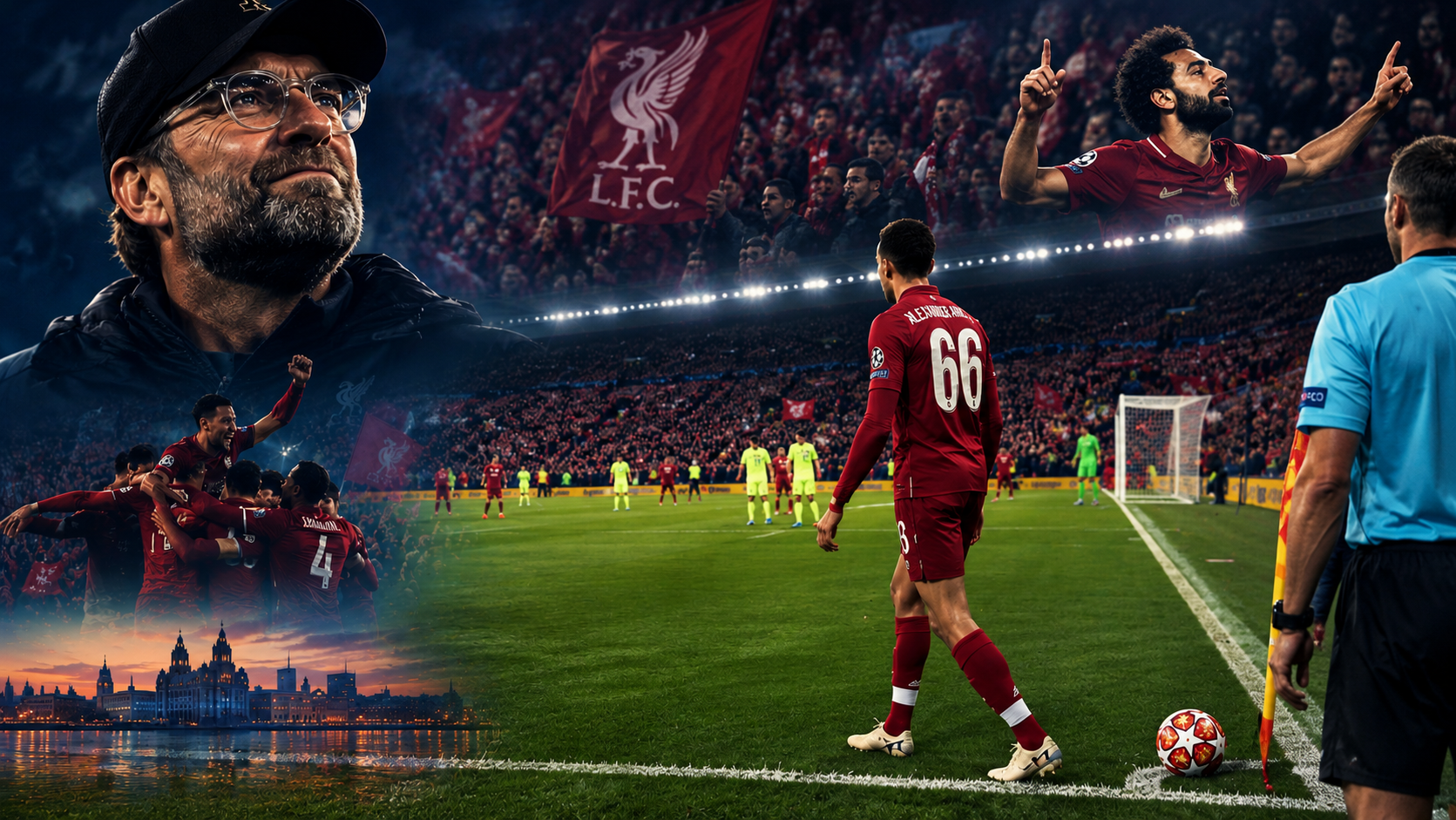
Barcelona were wobbling, and Liverpool were running out of time. When they won a corner on the right, Trent Alexander-Arnold, just twenty years old, walked over to take it. Barcelona's players, instead of settling into their marking, stood around talking and pointing, still sorting out who had which man. Coutinho, who had once played in red, had turned his head away.
Trent saw it. A ball boy, barely a teenager, had already slipped him a ball. Trent set the ball down, then turned and began to walk away, as if handing the job to someone else. Shaqiri, a left-footer, was the obvious man for it. His inswinging deliveries from the right were dangerous, and with so many aerial threats in the Liverpool box, Barcelona had every reason to organise themselves properly against the cross. Sergi Roberto saw Shaqiri coming over, turned his back on the ball and trudged towards the far post. Only Jordi Alba, posted on the edge of the box to stop a short corner, kept his eyes on Trent.
Origi did not turn away. He was far more alert than anyone in Barcelona's yellow, and as Trent suddenly spun back, he was already sprinting for the near post. The ball came in low and hard, bouncing awkwardly on the way, which made it far from easy to score from. Suárez threw his hands in the air the moment it was struck, unable to take in what he was seeing. It felt like an injustice. Alba had seen it coming, but from his position on the edge of the box he could not step in himself, and a shout to his team-mates would have come too late. All he could do was hope that Trent's quick delivery would find nobody.
It found Origi, who caught it a little high on the inside of his foot, the kind of contact that usually sends the ball over the bar. This time it flew into the top left corner. There was nobody in between to block it and nobody left at the near post to send the ball hurtling back out towards the touchline. Ter Stegen was nowhere near his ideal position.
Anfield exploded. The Kop roared, strangers hugged, and the stadium shook. 4-0 on the night, 4-3 on aggregate, and Liverpool were through to the final in Madrid. Barcelona had spent the evening defending a lead. Liverpool had spent it, and the whole season, refusing to switch off.
Two Clubs, Two Different Mornings
Liverpool flew to Madrid in a mood that was nothing like Kyiv a year earlier. Nobody in the squad pretended the night in Ukraine had been forgotten, but it had stopped weighing on them. They had just wiped out a three-goal deficit without Salah and Firmino, and after that a final felt like a smaller thing. For this team, impossible no longer meant impossible. It meant not yet done.
It showed from the first whistle. Salah scored from the penalty spot in the second minute, and Origi added another late on. Tottenham never found a way back. Liverpool were European champions for the sixth time.
But the bigger change had already happened at Anfield. The team that had spent years coming close now believed it could finish the job, and the belief lasted. Within thirteen months of Madrid, Liverpool had also won the Super Cup, the Club World Cup and, at last, the Premier League.
Barcelona went the other way. Rome had been a warning, and Anfield made it a pattern. They lost the Copa del Rey final within weeks, Valverde was sacked the following season, and in August 2020 they were beaten 8-2 by Bayern Munich. A year later, Messi left.
Not all of that can be traced back to one night. But Liverpool left Anfield with something Barcelona had lost: certainty. One club had found a belief that would carry it forward. The other had started to lose its grip on the past.
That is what made the night bigger than the scoreline. A comeback is a medal with two sides, and on that night Liverpool wore the one that shone while Barcelona were left holding the other. Two clubs walked into the same stadium, and they walked out into two very different mornings.
The Kop had roared them through, and the players had finished the job. Barcelona left Anfield with an empty glass; Liverpool left with one they would never again think of as half empty.