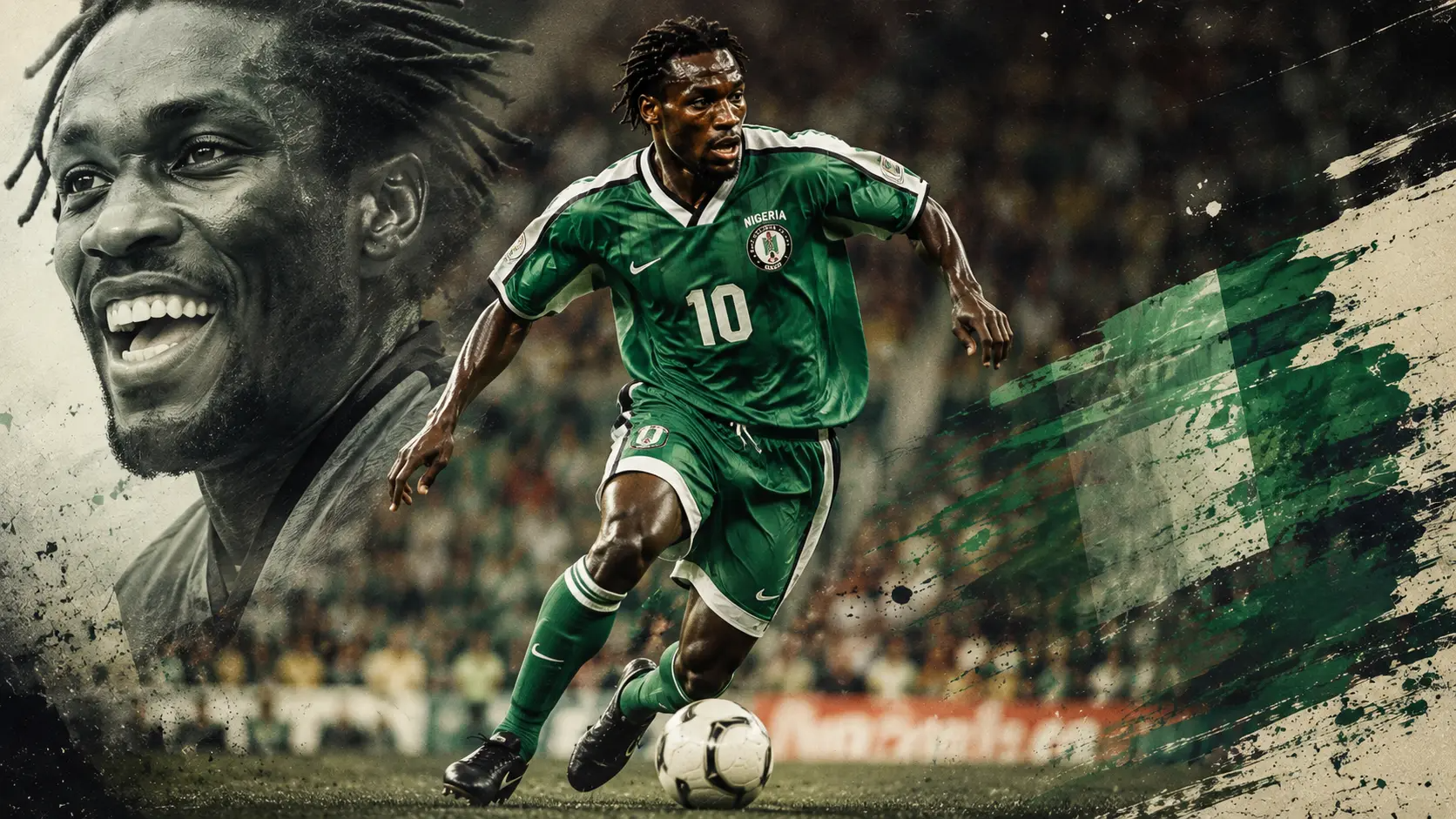
The Name Before the Name
Jay-Jay Okocha is one of those footballers whose nickname eventually became more recognisable than his real name, much like Edson Arantes do Nascimento became Pelé, Ricardo Izecson dos Santos Leite became Kaká, and Ronaldo Luís Nazário de Lima simply became Ronaldo.
Born Augustine Azuka Okocha in Enugu, Nigeria, he would spend much of his career being introduced simply as Jay-Jay, a name that followed him from Nigeria to some of Europe's biggest clubs and eventually became inseparable from the way he was perceived as a footballer.
But before Jay-Jay became a name associated with extraordinary technique and improvisation, there was simply Augustine Okocha, a young Nigerian growing up in a football culture where the game was part of everyday life, played in clubs, on school grounds and on the streets of his hometown.
At that point, there was nothing remarkable about the name. The football world had never heard of Augustine Okocha, and there was no reason to believe it ever would. The nickname that would eventually follow him across continents had yet to acquire its meaning, and the player behind it was still taking shape in Enugu.
The First Jay-Jay
The name Jay-Jay had already existed in Okocha's family before it became attached to one of the most recognisable footballers of the 1990s and 2000s. His older brother James was known as Jay-Jay, and when Augustine began playing football himself, the nickname was passed on to him. It was never intended to become a footballing identity, but it would eventually follow him far beyond Nigeria.
The name itself was not what made him stand out, however. By the time Okocha was making his way into senior football, there was already something distinctive about the way he approached the game. He was not simply trying to get past an opponent or move the ball into a better position; he was comfortable keeping possession for another second, taking another touch and attempting something that most players would have considered unnecessary.
The type of winger Okocha represented was already becoming rare. He was not the modern wide forward who receives the ball with the intention of attacking the space behind the full-back or cutting inside to create a shot, but a player who wanted the ball at his feet and saw the defender in front of him as part of the game rather than an obstacle to be avoided. These wingers could slow an attack down as easily as they could accelerate it, taking opponents on simply because the opportunity was there rather than because the tactical situation demanded it.
That kind of player has become even harder to find in modern football, where wide players are generally expected to make decisions quickly and contribute directly to progression, pressing or goals. Every now and then, someone comes along who seems to resist that trend; Neymar at his best, or more recently Désiré Doué. But the traditional winger who could spend several seconds isolated against a defender, repeatedly inviting him forward before deciding when and how to beat him, has almost disappeared.
Okocha was one of the players who kept that style alive, and few could make it look as natural as he did. He did not simply possess the ability to beat a defender. He seemed to enjoy giving the defender every reason to believe he had figured out what was coming next, only to take him on anyway.
Entering Europe
In 1990, at the age of seventeen, Okocha left Nigeria for Germany. He followed his brother Emmanuel, who was already living there, and initially joined Borussia Neunkirchen, a club playing in the lower levels of German football. His parents had given him the trip as a present after he completed secondary school, while Emmanuel paid for his flight.
He was not arriving with a professional contract or a carefully planned route into European football. He was there to spend time with his brother and experience a country whose football he had only known from afar.
Jay-Jay's career changed almost by accident. A friend took him along to a training session at the club, and Okocha asked if he could join in. The coach allowed him to train and was impressed enough to invite him back the following day. What had started as a visit to Germany was suddenly becoming an opportunity to stay.
Neunkirchen offered the seventeen-year-old his first professional contract, while people around the club helped him settle into a country that was completely unfamiliar to him. He had arrived without the security of a professional football career, but within a short period he had found himself living in Germany and earning a living from the game.
It was an unusual way to begin a European career, and Okocha's next move would make the circumstances of his arrival seem even more improbable.
The Bundesliga Learns His Name
Okocha's time at Borussia Neunkirchen lasted only one season. His performances were enough to attract the attention of Eintracht Frankfurt, and in 1991 he made the move to the Bundesliga. He was still only eighteen, but the step up was significant. Frankfurt was a well-established top-flight club, playing in front of much larger crowds and against players who had spent years at the highest level of German football.
It was here that Okocha began to attract attention beyond his ability to dribble past opponents. His first Bundesliga goal, against Karlsruhe in August 1992, offered an early indication of the kind of player he could become. After receiving the ball on the right, Okocha carried it into the penalty area before finding himself confronted by several defenders. Rather than releasing the ball, he kept moving, repeatedly changing direction as the defenders tried to close him down, eventually leaving them behind before finishing past Oliver Kahn.
Okocha had taken a situation in which most players would have looked for the quickest way out and turned it into an opportunity to keep playing with the ball.
Frankfurt also gave him his first experience of the pressures that came with being a young foreign player in European football. He was learning a new league, a new language and a different footballing culture while trying to establish himself in a team that already had its own hierarchy. His performances, however, were beginning to make the name Jay-Jay increasingly familiar in Germany.
By the time Okocha left Frankfurt, he was no longer simply a promising Nigerian winger who had found his way into European football. He had become a player capable of producing moments that people remembered long after the final whistle.
Becoming Jay-Jay
By the summer of 1992, Okocha had established himself in the Bundesliga, but his time at Eintracht Frankfurt was already becoming complicated. His talent was obvious, yet so was the difficulty of fitting a player with such a strong instinct for improvisation into a team that could not always accommodate it. After three seasons in Germany, he left Frankfurt and moved to Turkey, joining Fenerbahçe in a transfer worth around £1 million.
The move brought him into a completely different footballing culture. Fenerbahçe was one of Turkey's biggest clubs, with a huge and demanding support base, and Okocha quickly became one of the team's most recognisable players. He spent two seasons in Istanbul, scoring 30 goals in 62 appearances and establishing himself as a regular for Nigeria at international level.
His most memorable moment came against Trabzonspor in December 1995. With a free kick from just outside the penalty area, Okocha shaped as though he would strike the ball with his right foot before wrapping it around the wall with his left, sending the goalkeeper the wrong way. It was the kind of moment that captured his growing reputation in Turkey, where his technical ability and personality made him a favourite among the supporters.
By the time he left Fenerbahçe for Paris Saint-Germain in 1998, Okocha had already played in three countries and represented Nigeria at two World Cups. He was no longer a young player trying to establish himself in Europe. He had become an established international, a senior figure within his teams and a player whose influence extended beyond the moments of individual brilliance and unexpectedness that had first made him stand out.
Two worlds, one stage
His move to Paris Saint-Germain came with a fee of around £14 million, making him one of the most expensive African footballers in history at the time.
It placed him in a dressing room very different from the one he had known in Frankfurt or Istanbul. PSG had George Weah, Raí and David Ginola, three players who needed little introduction. Weah had won the Ballon d'Or two years earlier. Raí had lifted the World Cup with Brazil. Ginola was one of the most recognisable players in French football.
Okocha was now playing alongside footballers who had already reached the level he was still trying to establish himself at.
He did not arrive to replace any of them. Instead, he became another piece of a team that had ambitions in France and Europe. There was a particular freedom to his role, especially when he received the ball in the attacking half. PSG could rely on Raí's control, Weah's power and Ginola's creativity, while Okocha offered something that was harder to capture in any single quality.
His four years in Paris never quite produced the sustained individual success that his talent might have suggested. He made 84 appearances for the club and scored 12 goals, while competition for places and changes within the squad meant his position was never completely settled.
But Paris still mattered, as Okocha was playing regularly at a club operating under the brightest lights of French football, while continuing to establish himself as one of Nigeria's most important players. He featured at the 1998 World Cup in France, where Nigeria reached the round of 16, and remained central to a generation of Nigerian footballers that had already begun attracting attention across Europe.
There was also a different kind of recognition developing around him. Okocha was no longer simply being appreciated for what he did with the ball. His personality was becoming part of his appeal. Supporters knew that when he received possession, something might happen that was not in the script.
At PSG, that unpredictability existed alongside some of the biggest names in the game.
But there was a limit to how far that combination could take him. PSG changed managers, changed players and changed direction during Okocha's four seasons at the club. By 2002, at the age of 28, he was ready for another move.
He left Paris having played at the highest level he had reached so far, but without collecting the kind of major club honours that might have placed him alongside the players he had shared a dressing room with.
His next destination would be very different.
Bolton Wanderers were not competing for European dominance. They were not assembling a squad of global superstars. And they certainly did not have the reputation of Paris Saint-Germain.
But at Bolton, Okocha would finally have something he had not always possessed in Paris: the freedom to follow his own instincts, on his own terms.
And in a way, that freedom suited Okocha perfectly: once again, he was taking the less predictable route, following his own instincts rather than the path expected of him.
Bolton: The Wrong Ending to the Right Story
The move to Bolton in 2002 did not look like the natural next step for a player of Okocha's reputation. At 28, he had already played for three major European clubs and had spent the previous four seasons at Paris Saint-Germain. Bolton, by comparison, had only recently established itself in the Premier League.
But that was precisely what made the move so Okocha.
He had spent much of his career taking the route that was less obvious, and Bolton gave him a role that was difficult to find at a club like PSG. He was not one name among several. He was the player around whom much of the team revolved, and under Sam Allardyce he was eventually handed the captain's armband.
The football suited him. There was less need to conform and more room to impose himself on games, whether that meant carrying the ball through midfield, attempting something ambitious or simply slowing the game down until the moment felt right.
One of those moments came against Newcastle United in October 2002. Okocha collected the ball near the halfway line, drove towards the penalty area and worked his way through a series of challenges before finishing the move himself. It was not particularly efficient, and it did not need to be. The goal was pure Okocha: a sequence of decisions made because he could make them.
By then, his influence at Bolton extended beyond moments like that. He was becoming a leader as well as an entertainer, and his relationship with the supporters grew into something unusual for a player who had arrived with such an impressive CV.
For Bolton, this was Jay-Jay Okocha at his most visible.
For Okocha himself, however, the period would later carry a very different meaning.
He has described his time at Bolton as a waste, believing that he should have been playing at a higher level.
That assessment creates an uncomfortable contradiction. The club where supporters embraced him most completely was, in his own eyes, a period in which his career was not progressing as it should have.
And that is where the story becomes more interesting than the highlights. Had Okocha reached the point where he valued freedom more than status? Or had he simply taken a route that suited his personality but cost him the opportunity to compete for the biggest honours of his career?
There is no definitive answer. His performances at Bolton suggest that he had not lost his ability to operate at the highest level, but his surroundings had changed. The player who had once shared a dressing room with Weah and Raí was now the one expected to provide the inspiration himself.
Perhaps that was exactly what made Bolton so memorable. Okocha had never been particularly interested in doing things because they were expected of him. At Bolton, that instinct made him a cult hero. But it may also have left him wondering what could have happened had he chosen the more conventional path.
The supporters got the version of Jay-Jay they loved most. Okocha, looking back, saw the career he had and the career he might have had. Those were not necessarily the same thing.
The Problem with Trying to Define Him
There is a strange problem with Jay-Jay Okocha: almost every description of him is accurate, and almost every description of him is incomplete.
Call him an entertainer, and you overlook the captain who carried responsibility for Nigeria and Bolton. Call him a midfielder, and you miss the player who could turn a football match into a personal playground. Call him one of the most talented players of his generation, and the lack of major club honours immediately complicates the argument.
His career resists a simple hierarchy. He was too accomplished to be remembered merely as a player who produced spectacular moments, but too short of the game's biggest prizes to be placed comfortably among its unquestioned elite. He spent time at some of Europe's most recognisable clubs without ever becoming the defining figure of one of them.
That left everyone with their own version of Jay-Jay.
PSG saw a player capable of operating alongside their stars. Bolton saw a captain whose personality could define an entire team. Nigeria saw the player who carried the imagination of a generation.
And Okocha himself may have seen something different again: a player who had not made the most of everything he was capable of, and who, looking back, might have wished for the chance to be fifteen years younger and do it all again.
Perhaps the most revealing part of his career is not what he achieved, but the sense that he always believed there was more available to him. His later criticism of his time at Bolton suggests that the version of Okocha remembered most fondly was not necessarily the version he considered the best he could have been.
That makes his career difficult to rank, but easier to understand.
Because Okocha was never just one thing. The footballer, the entertainer, the leader and the individual who refused to follow the obvious path were all present at once.
Maybe the most fitting way to remember Jay-Jay Okocha, then, is not by what he was, but by the distance between what he became and what he might have been.
Two Names
Perhaps the most fitting place to end Okocha's story is where it began: with the name.
Augustine Azuka Okocha was the name he was given. Jay-Jay was the name that followed him through football, inherited from his older brother and eventually turned into something entirely his own.
But by the end of his career, the two names seemed to represent more than one person simply having two ways of being addressed.
There was Augustine, the boy from Enugu who left Nigeria at seventeen without knowing where football would take him. And there was Jay-Jay, the player who ended up in Paris alongside Weah and Raí, captained Bolton and became one of Nigeria's most celebrated footballers.
There was the professional and the artist. The leader and the entertainer. The player who could take responsibility for a team and the player who could ignore the obvious option simply because something more interesting was possible.
Even the path he took through football reflected that divide. Nigeria gave him his foundations. Europe gave him the stage. Germany taught him the demands of professional football, Turkey gave him his first real taste of stardom, Paris placed him among the elite and Bolton gave him the freedom to become completely himself.
None of those places produced the whole story.
The world got Jay-Jay.
Perhaps Augustine always knew there could have been more.
Augustine Okocha became Jay-Jay Okocha. The boy who left Nigeria became the footballer the world could not quite define, and perhaps that is why the name endured. Not because it told us exactly who he was, but because it left just enough unanswered.
How it happened
- August 1993The solo goal past Oliver Kahn in Karlsruhe makes his name in Germany.
- 1994Nigeria win the Africa Cup of Nations and reach the World Cup last 16.
- 1996Olympic gold in Atlanta, beating Brazil and Argentina on the way.
- 1998–2002Four seasons at Paris Saint-Germain, briefly the world's most expensive African player.
- 2002–2006Bolton: Premier League survival, a League Cup final, and the tricks people still replay.
Read next
The run that defined a life
The story of George Weah, told through ninety metres of football.
Read the storyLegend · 9 minThe Emperor Who Never Really Disappeared
The story of Adriano, a footballer powerful enough to dominate Europe, and the loss that made football feel smaller than the life waiting outside it.
Read the storySources & Further Reading
- Bundesliga, Premier League and Nigerian Football Federation records
- Africa Cup of Nations and FIFA World Cup official match data
- Contemporary reporting from BBC Sport, The Guardian and Kicker
- Bolton Wanderers, Paris Saint-Germain and Eintracht Frankfurt club archives
- Interviews with Jay-Jay Okocha and former teammates
Check it yourself
- Jay-Jay Okocha — caps, clubs and honours
- Atlanta 1996 — the Olympic tournament Nigeria won
- RSSSF — Nigeria international results archive
Last updated
Quotes are attributed to the outlet or interview in which they were originally published. Facts, dates and results were checked against contemporary match reports and official competition records. Spotted something that needs correcting? Email uncut.football0@gmail.com.