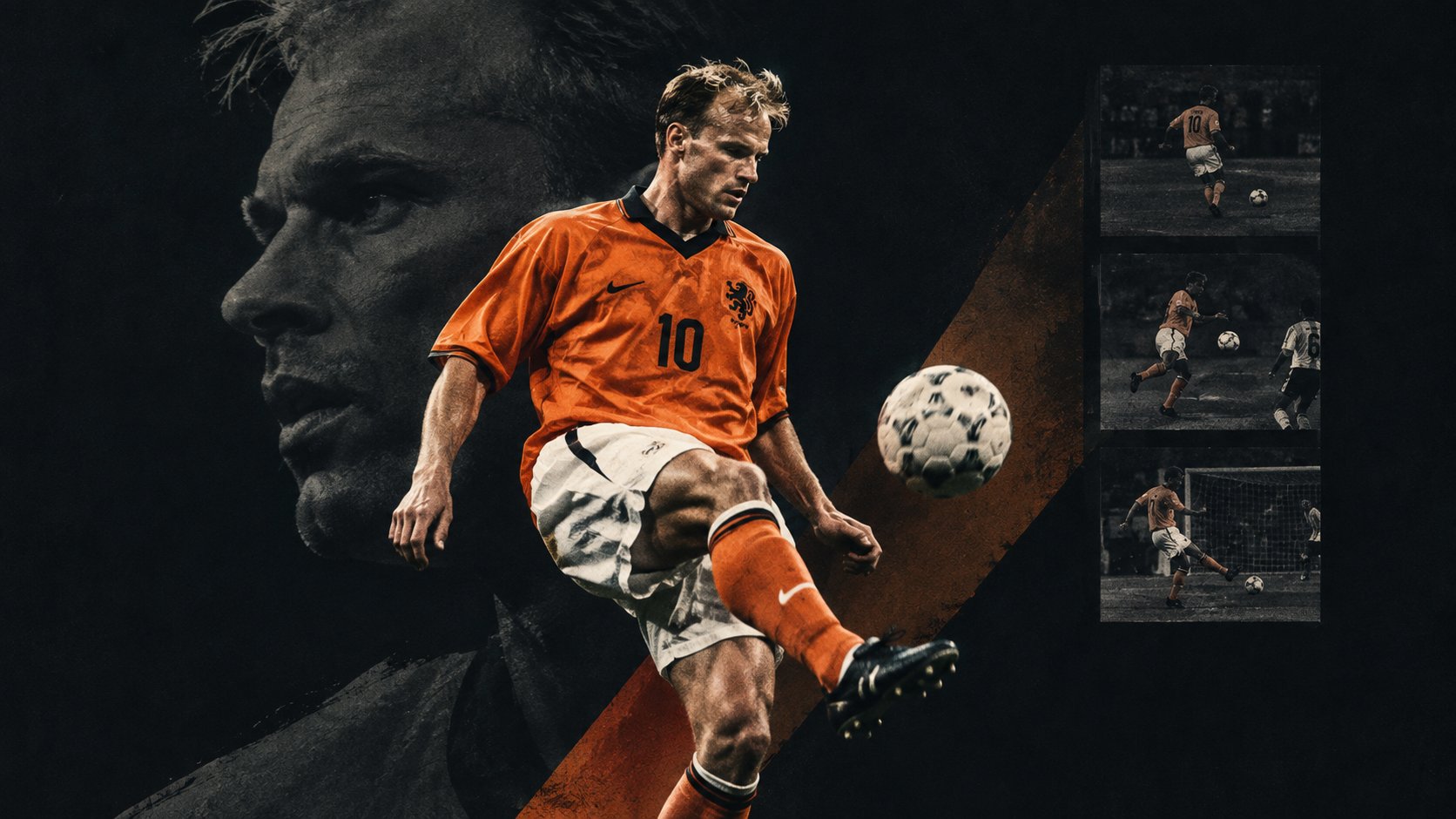
Built to Win
Marseille, July 4, 1974.
In the bowels of the stadium, beneath the concrete, the West Germany players were laughing at what they had just seen.
Berti Vogts stood with a grass stain on his white shirt. Next to him, Rainer Bonhof — midfielder, World Cup winner in waiting — shaking his head.
"We had to chase them. The whole time."
"They're unplayable."
They had just won, 1–0. An early Bernd Hölzenbein goal against the run of play, or rather against the run of everything. Vogts had scored an own goal. Nobody remembered. What they remembered was the way the Dutch had moved — the switching, the interchanging, the sense that eleven men had been replaced by a single organism.
Cruyff was everywhere.
Neeskens was everywhere.
The Germans couldn't keep up. And so they did what smart teams do when they can't keep up.
They cheated. Not openly — subtly. A foul in the 43rd minute that the referee, England's Jack Taylor, didn't see. Vogts hauled Cruyff down from behind, just outside the box. A yellow card anywhere else. A penalty in any other universe.
Taylor waved play on.
The Dutch filed off the pitch at halftime, knowing what the Germans knew: that they had been the better side, and that it hadn't mattered.
The Perfect Goal
The Netherlands didn't invent attacking football.
Hungary did that, in the fifties. Brazil refined it in the sixties. What the Dutch did was different — they built a machine for it.
Totaalvoetbal.
Total Football.
Rinus Michels built it at Ajax in the late sixties, refining ideas he'd absorbed from watching Hungary's Magical Magyars as a young player. The principle was simple: any player could play any position. The centre-back could become a midfielder. The winger could become a full-back. The goalkeeper could become a sweeper.
It required intelligence. It required technique. It required a kind of collective selflessness that went against everything football had traditionally rewarded.
It required Cruyff.
He wasn't the fastest player. He wasn't the strongest. What he had was a mind that processed the game faster than anyone else's — the ability to see patterns before they formed, to understand where the ball would be three passes before it arrived there.
At Ajax, he won everything.
Three European Cups in a row. Six Dutch titles. The Ballon d'Or in 1971 and 1973.
But the World Cup was different. The World Cup was the only stage that mattered, the only prize that would prove the machine worked against the best the world had to offer.
The Curse of the Penalty
The Netherlands reached the World Cup final in 1974 and lost.
They reached it again in 1978 and lost.
Between those two defeats, something shifted. Not in the talent — the talent remained, arguably deepened. What changed was the understanding of what it meant to wear the orange shirt.
In 1974, they were the innovators, the team everyone wanted to watch.
In 1978, they were the ones with something to prove, the ones carrying the weight of what should have been.
The 1978 World Cup was held in Argentina, in the middle of a military dictatorship. The Dutch considered boycotting. They decided to play.
They reached the final again.
Against the hosts.
In Buenos Aires, in the Estadio Monumental, they lost 3–1. Mario Kempes scored twice. The second goal, in extra time, came from a run that shouldn't have been possible — a player carrying the ball through three defenders, finishing with the calm of a man who had done it a hundred times before.
The Dutch had chances. They hit the post. They had a goal disallowed.
It didn't matter.
What mattered was the pattern: twice, they had been the better team. Twice, they had lost.
Then They Disappeared
After 1978, the Netherlands didn't qualify for the World Cup again until 1990.
Twelve years.
A generation came and went. The machine that Michels built fell into disrepair. Cruyff retired, came back, retired again. The 1980s produced good players — Marco van Basten, Ruud Gullit, Frank Rijkaard — but the system that had made them great was gone.
When they returned, in 1990, they won the European Championship. Van Basten scored one of the greatest goals in history — a volley from an impossible angle against the Soviet Union in the final.
It was the peak.
At the World Cup that followed, they lost in the round of 16 to West Germany. The Germans again. Always the Germans.
In 1994, they lost in the quarter-finals to Brazil. In 1998, they lost in the semi-finals to Brazil on penalties.
The pattern was becoming impossible to ignore.
The Netherlands produced world-class players in every generation. They played beautiful football. They were, more often than not, the best team to watch.
And they kept losing.
The Encore
The 1998 World Cup was supposed to be different.
This was the team of Dennis Bergkamp, of Patrick Kluivert, of Edgar Davids. They played with a fluidity that recalled the seventies, but with an edge that those teams had lacked.
In the quarter-finals, against Argentina, Bergkamp scored one of the greatest goals in World Cup history.
A long ball from Frank de Boer. Bergkamp, running at full speed, took it down with his right foot, cut inside with his left, and finished with his right.
It was perfect. The kind of goal that makes you believe in fate.
In the semi-final, against Brazil, they were the better team for long stretches. Ronaldo was unplayable, but the Dutch matched them blow for blow.
It went to penalties.
Phillip Cocu missed. Ronald de Boer missed. Brazil went through.
The Netherlands had lost to the eventual champions in the semi-final. Again.
Empty Shirts
The 2010 World Cup was the culmination of everything.
This was the best Dutch team since the seventies — better than 1998, better than 1978. They had Wesley Sneijder, Arjen Robben, Robin van Persie. They had won every qualifying match. They had beaten Brazil in the quarter-finals, Uruguay in the semi-finals.
In the final, against Spain, they had chances. Robben was through on goal twice. Both times, Iker Casillas saved.
It went to extra time. In the 116th minute, Andrés Iniesta scored.
The Netherlands had lost their third World Cup final.
The 2014 World Cup brought a different kind of heartbreak. In the semi-final against Argentina, they were the better team for 120 minutes. It went to penalties. Ron Vlaar missed. Wesley Sneijder missed. Argentina went through.
The pattern held.
The Netherlands were the best team to never win the World Cup.
What Happened to Oranje?
The Netherlands has won the European Championship once, in 1988.
They have reached the World Cup final three times and lost all three.
They have lost in the semi-finals on penalties twice.
They have produced Cruyff, Van Basten, Bergkamp, Gullit, Rijkaard, Robben, Sneijder, Van Persie.
They have never won the World Cup.
There is no explanation that satisfies. No single reason that accounts for the pattern. The talent was there. The system was there. The desire was there.
What wasn't there, in the moments that mattered, was the thing that separates the great from the immortal: the ability to win when winning is the only option.
The Germans had it. The Brazilians had it. The Argentinians had it.
The Dutch, for all their beauty, for all their innovation, for all their influence on how the game is played, never quite did.
Almost, again.
How it happened
- 4 July 1974The Netherlands dominate West Germany in Marseille — and lose the final 2–1.
- 25 June 1978A second final, against hosts Argentina in Buenos Aires, lost 3–1 after extra time.
- 1988Van Basten's volley seals the European Championship — the country's only major trophy.
- 7 July 1998Bergkamp's genius beats Argentina, then Brazil win the semi-final on penalties.
- 11 July 2010A third final: Iniesta's 116th-minute goal gives Spain the title in Johannesburg.
- 9 July 2014Another semi-final, another shootout — Argentina go through, the pattern holds.
Read next
What Baggio Was Carrying
Roberto Baggio, Italy, and the five seconds that football remembered — the story of USA '94 and the kick that defined him.
Read the storyHistory · 12 minFrance 2010: The Week French Football Fell Apart
How a generation of stars, a divided dressing room and one extraordinary week brought French football to its lowest point.
Read the storySources & Further Reading
- FIFA World Cup official records and match archives (1974–2014)
- KNVB (Royal Dutch Football Association) historical material
- Contemporary reporting from NOS, AD, De Volkskrant and The Guardian
- Documentary and interview material on Rinus Michels, Johan Cruyff and the Netherlands national team
- RSSSF competition archives
Check it yourself
- Netherlands at the World Cup — tournament by tournament record
- 1974 World Cup final — West Germany 2–1 Netherlands
- 1978 World Cup final — Argentina 3–1 Netherlands
- 2010 World Cup final — Netherlands 0–1 Spain
- RSSSF — World Cup results archive
Last updated
Quotes are attributed to the outlet or interview in which they were originally published. Facts, dates and results were checked against contemporary match reports and official competition records. Spotted something that needs correcting? Email uncut.football0@gmail.com.