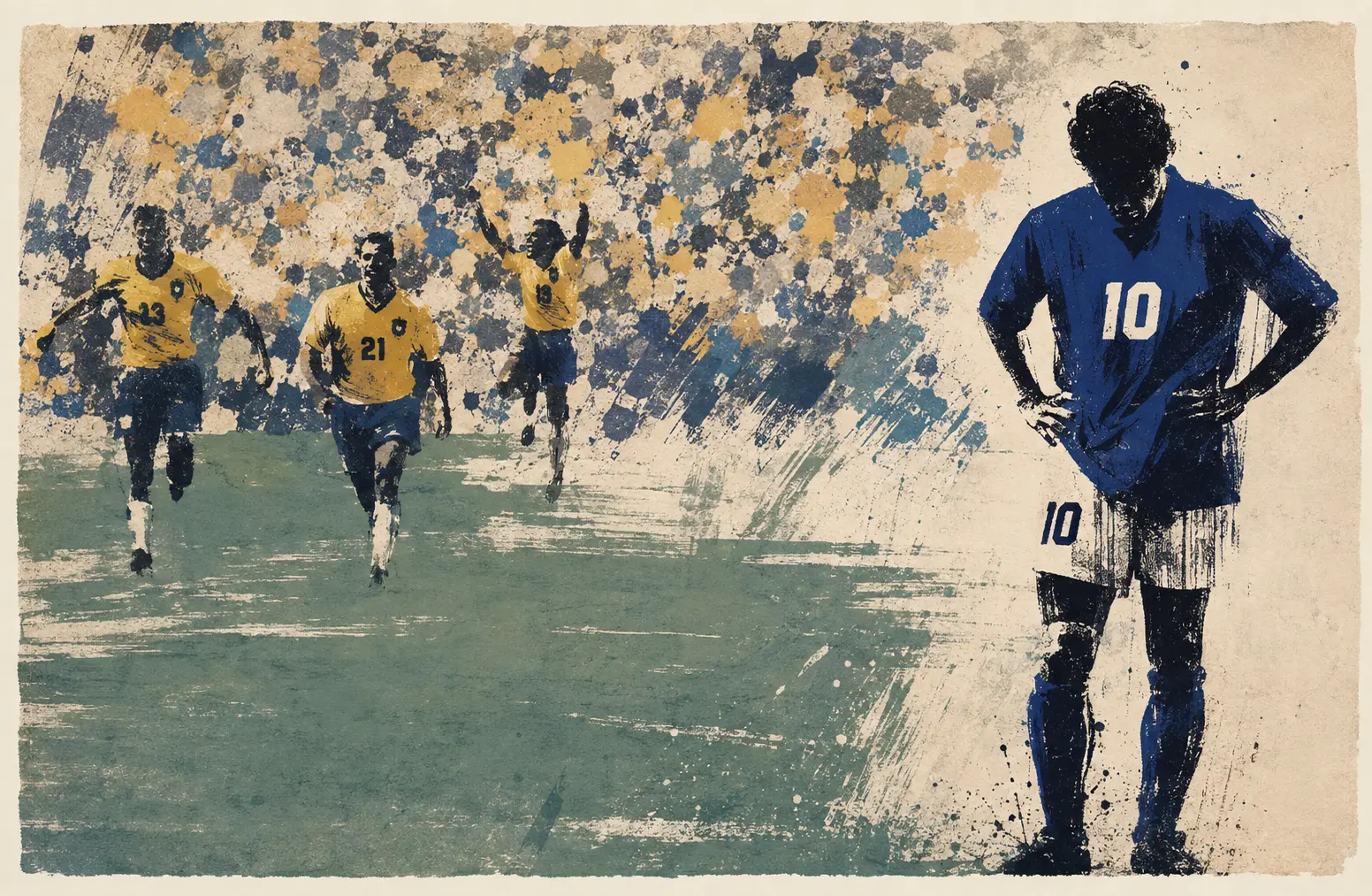
Hands on Hips
By late afternoon, the Rose Bowl has given its crowd almost nothing to release, and there is nowhere in the open, roofless stadium for anyone to escape what the sky has been doing to them all day. Two hours of football have passed and the scoreline still reads 0–0. Temperatures on the field have climbed past 38 degrees Celsius, and the heat has stopped feeling like weather and started feeling like something the players are physically carrying, a weight that settles into the legs and doesn't lift even as the afternoon light begins, finally, to soften.
It is 17 July 1994, and Brazil and Italy have played 120 minutes without a goal. The World Cup final is about to become the first to be decided by a penalty shootout, and there is a strange, suspended quality to the stadium in the minutes before the shootout begins, as if nobody is quite sure how to feel about a final being decided this way. Not by a moment of skill. Not by a mistake in open play. By five men, walking one at a time to a spot twelve yards from goal, with nothing standing between them and history except their own nerve.
Franco Baresi goes first for Italy. He has captained this team through a tournament that has asked more of his body than it had left to give, having undergone knee surgery just twenty-four days earlier, somehow willing himself back onto the pitch for the biggest match of his life. He strikes the ball high, and it sails over the bar. He turns away before it has even finished its arc, his hands pressed to his face.
Brazil miss one too, and for a moment it feels as though the shootout might stay level, cancelling itself out kick for kick.
Then Daniele Massaro steps up to take Italy's fourth. Cláudio Taffarel guesses correctly and saves it, and the Brazilian end of the stadium erupts in a way that makes clear what everyone already senses.
Brazil are one kick away from being world champions.
And so, with the entire tournament pressing down on a single walk from the halfway line to the penalty spot, it comes to Roberto Baggio.
He is not just any player taking a penalty. By this point in the tournament, he is the player, the one who has carried Italy through matches they had no business surviving. Against Nigeria, with Italy losing, down to ten men and elimination minutes away, it was Baggio who equalised and Baggio who won it in extra time from the spot. Against Spain, in the quarter-final, it was Baggio who found the goal that sent Italy through. Against Bulgaria, in the semi-final, it was Baggio again, twice, as if the tournament had simply decided to run through him.
Five goals in three knockout matches. Italy would not be standing on this field, ninety minutes from history, without him.
Which is exactly why what happens next matters so much.
Baggio places the ball on the spot himself. He does not rush, carrying a stillness about him that looks, from a distance, almost like calm, though anyone who has followed the tournament closely knows what that stillness is actually holding back.
He strikes it clean, with real conviction, exactly the way a man strikes a ball when he believes completely in the shot he has chosen.
The ball keeps rising. It doesn't dip in time. It sails over the crossbar and into the space above the goal, and for a fraction of a second the entire stadium seems to hang there with it, tracking its flight, before the sound finally arrives: half of Pasadena erupting, the other half falling into silence all at once.
Brazil are world champions.
There is no replay to check, no goalkeeper who made a genius save, no linesman's flag, no deflection to point to, nothing but the simplest and cruellest story football has to offer.
He missed.
For a few seconds, Baggio doesn't move, standing alone on the spot where he has just taken the most important kick of his career, watching the space where the ball has already gone, as if some part of him is still waiting for it to come back down inside the goal.
Then, slowly, he puts his hands on his hips. That is the image.
That is the one that gets printed, re-printed, framed and carried into every retrospective, every anniversary, every list of football's most heartbreaking moments for the next thirty years: Roberto Baggio, alone, hands on hips, head slightly bowed, the Californian sky behind him giving no indication of what it has just witnessed. Even Taffarel, speaking years later, would remember the photograph of Baggio with his head down as one of the defining images of the final.
For Italy, the story of USA '94 will collapse, almost instantly, into the story of that one kick. It shouldn't.
It should be about everything that came before it: the goals that rescued a team from elimination, the injuries that had already taken so much from its best players, and the tournament in which one man was asked, over and over, to be more than a footballer.
Because the strange thing about Roberto Baggio is not that he missed a penalty in a World Cup final.
It's that by the time he walked up to take it, an entire country had already decided he couldn't miss.
The Player Italy Needed
Italian football had entered the 1990s from a position of extraordinary strength, the kind of strength that made anything less than total success feel like a disappointment rather than a fair outcome. Serie A sat at the centre of the football world. The biggest clubs fought over the biggest players, and European trophies travelled back to Italy with a regularity that other nations could only envy. The national team had already won the World Cup once, in 1982, and eight years later the tournament itself had come home, staged across Italian stadiums in the summer of 1990. And yet something had begun to feel unfinished.
At Italia '90, Italy reached the semi-finals on home soil and went through the entire tournament without losing a single match in normal time. It should have been enough, but it wasn't. They fell to Argentina on penalties in the last four, then lost the third-place playoff, and the tournament that was supposed to crown Italian football instead left it a step short.
Two years later the disappointment sharpened into something worse: Italy failed even to qualify for Euro '92, a national embarrassment made all the more striking by the squad it happened to. This was a team that had Paolo Maldini and Franco Baresi anchoring the defence, and Roberto Mancini and Gianfranco Zola leading the line with genuine attacking quality up front. Talent had never been the issue. Somehow, it still hadn't been enough.
The country still had the clubs. It still had the players. It had the money, the prestige, the history, everything a footballing nation could ask for except the one trophy that would have justified all of it.
What it did not have, going into the 1994 World Cup, was another world title. And increasingly, it had begun to look for one man to provide it.
Roberto Baggio had, by the early 1990s, become Italian football's great individual talent, the kind of player who didn't just win matches but made people watch football differently while he did it. His rise at Juventus had already placed him among the best players anywhere in the world, and in 1993 that status was confirmed formally when he won the Ballon d'Or.
What made Baggio compelling wasn't only the quality of what he did with the ball. It was the shape of his game, which represented something slightly apart from the football Italy had traditionally celebrated.
He could improvise in moments when a more conventional player would simply pass sideways and wait. He could create from almost nothing, conjuring an opening where none seemed to exist a second earlier. He appeared, more often than his teammates, to see possibilities before anyone else on the pitch had registered them, and when the structure of a match broke down entirely, when both teams' plans had collapsed into chaos, Baggio tended to become more dangerous rather than less.
None of this had come easily to him. Serious knee injuries had already shaped his development as a footballer long before the 1994 World Cup, forcing him to learn a relationship with rehabilitation and uncertainty that most players his age never had to consider. He lived, in a sense, with the constant possibility that his body might simply take back what his talent had given him, that one bad landing could end the story before it had properly begun.
That struggle became part of his appeal rather than a footnote to it. He was a genius, certainly, but not an untouchable one, and there is a particular kind of admiration reserved for talent that has visibly had to fight to survive. Italy did not just admire Baggio. Increasingly, they began to need him.
Arrigo Sacchi, the coach entrusted with Italy's 1994 campaign, had a different idea entirely about what football should be. His Milan side had become one of the defining teams of the era through pressing, compactness and relentless collective movement. Sacchi's football was built on a conviction that the system mattered more than any individual working inside it, that eleven players moving as one organism would always outperform eleven talented individuals moving as themselves.
Baggio was therefore both perfect for Sacchi's Italy and a genuine problem within it. He did not fit neatly into a philosophy built around collective discipline. His gifts were the gifts of an individualist, someone who thrived precisely in the moments when structure broke down, which put him in quiet tension with a coach who wanted structure to hold at all costs.
The team, as Sacchi saw it, needed organisation. But every good plan needs a fallback for the moment it stops working, and Italy's plan B had a name and a number: it wore ten.
The Weight
The 1994 World Cup did not begin as a Baggio masterpiece, and for a stretch of the tournament it looked as though it might not become one at all.
Italy opened with a defeat to Ireland. They then drew with Mexico and needed a narrow victory over Norway, despite playing much of that match with ten men after Gianluca Pagliuca was sent off. They scraped through to the knockout rounds as one of the best third-placed teams, carrying with them the particular kind of confidence that comes from surviving rather than convincing. Baggio himself had failed to score in the group stage and had been criticised along with the rest of the team.
Then came Nigeria, in the round of sixteen, and everything about the tournament seemed to turn on a single afternoon.
Italy were losing 1–0. Gianfranco Zola had been sent off, leaving the team a man short. Elimination felt close enough to touch, the kind of scoreline that tends to hold until the final whistle confirms it.
Then Baggio appeared. He equalised in the 88th minute, snatching Italy level with barely any time left on the clock, and won it himself in extra time from the penalty spot. What followed against Spain and then Bulgaria only confirmed the pattern already forming: wherever Italy needed a goal most, Baggio tended to be the one providing it.
The tournament had changed, and so, unmistakably, had the way Italy looked at him.
He was no longer simply their most gifted footballer, the player capable of the moment nobody else could produce. He had become something closer to a guarantee, the player they now expected to rescue them whenever the situation called for it.
That expectation is easy to overlook when the tournament is remembered from its ending, collapsed into the single image of the missed penalty. In reality, the expectation had been built gradually, match by match, each rescue adding to the debt the next one would owe. Italy struggled. Baggio solved the problem. Italy survived. And then, inevitably, Baggio was asked to do it again, the same request repeated until it stopped sounding like a request at all and started sounding like the plan itself.
By the time Italy reached the final, the relationship between the team and its one indispensable player had become almost impossible to separate. The system Sacchi had spent a career building was still there, still functioning underneath everything, but when the decisive moments arrived, again and again, Italy kept turning toward the one man that system had never quite been designed to need.
Baggio had become the answer to problems Italy had largely created for itself, problems of nerve and finishing and moments that needed someone braver than the plan allowed for. He held that role through four matches without complaint, without visible strain, scoring when scoring was the only thing standing between his country and going home.
That kind of role doesn't lift once the final arrives. If anything it hardens, because by now an entire nation, glued to the television, has already decided how this story is supposed to end.
Ninety Minutes of Nothing
Brazil arrived in Pasadena as favourites, and with good reason. Their front line carried two of the most dangerous forwards in the world in Romário and Bebeto, a pairing that had torn through South American qualifying and looked, on paper, capable of breaking down almost any defence they were likely to face. Italy, by contrast, arrived as survivors rather than favourites, a team that had needed late goals and knockout drama simply to reach the final at all.
What followed did not resemble the tournament either side had played to get there.
Brazil's forwards found themselves shut out for long stretches by an Italian back line built on precisely the kind of discipline Sacchi had spent his career preaching. Space that Romário and Bebeto had exploited relentlessly through the earlier rounds simply wasn't there, closed off by defenders who understood exactly how much depended on holding their shape for ninety minutes and then some. Italy, in turn, struggled to create anything of real quality going forward, their own front players crowded out by a Brazilian midfield unwilling to give an inch.
The result was a final built on caution rather than spectacle. Both sides seemed to understand, almost from kickoff, what a single mistake would cost, and neither was willing to be the team that made it. Chances arrived, but rarely the clear kind, half-openings snuffed out before they became anything more.
Baggio had his moments. A driven effort here, a half-chance there, the occasional burst of movement that suggested the team might still be able to lean on him the way they had all tournament. But the version of Baggio playing in the final was carrying more than fatigue. He had picked up a hamstring problem in the build-up, and it showed in flashes, a slight hesitation in movements that had looked effortless against Bulgaria only days earlier. He kept playing anyway, because that had become the expectation attached to him, but the sharpest version of Roberto Baggio, the one who had carried Italy through the knockout rounds, wasn't fully available in Pasadena, and both sides seemed to sense it.
Ninety minutes produced nothing. Extra time, when it arrived, produced nothing either, thirty additional minutes in which exhaustion visibly began to outweigh ambition, players on both sides running on reserves that had been spent days, if not weeks, earlier.
By the time the final whistle sounded, neither team had managed to separate itself from the other across two full hours of graft, closing down, and tracking back.
No Roof to Hide Under
There is nowhere to disappear to in an open stadium. No tunnel close enough to reach in the seconds after missing a penalty like that, no roof to duck under, no shadow deep enough to stand in and simply not be seen. Baggio missed in front of 94,194 people who watched every foot of the ball's flight, and then he stood there, in full view. Whatever he wanted in that moment, and it is not hard to guess what that might have been, wasn't available to him. He had to remain standing exactly where he was, the whole weight of what had just happened settling onto him in real time, with nothing between him and ninety thousand witnesses except open air.
That, in the end, is what made the image endure the way it has. Not simply the miss, but the total absence of anywhere to hide from it.
There's an irony worth sitting with here. Sacchi had built this Italy specifically so that no single man would ever have to carry a match alone — that was the whole premise of his football, eleven players functioning as one organism precisely so the burden never landed on any one of them. And yet the final resolved into the purest possible version of the thing his philosophy was designed to prevent: eleven names on a team sheet, and then one man, alone on a spot, with nothing his coach's system could do for him.
Baggio's career did not end in Pasadena, whatever the photograph might suggest to anyone encountering it for the first time. He played on for another decade, returned to the World Cup in 1998, and remained one of the most admired footballers of his generation right through to his final seasons, when he became a beloved figure at Brescia, the kind of player supporters build a stand's atmosphere around rather than merely a scoreline. Italy did not vanish from the top of the game either. The national team reached the European Championship final in 2000, then won the World Cup outright in 2006, a full twelve years after Pasadena, proof that nothing about that missed penalty had permanently broken the country's footballing fortunes.
So the final itself was not the end of anything. It only looks that way in hindsight, which has a habit of rewriting photographs long after the moment they were taken.
Seen now, Baggio standing under that open California sky reads as something closer to a hinge point, an image caught at the exact moment before Italian football's long, slow drift away from its former dominance became visible to anyone watching. The signs of that drift were still years off. The Bosman ruling was roughly a year away from reshaping how players moved between clubs. The Premier League's rise, which would eventually pull talent and money north, hadn't yet gathered pace. Calciopoli, the scandal that would strip away so much of Serie A's credibility, was still a decade from breaking. None of it was visible yet in the summer of 1994. But Pasadena sits right at the edge of it, a photograph taken in the last years of an era that did not yet know it was ending.
When I first sat down to write this story, that was actually where I intended to start. I planned to use Pasadena as the opening chapter of that decline, the hook the rest of the piece would hang from: the tournaments Italy went on to miss, the slow slide of Serie A from the undisputed number one league in the world to, at best, Europe's third, the erosion of a market share Italian clubs had once taken for granted. Somewhere along the way, I realised that framing would do Baggio a disservice. He wasn't the problem. He wasn't even a symptom of it. He was simply a man who had been asked to carry an entire country on his shoulders alone, and who, on one afternoon in July, ran out of road.
And that, more than the miss itself, is the injustice.
He did not lose that World Cup for Italy. He had done more than almost anyone to put them in position to win it, dragging a struggling team through three knockout rounds it might not have survived without him. The missed penalty was one kick inside a tournament that had already asked nearly everything of him, and it is the only kick anyone outside Italy still remembers.
Football has never been especially fair about how it distributes blame. It tends to prefer a single image, a single kick, and if possible a single man to carry the memory of an entire defeat, regardless of how much that same man gave before the story arrived at its ending. For Roberto Baggio, that man was himself.
He had spent a career creating chances, scoring in matches that mattered more than almost any others, and returning from injuries that would have quietly ended other players. History, mostly, kept the miss.
Perhaps that is the real injustice of it. Not the miss itself, but what history chose to do with it: take a player who had given Italy almost everything he had to give, and reduce him, permanently, to the one moment he didn't.
How it happened
- 1993Baggio wins the Ballon d'Or and FIFA World Player of the Year.
- June 1994Italy stumble through the group stage and scrape into the last 16.
- 5 July 1994Two Baggio goals beat Nigeria; two more see off Spain and Bulgaria.
- 17 July 1994The final ends goalless after extra time and goes to penalties.
- 17 July 1994Baggio's kick clears the bar. Brazil are world champions.
Read next
The Second Ronaldo
The story of Ronaldo Nazario, told through the injury that nearly ended everything and the World Cup that made his return impossible to forget.
Read the storyHistory · 12 minFrance 2010: The Week French Football Fell Apart
How a generation of stars, a divided dressing room and one extraordinary week brought French football to its lowest point.
Read the storySources & Further Reading
- Contemporary match reports and tournament records from the 1994 FIFA World Cup
- Post-match interviews and retrospective coverage of the Rose Bowl final
- Reporting and analysis from Italian and international sports press on Arrigo Sacchi's Italy
- Claudio Taffarel's later recollections of the Pasadena shootout
- Documentary and long-form interview material featuring Roberto Baggio
Check it yourself
- 1994 World Cup final — match record and shootout detail
- Roberto Baggio — career record and honours
- 1994 World Cup — full tournament record
- RSSSF — historical results and competition archives
Last updated
Quotes are attributed to the outlet or interview in which they were originally published. Facts, dates and results were checked against contemporary match reports and official competition records. Spotted something that needs correcting? Email uncut.football0@gmail.com.