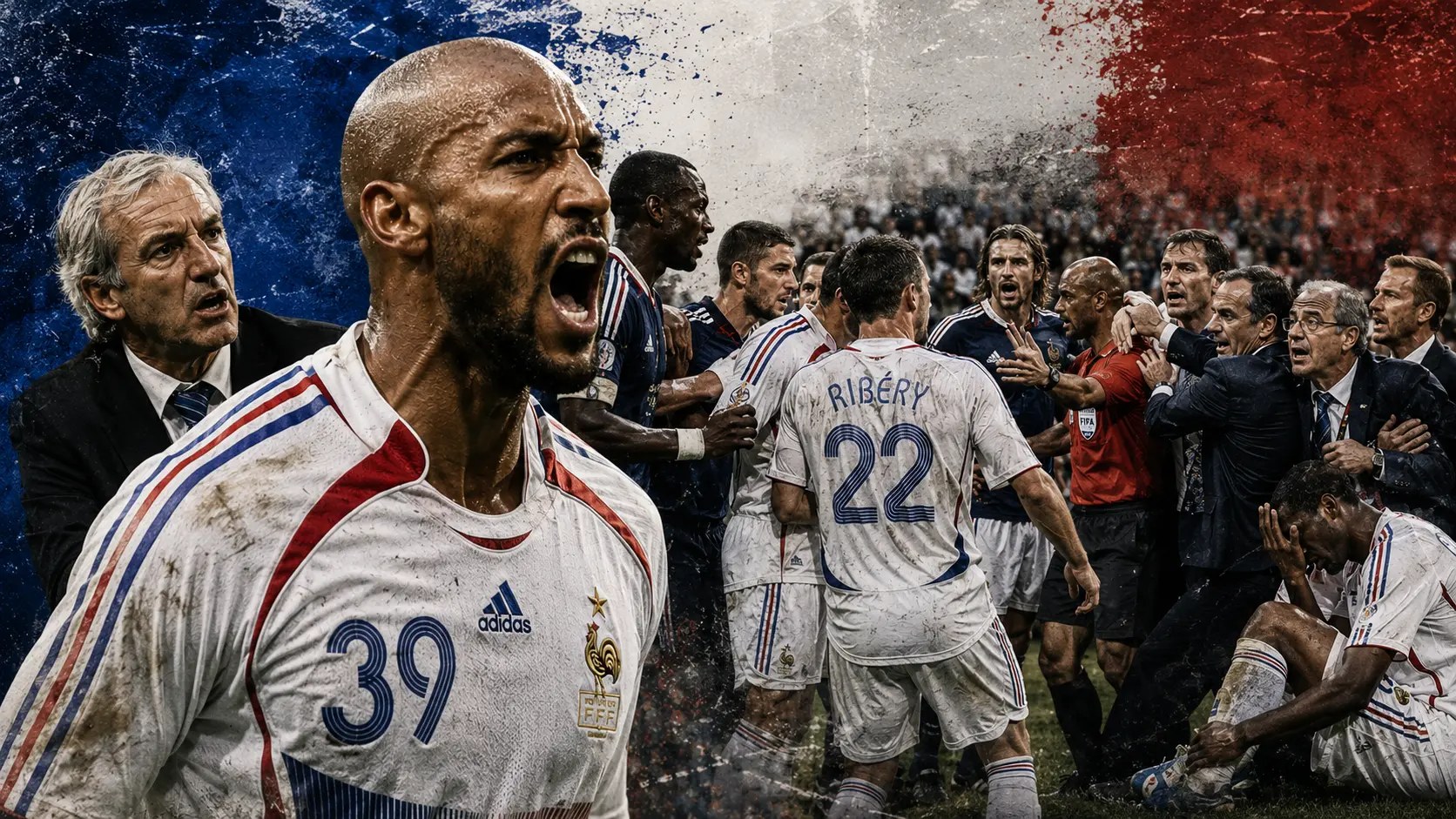
France 2010: The Week French Football Fell Apart
How a generation of stars, a divided dressing room and one extraordinary week brought French football to its lowest point.
The Ghosts of 2006
Berlin, 9 July 2006.
France had reached the World Cup final, four years after being eliminated in the group stage as defending champions. Now, they stood one match away from another world title.
Zinedine Zidane had scored. He had controlled the game. Then, in extra time, everything changed.
Marco Materazzi said something to him. Zidane turned. And with one of the most infamous headbutts in football history, his final match became something else entirely.
He walked past the World Cup trophy as he left the pitch.
France lost the final on penalties.
It was a painful ending, but not the end of France's golden generation. Far from it.
Zidane was gone, but Thierry Henry remained. So did Nicolas Anelka, Franck Ribéry, Patrice Evra, Éric Abidal and Yoann Gourcuff.
There was still enormous talent in the squad, and France remained one of Europe's great football nations.
Four years later, many of those players would return to the World Cup.
But Zidane would not.
Neither would the sense of control that had defined that generation.
South Africa was waiting.
Problems Exposed
The road to South Africa had already exposed the problems.
France had qualified, but hardly convincingly.
They finished second in their qualifying group behind Serbia, forcing them into a playoff against Ireland for a place at the World Cup.
The football was often unconvincing. The performances were inconsistent. And increasingly, the attention around the national team was drifting away from what happened on the pitch.
At the centre of it all was Raymond Domenech. He had already become one of the most divisive managers in French football. His methods were questioned, his tactical decisions were difficult to understand, and his fascination with astrology had become almost as famous as his football.
Domenech was not simply unpopular. His players were beginning to lose faith in him.
The relationship with some of France's senior players had deteriorated, while Thierry Henry, once the undisputed leader of the attack, was gradually losing his place in the team. Nicolas Anelka, meanwhile, had a complicated relationship with his manager and was never an easy player for Domenech to control.
And yet, somehow, France still had a squad with enough individual quality to compete with almost anyone in the world.
What it lacked was something much harder to find. A clear hierarchy. A manager the players trusted. And a reason to believe they were all pulling in the same direction.
The qualification campaign had not broken France. But it had revealed the cracks. And before France could even think about what might happen in South Africa, there was one final obstacle standing between them and the World Cup.
Ireland.
The Robbery
France were 90 minutes away from missing the World Cup.
Ireland had already taken the game to extra time in Paris, and with the score still level, the tension inside the stadium was rising.
Then came the moment that would follow France all the way to South Africa. A cross was sent into the Irish penalty area. Thierry Henry reached for it with his hand, controlling the ball before William Gallas finished the move.
Goal. France were going to the World Cup while Ireland were not.
The Irish players immediately surrounded the referee. Henry's handball had been obvious to everyone watching, except the officials who mattered. There was no VAR to correct the decision, no second look, no way back.
Ireland had been eliminated. France had qualified. But the controversy did not disappear when the final whistle blew.
Henry later admitted that the ball had touched his hand. The images were replayed around the world, turning one of France's greatest players into the face of one of football's most infamous qualifying controversies.
For France, the World Cup place was secured. But they were not arriving in South Africa as a team that had simply earned its place.
They were arriving under a cloud. The qualification had been difficult. The football had been unconvincing. Their manager was increasingly distrusted. And now their final step towards the World Cup had come through a goal that, for many, should never have counted.
France had made it to South Africa, but they had already given the world a reason to doubt them.
The Cracks
South Africa did not give France the fresh start they needed.
They opened the tournament against Uruguay in Cape Town. France had the better of the chances, but the game ended 0–0. It was not a disaster, but it was another performance that left more questions than answers.
Then came Mexico.
France looked disjointed from the start. Ribéry was frustrated. Anelka was isolated. The team struggled to create anything going forward, while Domenech seemed increasingly unable to find a way to make his players function as a unit.
Mexico eventually took control. Javier Hernández opened the scoring, lifting the ball over Hugo Lloris after beating the French defence. Then, with 11 minutes remaining, Mexico were awarded a penalty. 2–0.
France were now on the verge of elimination. But the result was about to become secondary to what happened inside the dressing room.
At half-time, Domenech confronted Anelka over his performance and positioning. The conversation escalated. Anelka refused to accept his manager's instructions, and the argument became personal.
By the time the players returned to the pitch, something inside the French camp had broken.
The exact details of what was said would soon become a national scandal. Because the following morning, they would appear on the front page of L'Équipe.
And they would soon change everything.
Something had happened at half-time.
The Breaking Point
The next morning, L'Équipe published five words that would define France's World Cup.
Va te faire enculer, sale fils de pute.
The sentence, reportedly directed at Raymond Domenech by Nicolas Anelka, was suddenly everywhere.
What had happened inside the dressing room was no longer an argument between a player and his manager. It was front-page news.
The French Football Federation had little choice but to act. Anelka was sent home. For the federation, that was supposed to be the end of the matter. It was anything but.
The players did not necessarily defend what Anelka had said. But many of them felt that the federation had turned a dressing-room argument into a public humiliation, and that Anelka had been made the sole scapegoat for problems that had been building within the squad for months.
That was where Patrice Evra stepped forward. As captain, he went to the federation's management to ask for an explanation and to understand why Anelka had been sent home. He was not simply speaking for himself. He was increasingly acting as the voice of a squad that felt it was being blamed for a crisis it believed went far beyond one player's outburst.
But the situation was already spiralling. When Evra was told that someone inside the squad had leaked the story to L'Équipe, he became determined to find out who it was. He confronted fitness coach Robert Duverne, who had been involved in the increasingly tense discussions around the team.
The confrontation escalated. Duverne eventually walked away, visibly furious, while federation officials tried to regain control of the situation.
And then came the decision that turned the crisis into something almost unimaginable.
The players would not train.
This was no longer about Anelka. It was a rebellion against the people running the French national team.
The Bus
The players never made it onto the training pitch. Instead, they gathered beside the team bus at the French training camp in Knysna. Coaches stood outside. Journalists watched from behind the barriers, trying to understand what was happening.
Inside the bus, the players sat together. They had made their decision: France would not train.
The federation had expected a football team preparing for its final group match. Instead, it was dealing with a squad refusing to work.
Eventually, the players' statement was read aloud by Raymond Domenech. They were protesting the decision to send Anelka home and the way the situation had been handled.
But the symbolism was impossible to miss. The manager was reading a statement written by the players.
The players were refusing to train under the manager, and the federation was standing outside the bus, unable to make them change their minds. The images travelled around the world.
France had arrived in South Africa as one of Europe's great football nations. Now, their World Cup was being defined by arguments, leaks, expulsions and a team bus.
Even for a tournament already filled with controversy, this was extraordinary.
There was still one match left.
France could still, mathematically, qualify for the knockout stage.
But the team had reached a point where football almost seemed irrelevant.
Exit
Three days after the players refused to train, France walked onto the pitch in Bloemfontein for their final group match.
Somehow, they could still qualify. They needed to beat South Africa, while Mexico needed to beat Uruguay. It was an unlikely scenario, but it existed.
For 90 minutes, there was still something to play for.
South Africa, however, had other ideas. Bongani Khumalo rose above the French defence and headed South Africa in front. France's already fragile hopes began to disappear. Then Gourcuff was sent off, leaving France with ten men.
And yet, for the first time in days, something resembling a football team appeared. Florent Malouda pulled one back. 2–1. France pushed forward.
In another stadium, Uruguay were beating Mexico. The result meant France needed more goals, but the possibility was still there. One more goal could at least keep the dream alive.
It never came. The final whistle confirmed what everyone already knew.
France were eliminated.
South Africa had won, but they had been eliminated too. Their players celebrated anyway. France stood still.
Then came one final image. Raymond Domenech walked across the pitch towards Carlos Alberto Parreira, the South African manager. Parreira offered his hand. Domenech refused it.
It was the final gesture of a tournament in which almost everything had gone wrong.
The football had disappeared somewhere between the dressing room, the newspaper and the bus.
France had not just been eliminated.
They had disappeared.
Exit.
The End of an Era
Four years can change everything.
In 2006, France had stood one penalty shootout away from becoming world champions. Their defeat had been painful, but the future still seemed to belong to them.
By 2010, the same generation had become almost unrecognisable.
The talent was still there. Henry, Ribéry, Anelka, Evra, Abidal, Gourcuff. What had disappeared was everything that connected them.
Trust in the manager. Trust between the players. Trust in the federation. And eventually, even the willingness to step onto a training pitch together.
The handball against Ireland had brought controversy. The defeat to Mexico exposed the fractures. Anelka's words turned them into a scandal. The bus turned the scandal into open defiance.
But perhaps the most striking part of South Africa was how quickly a team that had once seemed so difficult to break became impossible to hold together.
There was no single moment when France ceased to be France. It happened gradually.
A manager losing his dressing room. A captain losing control. Players losing faith in the people above them. And, eventually, a team losing the ability to see itself as a team at all.
That was the real legacy of 2010.
It was the disappearance of a generation that had once believed it belonged among the best in the world.
Four years earlier, France had lost a World Cup final. Four years later, they had lost themselves.
How it happened
- 11 June 2010France open with a goalless draw against Uruguay.
- 17 June 2010Mexico win 2–0; the dressing room turns on the manager.
- 19 June 2010Anelka is expelled from the squad after a half-time row.
- 20 June 2010The squad refuses to leave the team bus in Knysna.
- 22 June 2010France lose to South Africa and go home bottom of the group.
Read next
Sources & Further Reading
- FIFA World Cup 2010 official match records and squad data
- Contemporary French press reporting, including L'Équipe and Le Monde
- BBC Sport and The Guardian coverage of the France squad walkout
- French Football Federation (FFF) statements and post-tournament hearings
- Later interviews with players and staff involved
Check it yourself
- 2010 World Cup Group A — France's three matches
- Raymond Domenech — the manager at the centre of it
- Nicolas Anelka — the expulsion that started the strike
- 2010 World Cup — full tournament record
Last updated
Quotes are attributed to the outlet or interview in which they were originally published. Facts, dates and results were checked against contemporary match reports and official competition records. Spotted something that needs correcting? Email uncut.football0@gmail.com.