
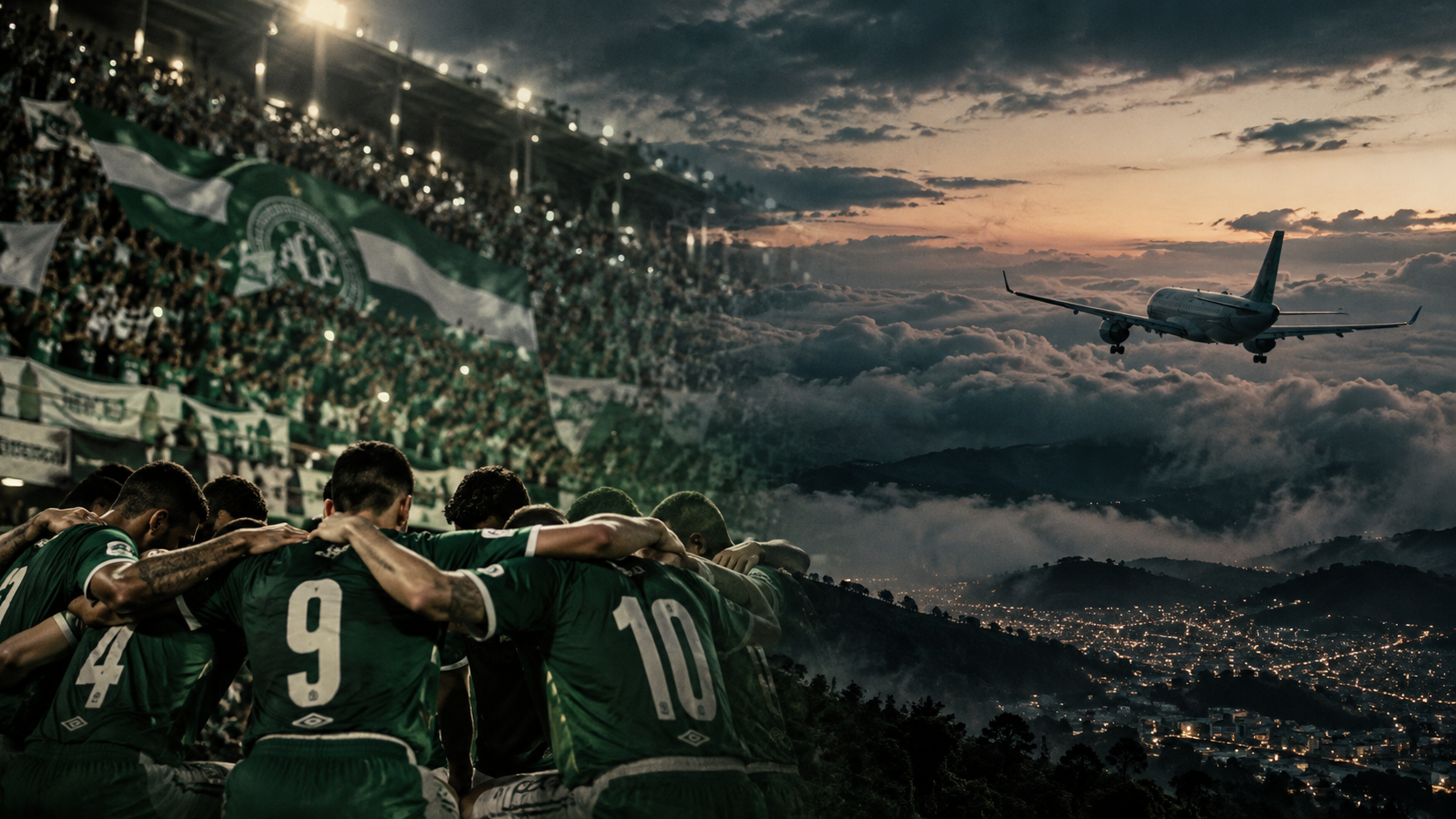
Boarding
Every journey starts with a boarding pass, and Chapecoense’s said Série D.
In 2009, the football world was not looking at Chapecó. Why would it? The city sits in the far west of Santa Catarina, in southern Brazil, a place known for agriculture and food factories rather than for football. Its club played in green and white, was known simply as Chape, and had just entered Brazil’s national league system at the lowest rung, the fourth tier.
Brazil has one of the richest football cultures on earth. Its biggest clubs are national institutions, with huge stadiums and fan bases counted in the millions. Down on that bottom rung the picture is different: long bus rides, modest crowds, and clubs that most Brazilians would struggle to find on a map.
That is where this story begins. Not in a final, and not in a stadium full of noise, but in a queue at the gate with a small ticket and a lot of patience. Nobody boarded with the sky in mind. They boarded because the plane was there, and because the only way to find out how high a small club can fly is to leave the ground.
Takeoff
A plane does not leave the ground gently. It rolls, it shakes, it gathers speed, and somewhere along the runway it reaches the point where stopping is no longer an option.
For Chapecoense, that runway took years. The club climbed one division at a time, never skipping a step and never being handed anything. Crowds stayed small and budgets stayed smaller. What the club had was a squad that played for each other and a belief that taking the next step was possible.
In 2013, V1 was finally reached. In aviation, that is the speed past which a takeoff can no longer be aborted. From that moment on, there was only one direction left: up. Chape finished as runner-up in the Série B, and the promotion was decided at home, in a 1-1 draw against Bragantino. Four years after starting on the lowest rung, the club had earned a place among the best in the country.
The nose had come up. Chapecoense played in the Série A, Brazil’s top flight. Overnight, the schedule was full of names that had been posters on bedroom walls: the biggest clubs in the country, with bigger stadiums and bigger wages. The small club from the west had been invited to the party.
Climb
Takeoff is the loud part. The climb is where a plane is tested. The air thins, the engines work harder, and every metre has to be earned.
Chapecoense did not arrive in the Série A as a tourist. In 2014, its first season among the elite, the club finished 15th, above the relegation places, and earned another year in the top flight. Then another. By 2016 it had been there for three seasons: not long, but long enough to belong.
It was never a team of stars. It was a team that knew each other’s habits, that ran for each other and trusted the man beside them. That belief showed in the results. In May 2014, Palmeiras went to Chapecoense’s Arena Condá and lost 2-0. Five months later, Internacional lost there 5-0. In October 2015, it was Palmeiras again, beaten 5-1 in the same week the club reached the quarter-finals of the Copa Sudamericana.
The small club had learned how to beat the big ones. Or, as a pilot would put it: visiting teams found out the Arena Condá was a difficult place to land.
Clear Skies
At cruising altitude, the engines settle into a steady hum, the seatbelt sign goes off, and for the first time since leaving the ground, the passengers can look out of the window and see how far they have come.
For Chapecoense, 2016 was that moment. The club was in the middle of the best season in its history, and in the Copa Sudamericana, the continent’s second-biggest club competition, it kept going further than anyone had expected. A year earlier it had been stopped in the quarter-finals. This time nobody was going to stop it.
In the second round, Cuiabá won the first leg 1-0, and Chape answered with a 3-1 win at home. Next came Independiente, one of Argentina’s historic clubs. Two games ended 0-0, and the tie went to penalties, which Chapecoense won 5-4. In the quarter-finals, Junior of Colombia won the first leg 1-0 in Barranquilla. Back in Chapecó, Chape scored three without reply.
Every time it looked like the story would end, it did not. Giants arrived, and giants left. Empty-handed.
The club began to stand out, and to win sympathy beyond humble Chapecó. Rival fans in Brazil started a campaign to move the second leg of a possible final to the Maracanã, so that more people could see this club play. A team from a city of 200,000 people, in a stadium most Brazilians had never visited, had become everyone’s second favourite.
Only San Lorenzo stood between Chape and the biggest night in its history. The seatbelt sign was off. From up here, everything looked possible.
Turbulence
Twenty-nine minutes into the first leg of the semi final, in Buenos Aires, San Lorenzo took the lead. Cauteruccio scored, the Nuevo Gasómetro roared, and for a while the story of Chapecoense looked like it had reached its last page.
It did not. Danilo kept making saves, Kempes equalised, and the game finished 1-1. On the scoreboard, a draw. In the arithmetic of a two-legged tie, something better: a draw, an away goal in the bag, and a match on home ground still to come.
Three weeks later, on 23 November, more people than ever had shown up to watch the team from the south of Brazil. The tie was level, and San Lorenzo needed a goal. For ninety minutes they pushed and Chapecoense held. The score stayed 0-0, which was enough for Chape, but only if nothing went wrong.
Then turbulence hit. San Lorenzo, the better side on the night, threw everyone forward in stoppage time. The home players were running on empty. A shot from Angeleri flew toward the goal, and toward the end of the dream. Danilo got there. He turned it away, and the whistle blew almost at once.
Chapecoense, through on away goals, was in the final of a continental competition.
Final Approach
About 2,985 kilometres. That is the distance of the flight between Santa Cruz de la Sierra, in Bolivia, and Medellín, in Colombia.
The team was not thinking about that number. It had a different problem first.
The plan had been simple: a charter flight from São Paulo straight to Medellín, with the Bolivian airline LaMia. Then Brazil’s aviation authority said no. Under the rules between the two countries, a flight like that had to be operated by a Brazilian or Colombian airline.
So the club made a new plan. The squad would fly on a regular commercial flight to Santa Cruz, and the LaMia plane would pick them up there. The departure from São Paulo ran about two hours late. The flight landed in Santa Cruz at 16:50 local time.
On the tarmac stood an Avro RJ85, the jet that had carried Argentina’s national team two weeks earlier. Cameras were out. Players, staff and the club’s directors were there, and so were more than twenty journalists who had come along to tell the story of the final. Afterwards, a club official said that before boarding, the players had talked about turning a dream into reality.
The passengers had no reason to doubt the plane. The boarding was relaxed, the mood light. The biggest match in the club’s history was waiting at the other end, and the flight there was only a few hours long.
How far an Avro RJ85 can fly is not one fixed number. It depends on the load on board and on the fuel that regulations require to be carried in reserve. A flight like this is planned with that in mind: fuel for the trip, for an alternate airport, for delays and for the unexpected.
Nobody said it out loud, and perhaps nobody thought about it. Pilots make these calculations. Passengers trust them.
Seventy-seven people took their seats. The doors closed.
One flight to go.
Radio Silence
At 21:43 on Monday night, Colombian time, the controller at Rionegro told LaMia 2933 to enter a holding pattern over the radio beacon south of the airport. Other aircraft were ahead of it, including a flight with a fuel leak of its own that had been given priority. The Bolivian jet had been in the air for more than four and a half hours, and began to circle.
Six minutes later the crew asked for priority to land, citing “problems with fuel” and nothing more. The controller told them to expect an approach clearance in about seven minutes. At 21:52 the crew declared an emergency and asked for vectors to the runway. A minute later two of the four engines failed. Two minutes after that the other two went.
The controller kept calling. The radar still showed the aircraft over the beacon, but its altitude was no longer coming through. Nobody answered.
The plane came down on Cerro Gordo, a steep, wooded hillside near the town of La Unión, less than twenty kilometres from the runway it had been trying to reach. It did not burn. There was no fuel left to burn.
By midnight the airport had confirmed the crash. The hill was reachable only on foot, and it was raining hard. A Colombian Air Force helicopter turned back because of poor visibility. The first ground crews, working in darkness and mud, had to pull back for roughly three hours when the downpour made the slope too dangerous. Then they went up again.
They found survivors. Alan Ruschel, a full-back, was the first to reach hospital, with a broken spine. Jakson Follmann, the reserve goalkeeper, would lose his right leg. Danilo, the goalkeeper whose save had put Chapecoense into the final, was also pulled out alive, but died hours later in hospital. A radio journalist, Rafael Henzel, and two crew members were found as well. The last to be found was the defender Neto, at around 05:40, with a fractured skull and severe injuries to his chest.
Even then, nobody knew what they were counting. In the first hours the figures changed with every announcement: 81 people aboard, then 77; 76 dead, then 71; five survivors, then six. Danilo’s death had been counted, then recounted. The final tally was 77 aboard, 71 dead and six survivors. Of the 22 players who had boarded, 19 were dead, along with the coach, Caio Júnior, club directors and nearly all of the journalists.
In Chapecó, the news reached a city of about 200,000 people that knew almost everyone on that list. Fans gathered at the Arena Condá, where the club’s mourning would begin. Across the continent, CONMEBOL suspended all football. In Medellín, a stadium was being prepared for a match that would not be played.
The survivors were slow to learn how much they had lost, and Neto learned it last. He was in intensive care, sedated and then conscious, and for thirteen days he was not told that his team-mates were dead. He asked, and his family could not bring themselves to answer. When doctors and a psychologist finally sat down with him, he was moved, and he understood.
Black Box
Of the plane itself, only the two recorders could still speak. Colombian investigators recovered the flight data recorder and the cockpit voice recorder from the hillside, and the leaked radio tapes began to circulate within days. The preliminary findings arrived in December, and the final report in April 2018. The conclusion was never in doubt, and it was simple. The aircraft had run out of fuel.
The harder question was how a flight had been planned that way at all.
Earlier, the question was how far an Avro RJ85 can fly. The answer was in the numbers. The Santa Cruz to Medellín route was about 2,985 kilometres. The crew expected to burn roughly 8,858 kilograms of fuel on it, and the aircraft left Santa Cruz carrying 9,073. That was almost exactly what the trip would use. Nothing was left over for an alternate airport, for holding, for a missed approach, or for the minimum required on landing. International rules would have required about 12,052 kilograms. The tanks of an RJ85 can hold just 9,362.
The plane could not legally have flown the route non-stop at all. It was never going to carry enough fuel to do so.
There had been a plan that worked. The original itinerary included a refuelling stop at Cobija, near Bolivia’s border with Brazil, which would have split the journey into two comfortable legs. But the departure from São Paulo had run late, and by the time the flight left Santa Cruz at 18:18 local time, Cobija’s airport was closing. The stop was dropped.
On the ground in Santa Cruz, someone saw the problem. Celia Castedo, an aviation officer at Viru Viru airport, reviewed the flight plan and found the fuel endurance equal to the flight time, with no margin at all. She said later that she raised five observations, and that she was pressured to change her report. Alex Quispe, the LaMia dispatcher who filed the plan, was himself on board and died in the crash. When Castedo questioned the figures, he reportedly replied that they were the data he had been given, and he was just following orders.
In the air, the people with the most to lose already had the information. The cockpit voice recorder captured the crew running fuel calculations during the flight. They discussed stopping at Bogotá, or at Leticia, because they were almost out of fuel. They decided against it. Bogotá was about 215 kilometres from Medellín, a short extra hop.
At about 21:16, roughly 330 kilometres out, the low-fuel warning came on. The crew said nothing to air traffic control. It was 36 minutes before they declared an emergency. The investigators concluded that the crew knew the fuel was short and failed to act on it as the situation demanded.
The captain was Miguel Quiroga, 36, with more than 6,600 flying hours. He was also one of the airline’s co-owners. That detail sits uncomfortably in the report. The man who could have ordered the stop was also a man with a stake in what a stop cost, in money, in time and in the chance that a charter customer would take its business elsewhere. The report did not say that this explained his decision. It found that both the airline and the crew had been aware that the fuel was insufficient, and that neither had chosen to land elsewhere to refuel.
Bolivia revoked LaMia’s operating certificate four days after the crash.
At the end there was a radio call. The Medellín controller had told them to wait. The plane was holding at around 9,000 feet. Then the crew called again, as the last engines gave out.
“LaMia 2933, total failure, total electrical failure, no fuel.” It was an accurate description of the aircraft and the last thing anyone heard from it.
Every earlier decision had offered a way out. The stop at Cobija would have saved the flight. So would a stop at Bogotá, a plan with the proper reserves, or an emergency call at 21:16 instead of 21:52. Any of them would have cost a little time and a little money, and the match was two days away. There was no need to press on. The plane would have landed. Seventy-seven people would have walked into a hotel that night, wherever that might have been, never knowing how close they had come to disaster.
Arrivals
On Wednesday 30 November, the night the final was due to be played, the Estadio Atanasio Girardot in Medellín filled anyway.
About 45,000 people came. They held white candles and sat under floodlights that were switched on for a match nobody would play. Atlético Nacional’s players walked to the centre circle in their kit, with no opponents to face. The stands sang the name of the club that was supposed to be on the other side of the pitch. A few days earlier those fans had barely known Chapecoense. That night they sang as if the team were theirs.
A day before the vigil, Nacional had made a request to CONMEBOL, and the club’s statement said what they wanted in plain words. The Copa Sudamericana should go to Chapecoense. In their view the title belonged to Chapecoense for good. On 5 December, CONMEBOL agreed. Chapecoense were champions of South America’s second-biggest club competition, without ever playing the final. Nacional received the Fair Play award for it, from CONMEBOL and later from FIFA.
In Brazil, the response was just as unusual. Brazilian club football is built on rivalry, and few countries hold their clubs’ loyalties as tightly. Within days, that rivalry was set aside. The biggest clubs in the country offered Chapecoense players on loan, for free, so the club could field a team at all. Some asked that Chapecoense be shielded from relegation for several seasons. Fans of clubs that had spent years as Chape’s opponents put on its shirt and stood in silence at their own grounds. A club of 200,000 people had asked for nothing, and the whole sport answered.
The survivors went different ways. Alan Ruschel recovered from his spinal injury and returned to play. Jakson Follmann learned to live with a prosthetic leg and became an ambassador for the club. Neto, who needed years of surgery and rehabilitation, tried to come back and could not. He retired in 2019.
He has said that the pain was bigger than the pleasure of playing. He had lost friends he had known since he was seventeen, and he had been told about it thirteen days late. After all that, a career was a small thing to give up.
“I’m alive, and that’s way more important than football.”
The club itself carried on. Chapecoense rebuilt on borrowed time and borrowed players. They stayed in the Série A in 2017 and 2018, which few people had expected. Then the ground shifted. The club was relegated in 2019, won the Série B and came straight back in 2020, and was relegated again in 2021. In 2025 it won promotion once more: a return flight, of sorts, to the division it was in when everything went wrong.
That cycle was ordinary, the kind of rise and fall that small clubs live through every year, and after what the club had been through, ordinary was a relief. The tragedy remains part of its history, but so does everything that came after it.
Winning and losing are back in the club’s dictionary.
How it happened
- 2014Chapecoense's first Série A season ends in 15th place.
- 2015The club reaches the Copa Sudamericana quarter-finals.
- 23 Nov 2016A 0-0 against San Lorenzo sends Chape to the final on away goals.
- 28 Nov 2016LaMia 2933 runs out of fuel while holding near Medellín and crashes.
- Dec 2016CONMEBOL awards the title to Chapecoense at Atlético Nacional's request.
Read next
Sources & Further Reading
- Colombian civil aviation authority (Aerocivil) final report on LaMia flight 2933
- CONMEBOL records of the 2016 Copa Sudamericana
- Contemporary Brazilian and Colombian press coverage of the crash and its aftermath
- Later interviews with survivors Alan Ruschel, Jakson Follmann and Neto
Check it yourself
- LaMia Flight 2933: accident record and investigation
- Associação Chapecoense de Futebol: club history
- 2016 Copa Sudamericana: full tournament record
Last updated
Quotes are attributed to the outlet or interview in which they were originally published. Facts, dates and results were checked against contemporary match reports and official competition records. Spotted something that needs correcting? Email uncut.football0@gmail.com.