
Two Good Teams
By the spring of 1985, Liverpool were not just good at the European Cup. They were the competition's dominant club. Four times winners in eight seasons (Rome in 1977, Wembley in 1978, Paris in 1981, and Rome again in 1984, where they beat Roma on penalties in Roma's own Stadio Olimpico), they had built a record that, left uninterrupted, might have put them alongside Real Madrid and Milan among the competition's great dynasties. This was their fifth final in nine years, and their manager, Joe Fagan, had inherited a squad built to win in exactly this manner: patiently, professionally, without much need for theater.
Juventus arrived at Heysel with a different kind of case to make. Twice before they had reached a European Cup final, in 1973 and 1983, and twice they had lost, which by Italian standards counted as a wound that hadn't closed. What they had instead was arguably the best collection of individuals on the continent: most of the Italian squad that had won the World Cup in Spain three years earlier, and at the center of it, in the middle of the best form of his career, Michel Platini, the reigning European Footballer of the Year, and a player capable of deciding a final on his own.
A win for Juventus would do something no club had done before: complete the set of all three major European trophies, the Cup, the Cup Winners' Cup and the UEFA Cup. A win for Liverpool would simply be Liverpool being Liverpool, the fifth star, the natural next entry in a ledger that already read like a monopoly.
None of this, on paper, had anything to do with what people would remember about the 29th of May. That is, in a sense, the whole point of starting here. Before Heysel became a byword for disaster, it was a fixture between two of the strongest teams European football had to offer, the kind of final broadcasters build a whole evening's schedule around, and fans save all year to attend. They expected a football match, quite possibly a great one. By the time the players actually kicked off, delayed by ninety minutes and playing in front of a stadium that had just watched people die, that match was still, somehow, the thing that had to happen next.
Rome, One Year Earlier
UEFA had chosen the Stadio Olimpico as the venue for the 1984 final years in advance, long before anyone could have known who would actually be playing there. What nobody could have predicted was that Roma, a club that had barely won anything before that season, would reach the final themselves, and end up playing the biggest match in their history on their own ground.
What followed was ninety minutes of football that Liverpool supporters remember mostly for Bruce Grobbelaar, whose wobbly-legged routine on the goal line during the penalty shootout became one of the enduring images of the club's European history. Steve Nicol missed first for Liverpool, and the home end roared as though the cup were already won. Then Bruno Conti and Francesco Graziani missed for Roma, and Alan Kennedy, a left back with no reputation from twelve yards, stepped up and scored the goal that gave Liverpool their fourth European Cup in eight seasons.
After the match, when Liverpool fans made their way back to their hotels through the city, groups of Roma's Ultrà Curva Sud went looking for them. Fans were beaten in the streets and stabbed, some of them nowhere near the stadium and with no part in any trouble themselves. A thirteen-year-old boy was attacked with a machete and needed more than two hundred stitches. The police, by most accounts, did little to stop it and in places behaved as though they were on the ultras' side rather than against them.
None of this made the papers back home the way it might have. Liverpool had won, the season was over, and a night of violence against traveling fans in a foreign city didn't fit easily into a story about a club's triumph. But it did not disappear for the people who had lived through it. Among a certain part of Liverpool's support, particularly the harder edges of it, Rome became something that needed answering. That desire for revenge was there in the year between Rome and Brussels, circulating in exactly the kind of company that would matter most on the 29th of May: some of the same faces, now traveling to a game against a different Italian club, in a different city, carrying an old grievance with them.
A Stadium Not Fit for This
Heysel was not a stadium anyone would have chosen if safety had been the first consideration. It had opened in 1930, and by 1985 much of it was showing its age. Sections of the ground were poorly maintained, and the perimeter walls and barriers were hardly designed for the kind of pressure a modern European final could generate. The stadium had hosted major matches before, including previous European finals, but familiarity had begun to substitute for scrutiny.
Both clubs had raised serious concerns about the arrangements for the final, particularly the deteriorating condition of Heysel and the dangerous layout of the ticket allocation. Neither concern was enough to change the plans.
Their concerns were not about some abstract possibility of trouble. The problem was visible before the gates opened. Heysel had deteriorated badly, with crumbling concrete, damaged terraces and inadequate barriers. More importantly, the stadium's layout placed the supposedly neutral Block Z directly beside the Liverpool section, with Juventus supporters able to obtain a large number of tickets for it.
That arrangement turned a neutral buffer into something much closer to an extension of the Juventus end. It meant that the two sets of supporters were not separated by distance or by a properly secured neutral area. They were separated by a fence.
On paper, the idea made sense. Liverpool were allocated sections X and Y at one end of the ground, Juventus had M, N and O at the other, and Block Z was supposed to sit between them as a neutral zone. In practice, the system depended on Z actually being neutral.
It wasn't. Tickets had been distributed through Belgian channels, travel agencies and other intermediaries, and there was no effective system for preventing Juventus supporters from buying them. Brussels had a large Italian community, while Juventus were one of the best-supported clubs in Europe. By match day, the supposedly neutral section contained a substantial Juventus presence, the very Italians some Liverpool supporters had been waiting a year to face.
Then there was the policing. The operation at Heysel was divided between the Belgian police and gendarmerie, with inadequate coordination between them. The numbers inside the stadium were insufficient for a match carrying this level of risk, and there was no properly positioned reserve force ready to intervene if the situation deteriorated.
The problem was not simply that Heysel was old. It was that the stadium offered almost no margin for error. Disasters rarely require a single failure. They require several failures to arrive at the same moment.
At Heysel, almost every layer of protection had been weakened before the supporters even took their seats. The stadium was old. The segregation was inadequate. The neutral section was not neutral. The policing arrangements were poorly suited to the situation. The clubs' concerns had not been enough to change the plan. And waiting behind Block Z was a wall that would eventually be asked to do something it was never capable of doing: hold back thousands of frightened people with nowhere else to go.
The ingredients were all there: a failing stadium, poor segregation, inadequate policing and a crowd with nowhere to go. But ingredients alone do not make a disaster. Something still has to set them in motion. At Heysel, that something would come from the Liverpool end.
Block Z
None of this excuses what happened next. The violence that began in Block Z was initiated by Liverpool supporters who charged towards the Juventus fans.
The first groups immediately began retreating towards the far end of the terrace. What had looked from a distance like another confrontation between rival supporters quickly became something more dangerous, because the people in Block Z had nowhere to go. Behind them stood the stadium wall, while the fence and the advancing Liverpool supporters closed off the other side. There was no clear exit, no open space into which the crowd could disperse, and no properly organised force capable of pushing the two groups apart.
The surge did not need to repeat itself more than a few times. Each charge pushed a portion of the crowd further back into itself, and with every retreat, the people at the rear had less room to absorb the ones now colliding into them from the front. Within minutes, what had started as isolated pockets of panic had become one continuous mass, packed so tightly that individuals could no longer move by their own choice. They moved only when the crowd around them moved.
It was around 7:00pm, roughly ninety minutes before the scheduled kickoff, that the crush found the one part of the terrace with nowhere left to give: a low retaining wall at the corner of the section, built to mark the edge of the stand rather than to hold back a stampede of frightened people. It had never been asked to bear that kind of weight before. Nobody inside Block Z that evening could have known it was about to be asked to.
For a short while, the wall held. Bodies pressed against it three and four deep, people gasping for room that did not exist, some already being lifted off their feet by the crowd around them and carried rather than walking. Photographers in the stands opposite, and the cameras already rolling for the evening's broadcast, caught the shape of it from a distance: a section of the ground bulging outward against its own boundary, the way water bulges against a dam before it finds the weak point.
Then it found the weak point.
The Nine Minutes
The wall did not explode outward so much as it simply gave up. A section of concrete, weakened by decades of Brussels weather and years of deferred maintenance, sheared away and dropped the people pressed against it onto the ground below. For a moment, those nearest the gap must have thought the pressure had finally been relieved. It hadn't. It had simply found a new direction to travel in.
What followed was, in the main, no longer a story about violence. It was a story about physics, about a few hundred square meters of terrace that could not hold the number of people now occupying it. Some were crushed against what remained of the wall. Others were trampled as the crowd behind them, unaware anything catastrophic had happened at the front, kept pushing forward, following the same instinct that moves any frightened crowd toward whatever gap seems to offer air.
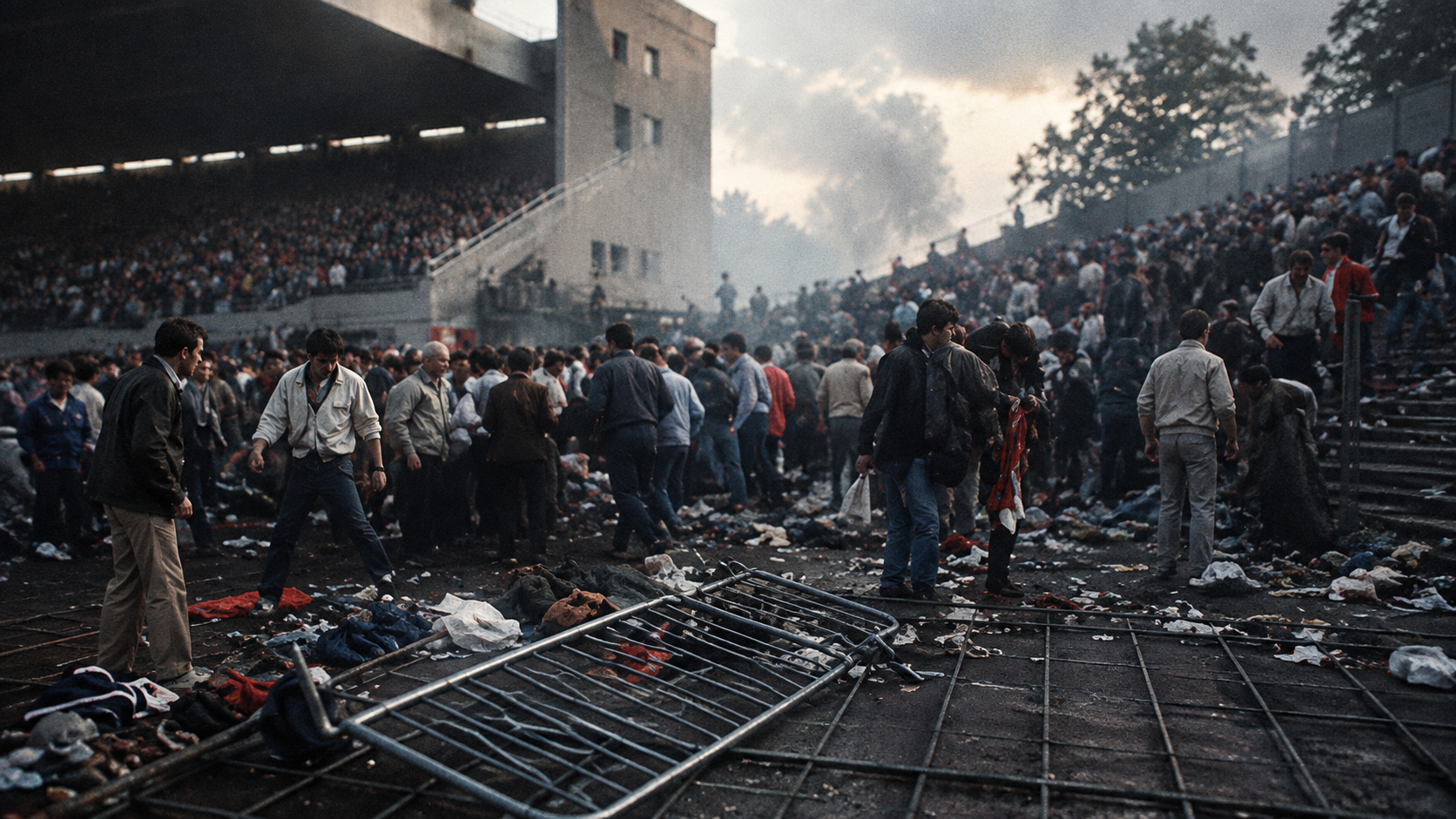
Stewards and police nearby had, moments earlier, been dealing with what looked like ordinary crowd trouble. What they were confronted with instead was a triage situation with almost no equipment and no plan. Fans who had been standing beside strangers now pulled bodies from under other bodies, performing chest compressions on people whose names they would never learn, using advertising hoardings as makeshift stretchers because nothing else was close enough to hand.
By the time paramedics and additional police reached the section in meaningful numbers, close to nine minutes had passed since the wall came down. For most of the 39 who would die, the outcome was already decided. Television cameras, positioned for pre-match coverage rather than disaster footage, kept rolling throughout. Viewers across Europe who had tuned in for a European Cup final instead watched, in real time and without understanding what they were seeing, people dying in what should have been a night of celebration.
Later, inquiries would settle on the collapse of the wall as the cause of most deaths, largely by asphyxiation. It is a clinical word for something that took nine minutes to happen to 39 people, each with their own name, their own reason for being there, and no real chance, once the crush had them, to do anything about it.
They Played the Match Anyway
Have we grown so much softer as a sport that we now stop a match for a single resuscitation, whether it happens on the touchline or somewhere in the stands? Do we simply have better systems today, quicker medical response, clearer protocols, so that a modern game can be paused and restarted without anyone questioning it? Whatever systems existed at Heysel that evening, medical, administrative, structural, had already failed once, with 39 innocent people dead as the result. And yet, roughly ninety minutes after the wall came down, the match kicked off anyway.
The decision was not left to the players, and it was not made by either club. It was UEFA that insisted the game go ahead, and the man ultimately responsible for that call was the organization's president, Jacques Georges, who judged that abandoning the final carried more risk than continuing it.
The reasoning, at the time, was that calling off the match might provoke further violence among a crowd that was still packed into the stadium and still, in places, hostile. Whether that reasoning was sound or simply convenient has been argued ever since. What is not in dispute is that a European Cup final resumed within sight of a stand where people had just died, on the order of an organization that would spend the following days trying to place the blame for the entire evening on the fans alone.
Joe Fagan had announced his retirement as Liverpool manager earlier that same day, a piece of news that, under any other circumstances, would have been the story of the evening. Instead it became a footnote to his own quote afterward: "There was a game of football in the end, but I don't think anyone's heart was in it. Mine certainly wasn't. It was UEFA's decision that we should play, not ours. What a sad way for me to end."
The first half was goalless, played in front of a crowd that had, in large part, just watched people die a few hundred meters away. In the 56th minute, Zbigniew Boniek went down under a challenge from Gary Gillespie, a foul that several observers placed outside the penalty area rather than inside it. The referee, André Daina, was well off the pace of the play and pointed to the spot anyway. Michel Platini stepped up and beat Bruce Grobbelaar, then celebrated for a moment before, by most accounts, remembering exactly where he was and what had happened that evening.
Juventus were presented with the trophy in the dressing room rather than on the pitch, a small concession to the circumstances. They went out for a lap of honour regardless, a decision some of their own supporters had urged them to skip entirely. It was their first European Cup, the trophy that completed the set no club had ever held all three of before. Almost nobody involved has ever described winning it as anything to celebrate.
The Verdict, and the Silence That Followed
The legal reckoning took years to arrive and, when it did, spread the blame further than the initial coverage had suggested it would. Twenty-six Liverpool supporters were eventually charged, and fourteen were convicted of manslaughter, each sentenced to three years in prison. But the courtroom also reached beyond the crowd. Johan Mahieu, the Belgian police captain responsible for security at Heysel that night, was convicted alongside them. A Belgian football official received a suspended sentence for his part in the ticketing and stadium arrangements. The message, buried under years of instinctive scapegoating, was that the deaths had multiple authors, not one.
UEFA's own response arrived much faster than the courts, and asked for far less nuance. Within a day of the disaster, the organization's chief observer had already assigned blame entirely to English fans. English clubs were banned from all European competition, a ban that lasted five years. Liverpool, singled out further, were kept out for six, unable to defend the title they had just failed to win, unable to test themselves against Europe at all during a period when the rest of the English game was still producing some of the continent's strongest teams.
The ban did not fall on Liverpool alone, and that is exactly what made it so bitter inside English football. Everton had just won the league title, their best side in years, and were denied their own first shot at the European Cup before they had even played a minute of it. Norwich City had won the League Cup and were due their first European campaign in the club's history. Both lost that chance for something neither club's fans had any part in. Liverpool carried the shame of Heysel, but Everton and Norwich carried the cost of it, and that resentment did not fade quickly.
The ban did more than cost Liverpool trophies. It cut a generation of English football off from Europe altogether, at exactly the moment English clubs had dominated the competition for the better part of a decade. What might have been an extension of that dominance became, instead, a six-year gap that the record books can never quite explain away. Heysel itself never hosted another major match. It was demolished in 1994 and rebuilt as the King Baudouin Stadium the following year, a new structure standing on ground that could not simply be renovated back into use.
Not the Only Disaster
Heysel did not happen in isolation, and it did not stay isolated for long. Eighteen days earlier, 56 people had died in a fire at Bradford City's Valley Parade, a wooden stand going up in flames within minutes. A few weeks after Heysel, a 15-year-old boy died in rioting at Birmingham City's St Andrews. English football entered the summer of 1985 having buried people from three separate disasters in barely a month, and the response, at first, was almost entirely about hooliganism: harsher sentences, an inquiry led by the judge Oliver Popplewell, and Margaret Thatcher publicly declaring war on what she called 'the hooligan problem.' For a season or two, recorded incidents did fall.
But the underlying issues, overcrowded terraces and aging stadiums chief among them, were never properly addressed. Four years later, on the 15th of April 1989, that failure produced a second catastrophe, and this one had almost nothing to do with hooliganism at all. At Hillsborough, in an FA Cup semi-final between Liverpool and Nottingham Forest, the match commander, Chief Superintendent David Duckenfield, ordered an exterior gate opened to relieve a crush building outside the ground. No effective plan existed for where that surge of fans should go once inside. They were funneled straight into two already overcrowded, fenced pens. Ninety-six Liverpool supporters died. There was no rival crowd to blame, no charge across a terrace. There was one man, in a position of authority, making a decision under pressure that turned out to be catastrophically wrong.
That detail matters, because it's easy to tell the story of these disasters as though better stadiums and better systems would have prevented all of them. They would have prevented some. A modern, all-seater ground with properly managed capacity makes a crush like Hillsborough's far less likely. It does nothing, on its own, to stop a police commander from making the wrong call in the moment, or a crowd of Liverpool fans from charging a fence at Heysel, or a Belgian police captain failing to react while a wall was giving way under the weight of people he was supposed to be protecting. Infrastructure can narrow the space in which individual misjudgment does damage. It cannot remove the person making the judgment.
The two disasters have never been remembered the same way, and part of that difference is exactly this: Heysel was set in motion by a crowd, so it was filed away as a hooligan problem, an English disease. Hillsborough was set in motion by a single decision inside the police command, and it took decades of campaigning by victims' families, the reopening of inquests, and eventual formal confirmation that supporters had not caused their own deaths, for that fact to be properly acknowledged in public. Heysel has never received an equivalent correction. It remains, for many, simply the night the hooligans did it. What actually happened, at both grounds, was closer and messier than either label allows: systems that were already fragile, pushed past their limit by the specific choices of specific people, on nights when there was no margin left for anyone to get it wrong.
What Heysel Changed, and What It Couldn't
The physical legacy of Heysel is, in some ways, the easiest part of this story to point to. Stadium design across Europe changed in the years that followed, first gradually, then decisively after Hillsborough forced the issue further. Terraces gave way to seats. Fencing that once penned crowds in like livestock was reconsidered, then largely removed. Segregation between rival supporters became a matter of proper planning rather than a chicken-wire fence and a hope that ticket touts hadn't sold the wrong seats to the wrong fans. Policing around major matches grew more coordinated, with clearer command structures and, in theory, clearer accountability when something went wrong.
All of that matters, and none of it should be understated. Fewer people die at football matches now than did in the 1970s and 80s, and that is not an accident. It is the direct result of decisions made in the aftermath of nights like this one, decisions that cost money and inconvenienced clubs and were, for years, resisted before they were finally required.
But it would be a mistake to read that progress as some kind of closed case, a problem that infrastructure alone has solved. Better stadiums lower the odds of disaster. They do not remove the choice that actually caused the deaths at Heysel: a group of Liverpool supporters who chose to charge a fence that night. No amount of seating, segregation or crowd modeling erases the fact that people, specific people, made a specific choice, just as a specific police commander made a specific choice at Hillsborough four years later. Systems can narrow the space in which those choices do damage. They were never going to eliminate the choices themselves.
That is the harder thing to sit with about the 29th of May, 1985. It is tempting to file Heysel away as a relic of an unsafe era, a problem later solved by better stadiums and better rules. But the wall gave way because of decisions, not just decay, and no rulebook removes the possibility of the wrong decision at the wrong moment. Infrastructure changed after that night. The people making the calls did not become infallible. They just got better tools, and, on most nights since, the good fortune not to need them.
How it happened
- 30 May 1984Liverpool beat Roma on penalties in Rome; violence against travelling Liverpool supporters follows.
- 29 May 1985Liverpool and Juventus supporters arrive at Heysel for the European Cup final.
- Before kickoffBlock Z, meant to be neutral, contains a substantial Juventus presence beside Liverpool sections X and Y.
- Around 7:00pmLiverpool supporters charge towards Block Z, triggering panic and a crush against the retaining wall.
- Minutes laterA section of wall collapses; 39 people die, most from crush injuries and asphyxiation.
- Later that nightUEFA orders the final to be played; Juventus win 1–0 through Michel Platini's penalty.
- 1985English clubs are banned from European competition; Liverpool's exclusion lasts six years.
- 1989Four years later, Hillsborough exposes again how fragile football's crowd-safety systems still are.
- 1994–1995Heysel is demolished and rebuilt as the King Baudouin Stadium.
Read next
France 2010: The Week French Football Fell Apart
How a generation of stars, a divided dressing room and one extraordinary week brought French football to its lowest point.
Read the storyLegend · 15 minWhat Baggio Was Carrying
Roberto Baggio, Italy, and the five seconds that football remembered: the story of USA '94 and the kick that defined him.
Read the storySources & Further Reading
- Contemporary reporting and broadcast records from the 1985 European Cup final
- European Cup records for Liverpool, Juventus and the 1984 and 1985 finals
- Legal and inquiry material on the Heysel Stadium disaster and the later European ban
- Historical reporting on Bradford, Birmingham and Hillsborough in the wider stadium-safety context
- Club and competition records on the aftermath of Heysel and the rebuilding of the stadium
Check it yourself
- Heysel Stadium disaster: overview, aftermath and legal consequences
- 1985 European Cup final: Juventus v Liverpool match record
- 1984 European Cup final: Liverpool v Roma background
- Bradford City stadium fire: the disaster weeks before Heysel
- Hillsborough disaster: the later crowd-safety catastrophe
Last updated
Quotes are attributed to the outlet or interview in which they were originally published. Facts, dates and results were checked against contemporary match reports and official competition records. Spotted something that needs correcting? Email uncut.football0@gmail.com.