
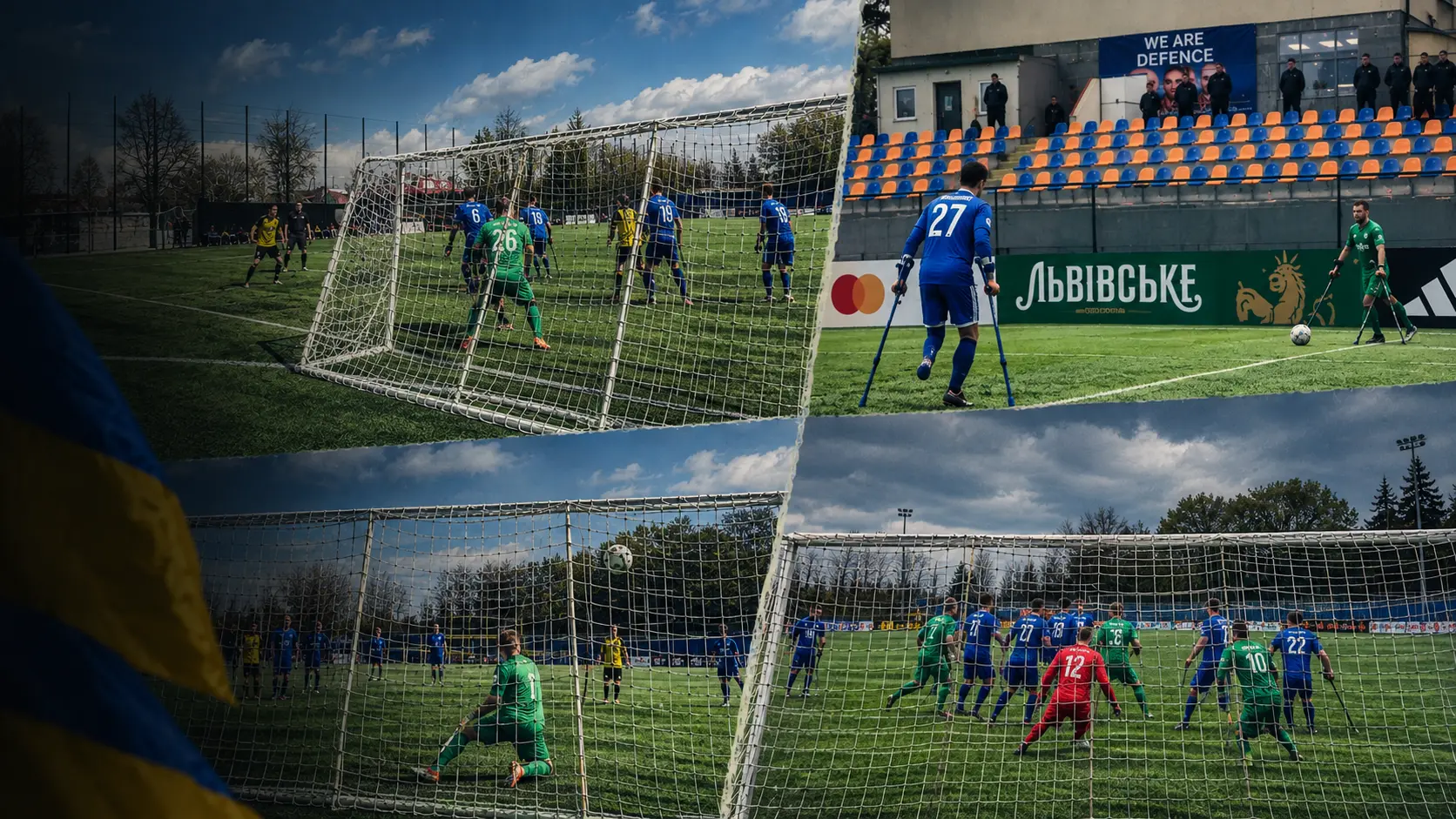
From Silence to Whistle
Before anything else, there was silence. Not peace, but the other kind. The silence that settles over a street after the power goes out, the kind that makes people listen harder rather than relax. Then, somewhere in the distance, a siren. A pause. The delayed echo of an impact, sound trailing behind an event that had already ended.
These are the sounds that have shaped daily life in Ukraine for years now. Not constant noise, but constant listening: for what might come next, for how far away it was, for whether it was safe to go on with the day.
And then, in the middle of it all, a different sound cuts through: a whistle. Sharp, short, deliberate. A sound that means something specific and nothing more, the start of something, the end of something, a decision that everyone on the pitch understands at once.
It is followed by others. The dull contact of a foot against a ball. A shout across open grass, calling for a pass. Studs on turf. Applause, scattered but real.
It comes from the same people who had spent years keeping a different kind of count: what was lost, who made it home, and what still needed to be rebuilt. For them, the whistle carries none of that weight. It asks for nothing except attention, and gives back something to watch, something to cheer for.
That is what makes the second sound matter. It does not erase the first. It exists next to it, in the same towns, sometimes on the same day, offering something the rest of daily life no longer can: a stretch of time with its own simple rhythm, nothing to prove, nothing to carry.
The Pitch as Solid Ground
Outside the pitch, daily life in Ukraine moves without a script, something to navigate rather than plan. What happens next is rarely up to the people living it. For many, especially those who have lost a limb to the war, even simple tasks now require new ways of moving through the world.
The scale of this is difficult to grasp. Ukrainians have undergone over 100,000 limb amputations, a number that far surpasses the total recorded among U.S. forces across the entire Global War on Terror. Behind that number is a rehabilitation system stretched far beyond its capacity. Prosthetics and orthopedics services are currently available in less than one percent of Ukraine's medical facilities, and only a small fraction of hospitals offer inpatient rehabilitation care at all. Equipment, from proper prosthetics to powered wheelchairs, remains out of reach for many who need it, leaving thousands to manage with whatever mobility aids they can find.
A football pitch does not run out. It stays where it is, a fixed point people can return to when little else holds steady. A match lasts a set length of time, decided in advance, and everyone on the field knows the same set of rules. There is no ambiguity about what happens next: a pass is a pass, a goal is a goal, a foul is a foul. In a country where so much has become unpredictable, and where even basic equipment is hard to come by, that kind of clarity is rare.
For the amputee players who make up the League of the Mighty Ukraine, this structure means something specific. Many of them lost a limb only months or years earlier, and had to relearn, from nothing, how to stand, walk, and move. Learning to play again, on crutches or with a prosthetic, is its own long process of trial and adjustment, often without the equipment or support that would make it easier. But once the whistle sounds, the pitch does not ask where a player came from or what they went through to get there. It only asks whether they can play. For ninety minutes, or however long the match runs, that is enough.
Who They Are
Behind every player on the pitch is a story that started somewhere else entirely. Before the war, they were mechanics, students, farmers, unemployed, fathers. Some had never played football competitively before losing a limb. Others had played their whole lives and assumed that part of their story was over the moment they woke up in a hospital bed.
Their injuries came from different places and different moments. Some lost a limb on the front line, in the middle of active combat. Others were injured by shelling far from any battlefield, in a market, a home, a street they had walked a hundred times before. What unites them is not how the injury happened, but what came after: months of recovery, a body that had to be relearned, and a future that suddenly looked nothing like the one they had planned.
For many, the return to football did not begin as ambition. It began as something closer to necessity, a reason to leave the house, a way to move the body again, a place to be around people who understood without needing an explanation. Teammates on these squads share something that is hard to replicate anywhere else: not sympathy, but recognition. Every player on the pitch has faced the same basic question, how to keep living a full life with a body that changed overnight, and every player has found a different answer. Or perhaps they haven't even found the answer yet.
What they share now, on the same pitch, is not certainty but a shared search for it. A former soldier and a civilian who never expected to be injured at all can end up in the same position, on the same team, still working out what comes next in different ways. The league does not organize itself around what happened to these players, or around whether they have made peace with it. It organizes itself around what they can do together, right now.
That is, in the end, what makes them footballers rather than survivors first. Not because their history disappears, and not because every question has been answered, but because for a set stretch of time, it stops being the only thing that defines them.
What Remains
Some players move on from the league, into new jobs, new routines, new versions of the lives they are rebuilding. Others stay for years, because the pitch keeps offering the same thing it always has: a place to show up, be counted, and be judged on nothing but the game.
Outside the boundaries of that pitch, the war has not stopped. The sounds described at the start of this story, the sirens, the pauses, the distant echoes, are still part of daily life across Ukraine. Little about that has resolved itself with time. What has changed is smaller and harder to measure: a growing number of people who have found, in football, one of the few things that still makes sense to them.
This is the current reality in Ukraine. A country where so much has been disrupted, and where football remains one of the few things still holding people together, on and off the pitch. The documentary 'Football in Times of War' by Italian Fabio Izzo, captures this exact moment: a country still at war, and a game carrying weight it was never designed to carry.
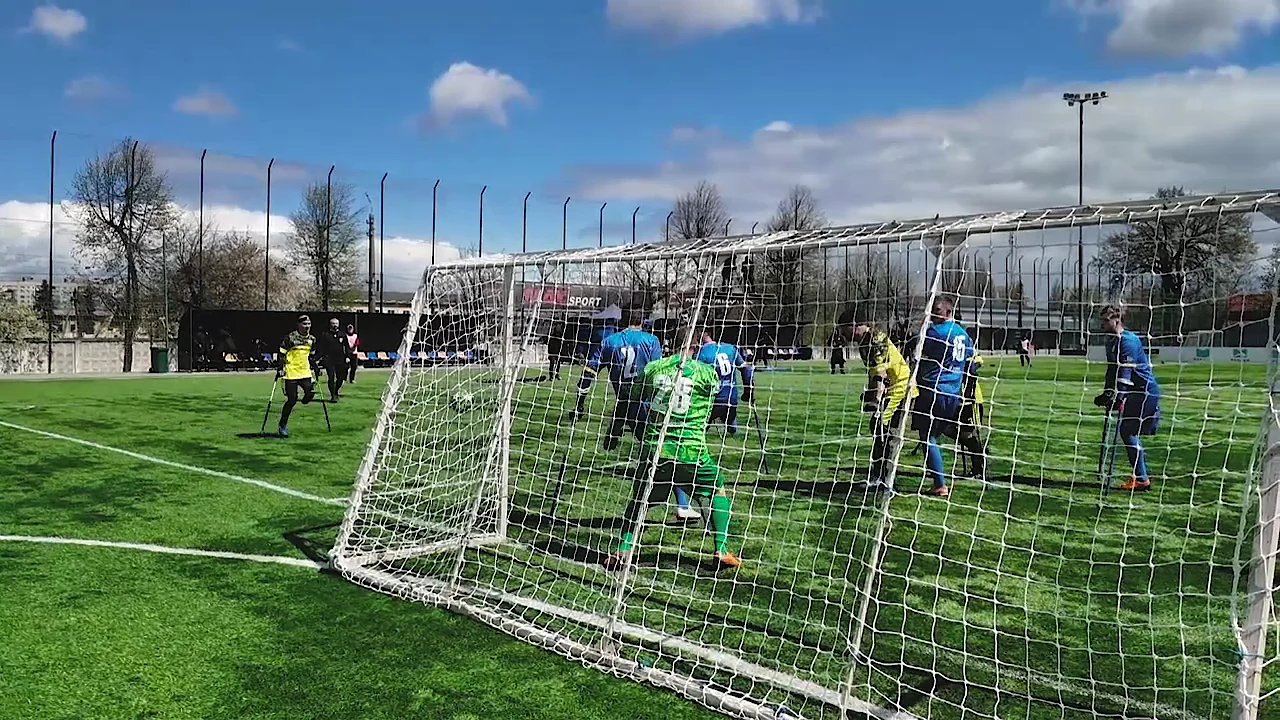
🎥 Watch the full film by Fabio Izzo: https://youtu.be/6JqKAbU1qzw?feature=shared
How it happened
- 2022Russia's full-scale invasion of Ukraine begins; daily life reshapes around sirens, blackouts and loss.
- Years of warOver 100,000 Ukrainians undergo limb amputations; rehabilitation services reach only a fraction of those who need them.
- The returnFormer soldiers and civilians alike relearn how to stand, walk and move, then how to play.
- TodayThe League of the Mighty Ukraine gives amputee players a fixed point: a pitch, a whistle and ninety minutes with their own rhythm.
- On filmFabio Izzo's documentary 'Football in Times of War' captures a game carrying weight it was never designed to carry.
Read next
Sources & Further Reading
- Documentary film: 'Football in Times of War' by Fabio Izzo
- Reporting and public data on amputee football and rehabilitation in wartime Ukraine
Check it yourself
Last updated
Quotes are attributed to the outlet or interview in which they were originally published. Facts, dates and results were checked against contemporary match reports and official competition records. Spotted something that needs correcting? Email uncut.football0@gmail.com.