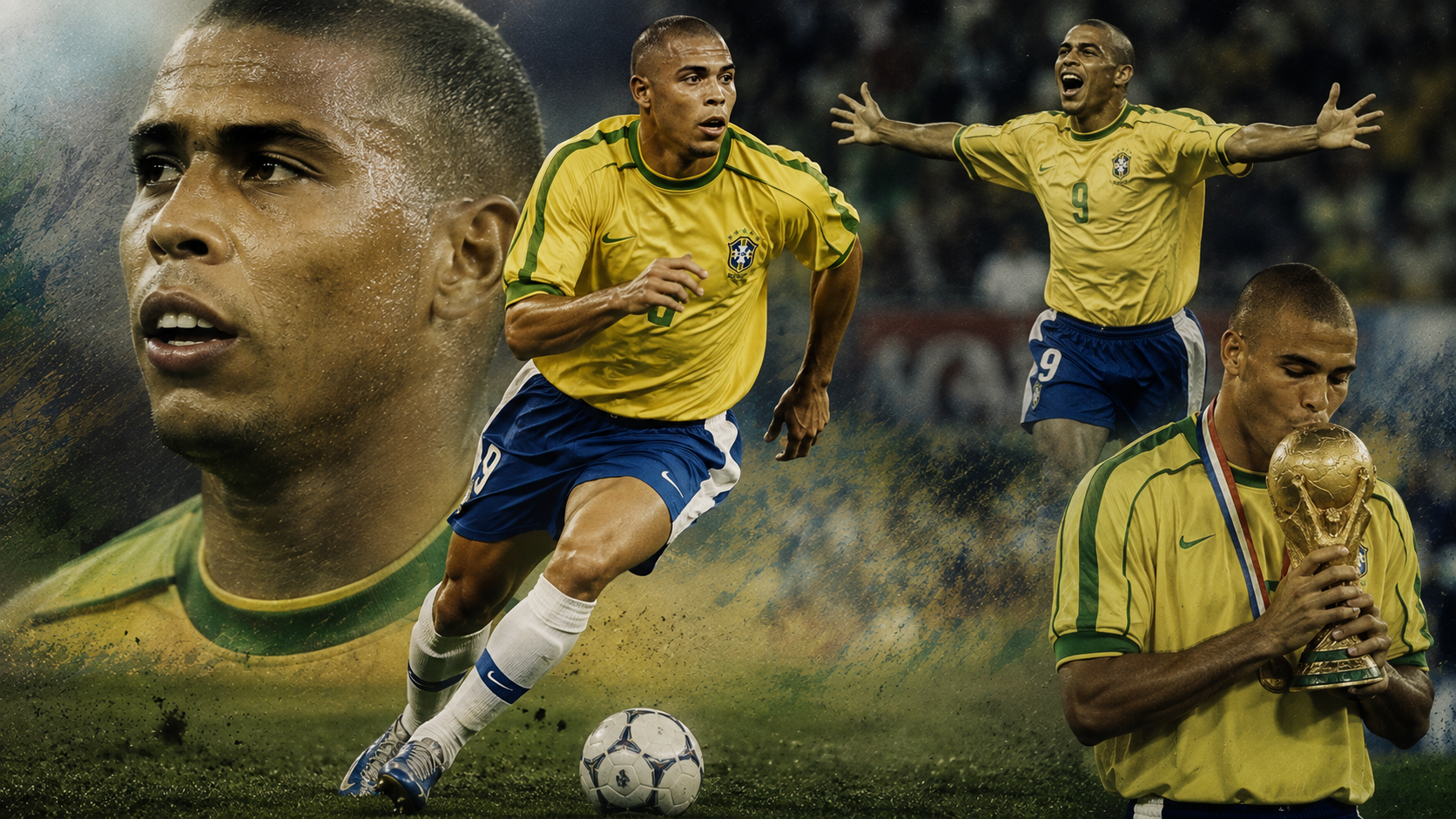
Ronaldo Nazário
The Second Ronaldo
The story of Ronaldo Nazário, told through the injury that nearly ended everything and the World Cup that made his return impossible to forget.
Rome
Inter were losing when they brought him on, which is the detail everyone forgets, because the thing that happened six minutes later erased everything about the match itself, the scoreline, the opponent's name, the reason Inter needed him at all, and left behind only the shape of a man falling to the grass for no visible reason. It was the first leg of the Coppa Italia final, Stadio Olimpico, the twelfth of April, 2000, and Lazio were up two goals to one when Ronaldo came off the bench in the fifty-eighth minute, which meant he was not walking into a match his team controlled but into one they were chasing, the kind of situation that asks a player to do something immediately rather than settle into the game around him. He had spent almost five months building toward this exact substitution. Nobody in the stadium knew that yet, not really, not the way his own body knew it.
The ball reached him wide on the right, in the kind of position defenders had spent a decade failing to defend properly, with Fernando Couto in front of him and just enough grass behind Couto to make the whole thing dangerous again. Ronaldo did what he had always done there. He shaped his body one way, shifted his weight, began the small theatrical lie that a stepover always is, and then he planted his right foot to change direction, the most ordinary motion in his entire vocabulary, the one his knee had performed uncounted thousands of times without asking permission.
This time the leg did not follow the instruction.
He went down almost before Couto had moved, before the defender had even committed to a direction worth reacting to, which is what made the moment so hard to read from the stands: there was no collision to explain it, no crunching tackle, nothing for thirty-eight thousand people to point to and say there, that's what he did. It looked, for one confused second, like a man who had simply decided not to continue with an action he'd already begun. Then the scream arrived, and the confusion turned into something else, because you do not scream like that over a decision.
The players nearest him understood before the ones further away did. A few started forward and then stopped, the way people stop when they realize there is nothing useful their bodies can do, and stood instead in that particular football formation reserved for genuine crisis: a loose ring around a man on the ground, faces turned away as often as toward him, because watching directly felt like an intrusion into something that should have stayed private.
He was twenty-three years old. Five months earlier, in a league match against Lecce that nobody outside Italy had paid much attention to at the time, he had damaged the patellar tendon in the same knee, and had spent the months since relearning the most basic instructions his leg used to execute without thought (plant, push, go) as though speed and balance were not gifts he'd been born with but a language he now had to study. Rome was supposed to be the sentence where he proved he could speak it again. Instead the tendon that had been surgically repaired once already gave way completely, all the way through, and the question that had shadowed Italian football for a year and a half stopped being when will Ronaldo return and became something far less comfortable to ask out loud: whether there would be a return to speak of at all.
The Rise
Before any of that, there had only ever been ascent, and it came so fast that it barely left room for the word "promising," the word football usually reserves for young players so it can hedge against disappointing them later. Ronaldo skipped the hedge. He grew up in Rio de Janeiro, broke into Cruzeiro's first team while still a teenager, and by seventeen was already good enough that PSV Eindhoven brought him to the Netherlands in 1994 believing a full season of adjustment would be required before he produced anything resembling his South American form. He scored thirty league goals that first season instead, which told European football something it would spend the rest of the decade failing to fully absorb: that there was no defensive scheme built for him, because low centre of gravity and top-end speed and a first touch that doubled as the opening stride of a sprint were not separate qualities a defence could isolate and cancel out one at a time. They arrived together, in the same motion, and a back four either lost the duel early or lost it late; there was no version where they simply didn't lose it.
Barcelona is where the rest of football stopped being able to describe him in ordinary terms. Forty-seven goals in forty-nine matches across the 1996-97 season is the number people reach for, but the number undersells what actually happened on the pitch, which had less to do with volume than with the sense that Ronaldo did not require the usual conditions to be dangerous. Against Compostela that October he picked up the ball deep in his own half, absorbed a defender trying to drag him back almost before he'd taken his first stride, absorbed another near the halfway line, had his shirt pulled and his path narrowed the entire length of the pitch, and arrived in the box having changed the identity of the players around him three or four times over without ever losing the thread of the run itself. Bobby Robson watched it from the touchline with both hands on his head, which is not really a coach's gesture. It's closer to the gesture of someone trying to work out whether what he just saw actually happened. That reaction, more than any statistic, is the one that survived. People started calling him O Fenômeno because ordinary language kept failing the assignment.
Inter paid a world-record fee for him in the summer of 1997 on the theory that Serie A, tighter, meaner, built by and for defenders who had spent careers refining the art of removing space rather than conceding it, would finally be the league that made him work for it. He scored thirty-four goals in his first season anyway and helped Inter to the UEFA Cup, and the final against Lazio produced the cleanest possible demonstration of what made him so difficult to plan for: running through alone on goalkeeper Luca Marchegiani, he simply waited, shifted his weight one way and then the other until Marchegiani's body had committed to a guess, and only then went around him. The finish looked effortless because the actual difficulty, the patience, the refusal to decide early, had already happened before the ball reached the net.
By the time Brazil arrived in France for the 1998 World Cup, Ronaldo carried the kind of expectation usually reserved for players closing out long careers, not ones just beginning theirs, and for most of the tournament he answered it, scoring four times as Brazil reached the final. Then, on the afternoon of the match itself, his name was missing from the first team sheet released to the press. A convulsive episode hours earlier had sent him for medical tests, and only a second, corrected sheet put him back in the side. Whatever had actually happened inside the Brazilian camp that day, the player who walked out at the Stade de France bore only a physical resemblance to the one who had carried the tournament. Brazil lost 3-0, Zidane scored twice, and Ronaldo barely entered the game at all. The defeat was enormous, but it still felt temporary at the time. He would be only twenty-five at the next World Cup, and there was no reason yet to doubt his body would simply be there waiting for him when it came.
Lecce
Inter beat Lecce six goals to nil on the twenty-first of November, 1999, a scoreline so lopsided that nobody watching had any reason to expect the afternoon would be remembered for anything other than the result. Ronaldo scored in it, one goal among six, and then at some point in the second half he went down holding his knee, the way players go down dozens of times a season for reasons that turn out to be nothing. It was the patellar tendon in his right knee, torn badly enough that surgery was never really a choice, and he flew to Paris, where the surgeon Gérard Saillant, already the name European clubs called when a body had failed in a way ordinary treatment couldn't fix, performed the operation. Inter's public language afterward was patient and measured: several months, a full recovery expected, no reason for real alarm. Ronaldo was twenty-three, and there was no obvious reason yet to think this ordinary-looking injury, on an ordinary rout of an unremarkable opponent, was the first sentence of a story that would take the better part of three years to finish.
The Lost Years
There is no highlight reel for what came next, because nothing happened in front of anyone. Rehabilitation lived in gyms and treatment rooms rather than stadiums, measured in units too small to ever make a montage: a few more degrees of flexion, a slightly longer stride on the treadmill. Before the injury, Ronaldo had never had to think about the leg. Afterward, every plant of the foot carried a question that hadn't existed before. Football moved on without him, and by April 2000, five months into a recovery that had gone as well as anyone could ask, Inter brought him back as a substitute against Lazio, which is where this story already began: the six minutes, the stepover, the knee giving way completely this time. What followed was worse than anything that came before it. He went back to Paris for rehabilitation a second time, missed the entire 2000-01 season, and when he finally returned that September, a strained thigh muscle put him straight back on the treatment table. He was twenty-five, and had played ninety-nine games across four seasons at a club that had paid a world record to sign him.
Brescia
The return, when it finally held, arrived without ceremony: the ninth of December, 2001, away at Brescia, a bent finish with the outside of his right foot in the nineteenth minute, his first league goal since Lecce. The reaction on the ground was less about the goal than the fact of it happening at all. He was not the player who had torn Barcelona apart five years earlier, the explosiveness now arriving in flashes rather than as a constant, but he was playing, and he was scoring, and somewhere in Brazil's camp Luiz Felipe Scolari was weighing a gamble that looked reckless from the outside: building part of a World Cup attack around a striker who had played only a handful of matches in three years, whose body had already ended one World Cup campaign from the inside. Scolari picked him anyway. If the knee held, Brazil had a forward defences still didn't know how to play against. If it didn't, they would find out in Japan rather than in training, which was exactly the gamble a team with nothing left to lose could afford.
Yokohama
Brazil opened the tournament with Ronaldo scoring against Turkey, then China, two more against Costa Rica, another against Belgium, five goals before the semi-final. The explosiveness hadn't fully returned and never would, but the understanding of exactly where a chance was about to open had survived everything the knee had taken, and that turned out to be the part that actually mattered.
The final, against Germany, stayed goalless for an hour while Oliver Kahn, who had conceded once all tournament, controlled his own box like the best player in the competition. Then, in the sixty-seventh minute, Ronaldo won the ball back in midfield, fed Rivaldo, and Kahn spilled the shot that should have been comfortable. Ronaldo was already moving before it finished bouncing, and touched it home. Twelve minutes later Kléberson drove down the right, Rivaldo stepped over the cross rather than touching it, and Ronaldo arrived behind him to place the second goal low into the corner. Two-nil. Brazil were champions for a fifth time, Ronaldo the tournament's top scorer with eight goals, and afterward, in tears, he thanked his family and then thanked Gérard Saillant by name, the surgeon who had rebuilt the same knee twice, as though the trophy needed a second dedication to the man who had made it structurally possible for him to be holding it.
Manchester
Real Madrid signed him that summer into a dressing room that already held Figo, Zidane, and Roberto Carlos, and the quiet question underneath the fee was whether he could still be the point a team organized itself around, or whether he'd arrived as an expensive contributor to somebody else's team. Thirty goals in his first season answered it: less carrying the ball over long distances, less dribbling through entire defenses, but no loss in his sense of where and when the ball needed to arrive.
The clearest proof came at Old Trafford in April 2003, Real three-one up from the first leg of a Champions League quarter-final. Ronaldo scored in the twelfth minute, added a second before the hour, then a third from distance that Fabien Barthez had no chance of reaching. Real were losing the match itself by the end, four-three, but the tie was already decided, and when Vicente del Bosque took him off, Manchester United's own supporters rose to applaud him from their own ground. He was twenty-six, three years removed from a knee that had twice threatened to end his career, and he had just made one of Europe's great defenses look like a training exercise.
Dortmund
He arrived at the World Cup heavier and slower than he'd ever been, quite the opposite of the starboy that once shared the pitch in Eindhoven. The Brazilian press spent the opening matches asking whether anything was left. He kept scoring anyway, and in the round of sixteen against Ghana, five minutes in, he ran onto a Kaká pass, feinted past goalkeeper Richard Kingson with the stepover that had been his signature since Barcelona, and scored his fifteenth World Cup goal, passing Gerd Müller's record of fourteen, a mark that had stood since 1974.
The run ended in the quarter-final against France, and the shape of the defeat felt less like a new result than an old one repeating itself. Zinedine Zidane, by then Ronaldo's own teammate at Real Madrid, swung in the free kick that Thierry Henry volleyed home for the only goal of the match. It was the same country that had beaten Brazil in the 1998 final, and once again it was Zidane who decided it. This time, though, Ronaldo left the field with nothing left to prove. Four goals in France, eight in Japan and South Korea, three more here in Germany: no forward in the tournament's history had ever scored that many, and one lost quarter-final was never going to be the sentence that defined him.
What Remained
The final years read less like decline than a long negotiation with a body that kept renegotiating the terms. He left Real Madrid for AC Milan in 2007, and in February 2008, against Livorno, went down clutching his knee again, this time the left one, the tendon ruptured completely, back under Saillant's care in Paris for a third time. There was a brief return to Brazil with Corinthians, the club where it had all first shown itself, goals scored on a body that no longer moved the way it once had but still understood where they were going to come from. He retired in 2011, thirty-four years old, leaving behind a career that could be read as a tragedy of what four ruptured tendons had stolen from the most explosive forward of his generation, or as proof of exactly how much of his greatness had never actually depended on that explosiveness at all.
Which brings the story back to Rome, because it has to. Ronaldo has the ball near the edge of the box. Couto is in front of him. A shift of the hips, a stepover, the plant of the right foot that had carried him through Rio, Eindhoven and Barcelona without once failing him, until, on this particular afternoon, it did. For anyone watching, the story appeared to have ended too early, a supremely gifted player whose body had simply stopped keeping pace with his talent. There was more than enough evidence to support that reading, and football is generally willing to accept that some careers simply end there.
Ronaldo did not know, lying on the grass, what would come after. He spent the better part of two years relearning what had once required no thought at all, and by the time Brazil arrived in Japan and South Korea, there was still no real consensus on what remained. Then Kahn spilled a shot he should have held, and the player carried around Yokohama on his teammates' shoulders afterward was not a restoration of the boy who had destroyed Compostela's defense alone. He was someone else, built from the same instincts inside a more careful body, arriving at the same distinction by a route nobody would have chosen for him. What the six minutes in Rome never managed to take was the part that had never actually lived in his legs: the understanding of exactly where to be, and when. In Yokohama, it turned out to be enough. It had to be. It was all that remained.
More from this archive: Brazilian football stories
How it happened
- 1996–1997Barcelona: 47 goals in a single season, then a world-record move to Inter.
- November 1999First serious knee injury in Milan.
- 12 April 2000Returns against Lazio and the knee gives way again after seven minutes.
- 2001–2002Almost two years of rehabilitation before returning for the World Cup.
- 30 June 2002Two goals in the final; Brazil win a fifth World Cup.
Read next
The Emperor Who Never Really Disappeared
The story of Adriano, a footballer powerful enough to dominate Europe, and the loss that made football feel smaller than the life waiting outside it.
Read the storyLegend · 15 minWhat Baggio Was Carrying
Roberto Baggio, Italy, and the five seconds that football remembered — the story of USA '94 and the kick that defined him.
Read the storySources & Further Reading
- FIFA World Cup 1998 and 2002 official match records
- Serie A and La Liga records via club and league archives
- Contemporary reporting from BBC Sport, The Guardian and Gazzetta dello Sport
- Medical and comeback coverage published at the time of the injuries
- Later interviews with Ronaldo Nazário and his medical team
Check it yourself
- Ronaldo — career record, injuries and comebacks
- 2002 World Cup final — Brazil 2–0 Germany
- 2002 World Cup — full tournament record
- RSSSF — historical results and competition archives
Last updated
Quotes are attributed to the outlet or interview in which they were originally published. Facts, dates and results were checked against contemporary match reports and official competition records. Spotted something that needs correcting? Email uncut.football0@gmail.com.