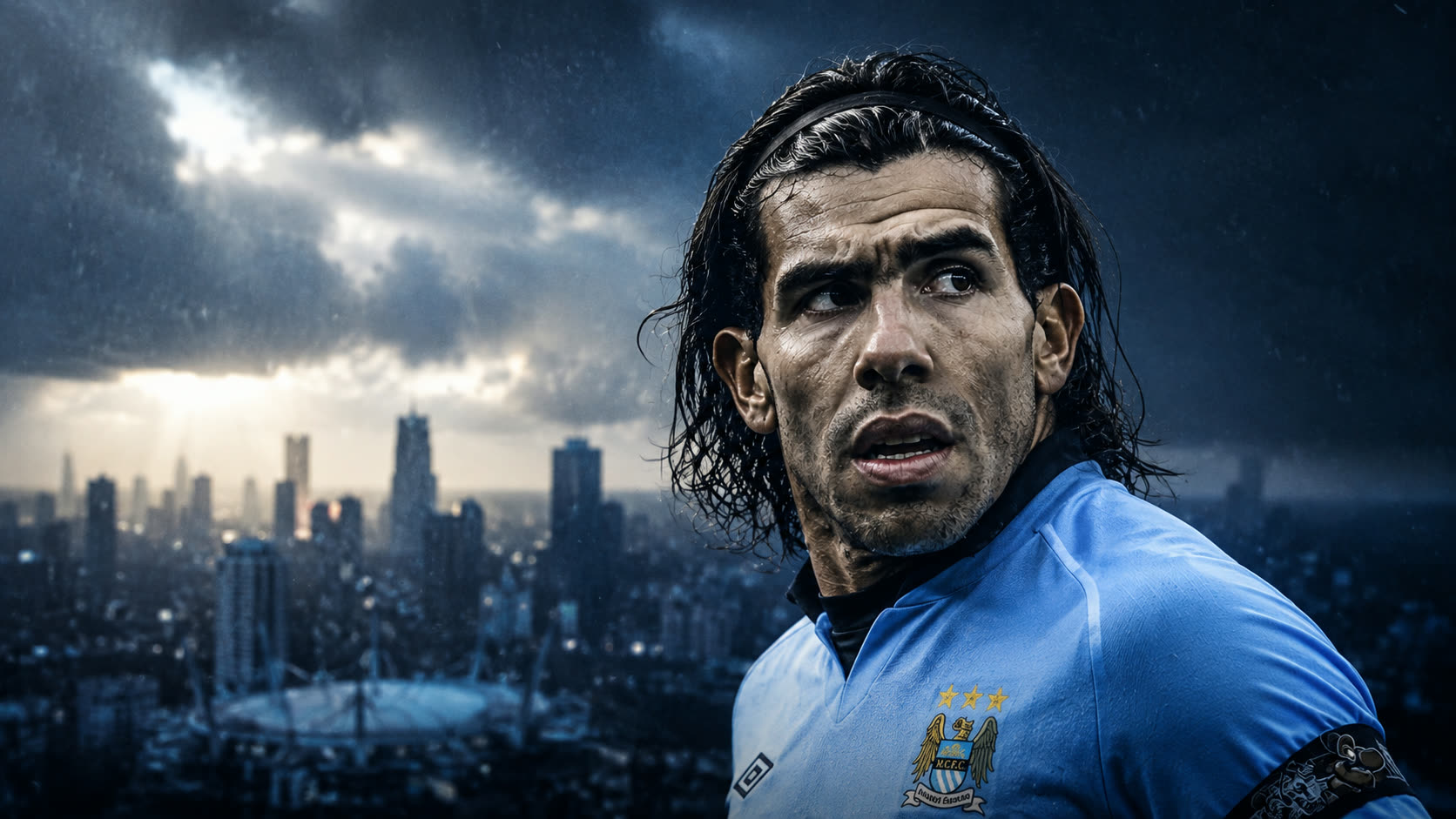
Carlos Tevez
The payback that resulted in a decade of dominance
A football history long read on Carlos Tevez: the 2009 move across Manchester that changed the city's balance of power for a decade.
It wasn't supposed to happen.
Manchester United had just won three consecutive Premier League titles and reached two straight Champions League finals.
Sir Alex Ferguson's side looked untouchable.
Across town, Manchester City were still searching for relevance despite new billionaire owners.
At the time, it was just another transfer saga. But Carlos Tevez wasn't just leaving Manchester United. He was joining the one club they could never afford to strengthen.
The price of that decision would be paid for the next decade. It marked the moment the balance of power in Manchester began to shift, and the beginning of an era that would redefine English football.
The hero they would eventually lose
When Carlos Tevez arrived at Manchester United in the summer of 2007, nobody knew exactly what to expect.
He was already a cult figure in England after dragging West Ham United away from relegation on the final day of the previous season, but moving to Old Trafford was an entirely different challenge. At United, passion and effort were not enough. Every player had to prove they belonged among the elite.
Tevez did that almost immediately. From his first appearances, he looked like the kind of player Manchester United supporters had always admired: fearless, aggressive, and willing to fight for every single ball. He pressed relentlessly, threw himself into tackles, and celebrated every goal as if it was the most important moment of his career.
For a club built on attacking football, Tevez brought something different. He brought chaos.
Alongside Cristiano Ronaldo and Wayne Rooney, he formed one of the most exciting attacking trios in Europe. Ronaldo provided the brilliance, Rooney brought intelligence and versatility, while Tevez brought the fire.
And the timing could not have been better. Manchester United was entering one of the greatest periods in its history. Under Sir Alex Ferguson, they were rebuilding a side capable of dominating England and competing for Europe's biggest prize. The arrival of Tevez helped complete an attack that would soon become legendary.
The 2007-08 season delivered the ultimate reward. Not only did United win the Premier League title. They also reached the Champions League final in Moscow. And on that unforgettable night against Chelsea, Tevez scored in the penalty shootout as United lifted the European Cup for the third time in their history.
But his importance was not measured only by medals. It was measured by how quickly he became a fan favourite.
The chants from the Stretford End grew louder. His name became part of the atmosphere at Old Trafford. Supporters saw a player who had not simply joined Manchester United — he had embraced what the club stood for.
For a brief moment, everything seemed perfect. United had Ronaldo, Rooney, and Tevez. They had the trophies. They had the best attack in England. And they had a striker many believed would be part of their future for years to come.
The £25 Million Mistake
By the end of the 2008-09 season, Carlos Tevez had done almost everything Manchester United could have asked of him.
In two years at Old Trafford, he had helped the club win back-to-back Premier League titles, the Champions League, the FIFA Club World Cup, and the League Cup.
There was just one problem: Carlos Tevez wasn't actually a Manchester United player. He had joined the club in 2007 on an unusual two-year loan agreement, with Manchester United holding an option to buy him permanently at the end of the deal for around £25 million.
While Tevez wore the famous red shirt every week, his future remained uncertain. As his loan neared its end, the question was no longer whether Tevez had proven himself. It was whether Manchester United was willing to pay to keep him.
The answer to that question became increasingly unclear. Sir Alex Ferguson had already invested more than £30 million in Dimitar Berbatov during the summer of 2008. The Bulgarian was expected to become United's long-term first-choice striker alongside Wayne Rooney. With Cristiano Ronaldo contributing an extraordinary number of goals from the wing, Ferguson believed he already had enough firepower.
Suddenly, Tevez found himself fighting for a place rather than being guaranteed one. To Ferguson, it was squad rotation. To Tevez, it felt like rejection.
The striker never hid his frustration. He spoke publicly about the lack of faith from the club. "I needed to feel wanted," Tevez would later admit.
Every passing week without an agreement only reinforced the feeling that, despite everything he had given the club, Manchester United were prepared to let him walk away and move on without him.
Ferguson saw the situation differently. The United manager maintained that he wanted Tevez to stay but argued that negotiations had become complicated due to third-party ownership and the demands of Tevez's representatives.
But in football, perception often matters more than intention. While Ferguson believed he was making the right decision for the club, Tevez believed the club he had fought for no longer valued him.
The supporters felt the same way. Whenever Tevez stepped onto the pitch at Old Trafford, banners appeared in the stands carrying the same message: "Fergie, sign him up.✍️"
It was rare for Manchester United fans to openly pressure Sir Alex Ferguson, but Tevez had become the exception. They saw something beyond statistics; they saw a player who embodied the work ethic and determination that had defined Ferguson's greatest teams. A player who represents them.
Yet sentiment rarely decides transfers.
By the summer of 2009, the relationship had reached a breaking point. For Manchester United, it was a decision about squad planning. For Carlos Tevez, it had become personal.
And somewhere across Manchester, another club was paying close attention.
Manchester City didn't just see an elite striker becoming available. They saw a chance to strike at the heart of their neighbour and greatest rival.
Controversial move completed
On 13 July 2009, Carlos Tevez became a Manchester City player.
City had been taken over by the Abu Dhabi United Group less than a year earlier, transforming them from an ambitious Premier League club into one of the wealthiest teams in world football. They had already shown their intentions by signing Robinho. Now they had taken one of United's most popular players.
And they wanted everyone to know about it.
Shortly after the transfer, City placed a giant billboard in Manchester featuring Tevez with the words:
"WELCOME TO MANCHESTER."
The message was deliberately provocative. Tevez had spent the previous two seasons playing at Old Trafford, yet City were presenting his arrival as though he had finally arrived in the city.
It was no longer subtle.
Manchester City weren't asking permission to challenge United.
They were announcing themselves.
For United supporters, the move was difficult to accept.
They had watched Tevez become one of their own, had spent months asking Ferguson to sign him permanently, and now had to watch him wear the blue shirt of their biggest local rival.
Tevez was a statement of intent. The club could now attract players who had already proven themselves at the highest level of English football.
They were no longer simply buying potential.
They were buying established stars.
And Tevez was about to prove exactly why.
Revenge in blue
Tevez's first season at City was almost a perfect answer to the doubts surrounding his departure.
He scored regularly, became one of the club's most important players and quickly developed the same relationship with City's supporters that he had once enjoyed at Old Trafford.
But nothing could have prepared Manchester for January 2010.
City and United met in the first leg of the League Cup semi-final.
United scored first. Then Tevez took over.
He equalised from the penalty spot before heading City in front in the second half. He had scored twice against the club that had decided he was no longer worth keeping.
The celebration was as important as the goals.
Tevez had spent two years being adored by the supporters on the other side of Manchester. Now he was standing in front of them in blue, having just put their team behind.
City eventually lost the second leg at Old Trafford and United progressed 4–3 on aggregate, but something had changed.
Tevez had shown that leaving United had not diminished him.
If anything, it had liberated him.
He finished his first season at City with 29 goals in all competitions and was named the club's Player of the Year.
He was no longer simply the former United striker. He was City's.
And City were beginning to look like something much more serious than a wealthy club with expensive players.
The following season, Tevez became captain. Around him, the project was accelerating.
David Silva arrived from Valencia. Yaya Touré came from Barcelona. Vincent Kompany was developing into one of the Premier League's best defenders. The squad that would eventually dominate English football was beginning to take shape.
Tevez was right in the middle of it. In 2010–11, he scored 21 Premier League goals and helped City finish third. More importantly, they finally won a major trophy.
Tevez lifted the FA Cup trophy as captain, after defeating Stoke City in the final.
For decades, City had lived in United's shadow. Now they had something tangible to show for their new ambition. And the distance between the two was shrinking.
Establishing City's ambition
City were spending enormous amounts of money, but money alone did not guarantee success. They needed players capable of turning investment into trophies.
Tevez was one of those players. His importance was not simply measured by his goals. He gave the new City side an identity.
He was aggressive, relentless and emotionally invested. He played with the intensity of someone who wanted to prove something every time he stepped onto the pitch. That made him the perfect player for City's transition.
The club was moving from outsider to contender.
Silva brought control and creativity. Touré brought physical dominance. Kompany brought leadership. Behind them came Sergio Agüero, Samir Nasri, Edin Džeko and others. Suddenly, Manchester City had depth, quality and ambition.
They were no longer trying to finish above United. They were trying to win the league.
By the beginning of the 2011–12 season, the idea no longer sounded ridiculous.
City started the campaign brilliantly and eventually produced a run of form that put them firmly in the title race. At one point, they led United by eight points with six matches remaining.
Then everything began to fall apart.
A defeat to Arsenal appeared to have ended their challenge.
United had experience. They had Ferguson. They had won the league countless times before and had spent decades competing at the very top of English football.
City had, of course, been English champions before. Their most recent title had come in 1968, back when the competition was still known as the First Division. Since the Premier League was formed in 1992, however, they had never finished at the top.
Now, with the season entering its final weeks, City had to prove they could handle the pressure of a title race that United knew all too well.
Roberto Mancini's team recovered. They won six in a row.
And on the final day of the season, everything came down to one afternoon in Manchester.
93:20
Manchester City needed to beat Queens Park Rangers. United were playing Sunderland.
The mathematics were simple. City were level on points with United and ahead only on goal difference. Win, and City would be champions. Anything else could hand the title to United.
The match began exactly as City would have wanted. Pablo Zabaleta gave them the lead.
Then QPR equalised through Djibril Cissé. With 25 minutes remaining, City were suddenly in trouble.
Then came the moment that seemed to confirm the inevitable. Jamie Mackie put QPR ahead.
The stadium fell silent. United were effectively champions.
City had spent billions trying to reach this moment, only to watch it disappear in front of their own supporters.
The clock passed 90 minutes. City were still losing.
Four minutes into stoppage time, Edin Džeko headed in the equaliser. 2-2. One goal was still needed.
Then, in the 93rd minute and 20 seconds, Sergio Agüero received the ball inside the penalty area.
One touch. A second. Then the shot.
Agüero sprinted towards the corner. The stadium erupted. Players disappeared beneath a pile of blue shirts.
City had done it. They were champions of England for the first time in 44 years.
And United, despite winning their own match, could do nothing about it.
Tevez had not scored the goal. He had not won the title by himself. But it was impossible to ignore the symbolism.
The player who had crossed Manchester was now part of the team that had finally crossed United.
The domino effect
It would be too simplistic to say that Carlos Tevez caused Manchester City's rise.
He didn't. The takeover, the investment, the recruitment, the managers and the players who followed all played their part.
But Tevez's transfer represented something important. It showed that City's new owners were willing to take players from the very top of English football.
And, perhaps more importantly, it showed those players that joining City no longer meant sacrificing the chance to win major trophies. That distinction mattered.
Players joined them because they believed City could become the next superpower of English football.
The 2011 FA Cup was the first warning. The 2012 Premier League title was the confirmation. And from there, the balance of power continued to shift.
City won the Premier League again in 2013–14. They added domestic cups. They continued attracting world-class players.
Then came Pep Guardiola. Under Guardiola, City evolved from ambitious challengers into an extraordinary footballing machine.
The Premier League titles became more frequent. The domestic records began to fall. In 2022–23, City finally conquered Europe as well, winning the Champions League and completing a historic treble.
The club that had once been trying to escape United's shadow had become one of the defining teams of modern European football.
Meanwhile, Manchester United were moving in the opposite direction.
Ferguson retired after the 2012-13 season. United won the Premier League in his final campaign, but they never regained the same consistency after his departure.
Managers came and went. Squads were rebuilt. Big transfers failed.
City kept winning. Looking back, Tevez's transfer feels like one of the early dominoes of that success.
United had been the established power, while City were the challenger. Tevez was the moment the challenger reached into the champion's squad and took something valuable.
Long-term impact
Tevez eventually left Manchester City in 2013, four years after arriving. By then, his relationship with the club had become complicated, with the infamous fallout with Roberto Mancini, disputes over his future and a period in which he spent months away from the first team. But by the time he left, his place in City's history was secure. He had scored 74 goals in 148 appearances, won the FA Cup, lifted the Premier League trophy and captained City through the most important years of their transformation.
Yet his greatest significance was never simply what he achieved in a City shirt. It was what happened because of the decision to put one on. His transfer had changed the meaning of a Manchester derby, showing that City could take an established star from United and compete for the trophies that had once seemed out of reach.
Manchester United had not been forced to sell Tevez. They had made a judgement: that he was valuable, but not indispensable. City made the opposite judgement. Four years later, one club had won its first Premier League title, while the other was entering a new era without the manager who had defined it for more than two decades.
That does not mean Tevez caused United's decline or single-handedly created City's dominance. Abu Dhabi's investment, City's recruitment and the arrival of Guardiola mattered far more to what followed. But transfers can be symbolic long before their consequences become clear. In 2009, Tevez crossing Manchester felt like the end of a contract dispute. In 2012, it looked like something much bigger: one of the moments when the old order began to crack.
For Manchester United, Tevez became the player they had allowed to walk away. For Manchester City, he became one of the first players to arrive when ambition was turning into expectation. He didn't build the dynasty that followed. He helped open the door. City walked through it, and they never really looked back.
How it happened
- July 2009Tevez crosses the city; the billboard goes up days later.
- 2009–1029 goals in his first season at City.
- May 2011Captains City to the FA Cup and a return to the Champions League.
- September 2011The Munich touchline row and months of exile.
- 13 May 2012Back in the side as City win the league in stoppage time.
Read next
José Mourinho: The Special One
How one manager turned the touchline, the press room, and English football itself into his stage.
Read the storyLegend · 10 minThe Second Ronaldo
The story of Ronaldo Nazario, told through the injury that nearly ended everything and the World Cup that made his return impossible to forget.
Read the storySources & Further Reading
- Premier League match and transfer records
- Manchester United and Manchester City club archives
- Contemporary reporting from BBC Sport, The Guardian and Manchester Evening News
- Interviews with Carlos Tevez and managers involved
- Argentine press coverage of Tevez's career
Check it yourself
- Carlos Tevez — transfers, seasons and honours
- 2011–12 Premier League — the title decided on goal difference
- 2011–12 Manchester City season — match by match
Last updated
Quotes are attributed to the outlet or interview in which they were originally published. Facts, dates and results were checked against contemporary match reports and official competition records. Spotted something that needs correcting? Email uncut.football0@gmail.com.