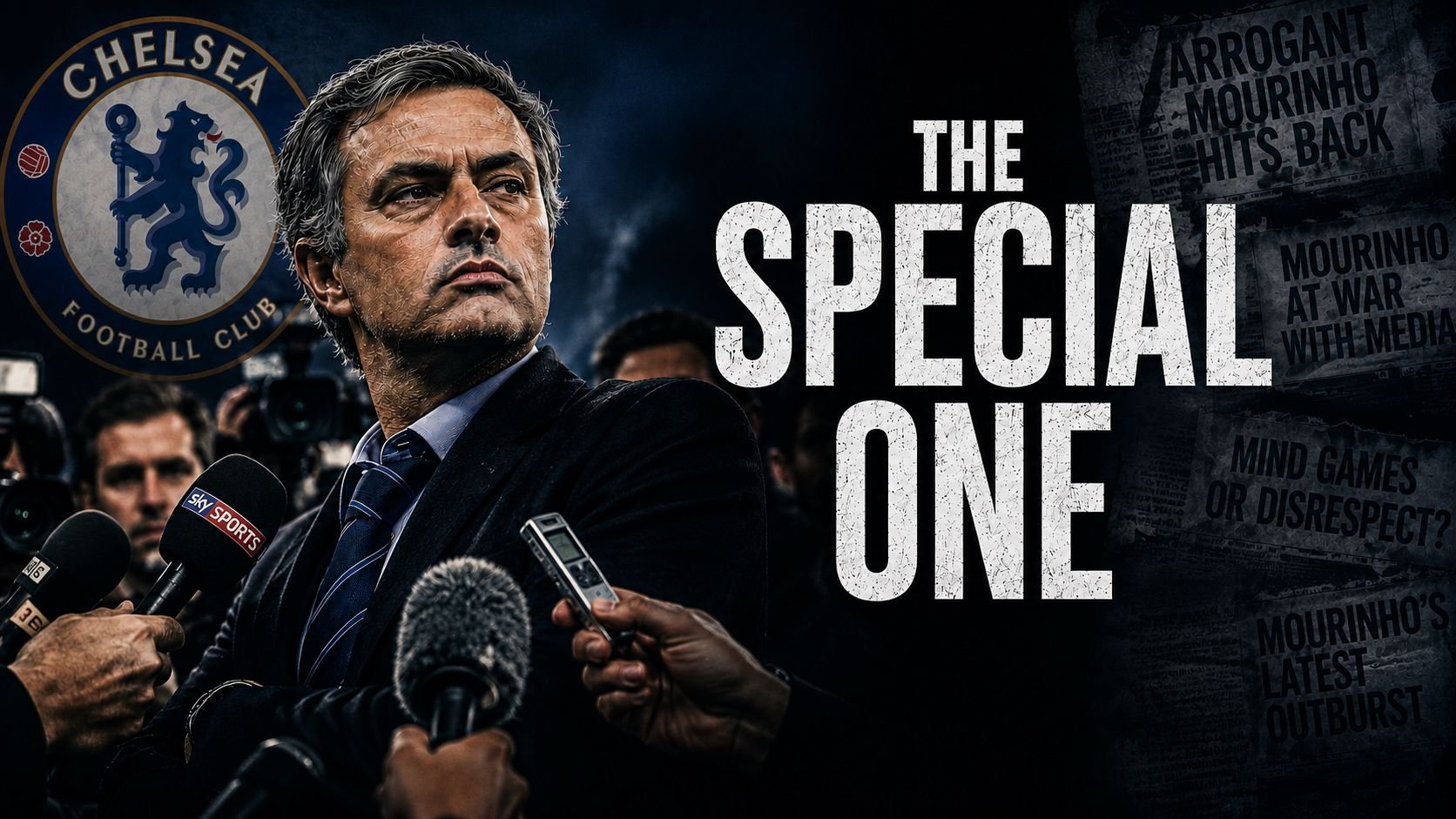
Who is this man?
A Special One
When José Mourinho arrived in England in June 2004, he had been in the country for about five minutes before explaining why everyone should take him seriously.
Chelsea had just been bought by Roman Abramovich, a Russian billionaire who had spent the previous year turning Stamford Bridge into the most expensive construction site in English football. The club had bought Claude Makélélé, Hernán Crespo, Damien Duff and several others. Claudio Ranieri had finished second in the Premier League and reached the Champions League semi-finals, but it was not enough. Chelsea wanted someone who could turn money into trophies.
They found a 41-year-old Portuguese coach who joined from Porto. José Mário dos Santos Mourinho Félix.
At his first press conference, Mourinho was asked about the pressure. He was not interested.
“Please don't call me arrogant,” he said, “but I think I'm a special one.”
He knew what people expected from him. They expected arrogance, and a foreign coach with an inflated opinion of himself. Mourinho instantly gave them what they were waiting for. Already, he had given himself a nickname.
It was exactly the sort of introduction that could have gone badly wrong. Yet there was a reason Mourinho could afford to be so confident. Less than three months earlier, he had eliminated Manchester United from the Champions League at Old Trafford, sprinting down the touchline after Costinha's late equaliser before leading Porto to the final and, eventually, the European Cup. His reputation had not been built on charm. It was built on winning.
Manchester United and Arsenal had spent years building their dominance through commercial growth, recruitment and successful managers. Chelsea had found another route. They had discovered what money could do and spent £113 million in Abramovich's first summer window, more than Manchester United, Arsenal, Liverpool and Newcastle United combined.
The spending was not simply a matter of adding a few expensive players to an already competitive squad. Chelsea were changing the scale of what was possible. Players who might previously have been considered unattainable were suddenly within reach, while clubs across England had to watch Chelsea enter the market with a financial power that had not existed at Stamford Bridge before.
Mourinho was being handed the job of making sense of it all, and he wasted little time in making Chelsea look different. He brought in Didier Drogba from Marseille for a club record fee, Ricardo Carvalho and Paulo Ferreira from Porto, Arjen Robben from PSV Eindhoven and Petr Čech from Rennes, a group of players who would become central to the team he was building.
On paper, it looked like exactly the sort of squad Mourinho would need to fulfil the ambitions he had announced in his first press conference. But there was still an obvious question hanging over him: was he really as good as he thought he was, or had English football simply been introduced to another manager who was very good at talking about himself?
The first few weeks provided an answer rather quickly.
Chelsea opened their league campaign against Manchester United at Stamford Bridge, perhaps the best possible opponent for a manager who had spent the previous season eliminating English clubs from Europe and had arrived promising he was different from the rest. Chelsea won 1–0, with Eidur Guðjohnsen scoring the only goal. The result itself was hardly spectacular, but there was something significant about the way Chelsea managed the game. They did not look overwhelmed by the occasion, nor like a newly assembled team still trying to understand what their manager wanted from them. They looked organised, confident and entirely comfortable with the idea that Manchester United were no longer the club expected to dictate the terms.
The performances that followed only strengthened the impression, although they also revealed something about the football Mourinho was going to play. Chelsea won a remarkable number of matches by a single goal, often 1–0, because once they had taken the lead there was little incentive for Mourinho to turn the game into something more open. He did not care whether Chelsea had scored three or four if one was enough. To him, football was not an artistic exercise in which a team had to win beautifully to justify the victory. It was a competition in which one side had to score more goals than the other, and if that meant scoring once and spending the rest of the afternoon making sure the opponent could not score at all, so be it.
By Christmas, the results had made one thing clear: Mourinho was not bluffing. The Special One was beginning to look exactly like what he had claimed to be.
By the spring, Chelsea had lost only once in the league and were closing in on a title that had seemed unrealistic only a few years earlier. On 30 April, a 2–0 victory at Bolton secured the championship, giving Chelsea their first league title in fifty years.
Mourinho had arrived calling himself special. Now he had the trophy to make the claim considerably harder to laugh at.
Now everyone knows him.
The Enemy
The title changed the dynamic.
Mourinho no longer had anything to prove. Chelsea were champions, and he had delivered the title he had promised. The novelty of his arrival was beginning to disappear, but in its place came something more permanent: the expectation that Chelsea would win, and the growing frustration whenever they did.
That changed the nature of the attention around him. Every Chelsea match now carried a second question alongside the football itself. Could anyone make Mourinho lose his composure? Could anyone finally make him look ordinary?
Mourinho seemed to understand that the position of champion gave him even more freedom than before. He no longer needed to convince people Chelsea belonged at the top of English football, and he had no intention of making himself smaller now that he had reached it. If anything, the confidence became more pronounced, because every victory gave him another reason to believe his methods, his decisions and his instincts were being justified.
Chelsea were becoming difficult to enjoy unless you supported them. Their opponents were often left with possession but very little space, while Chelsea seemed perfectly comfortable allowing a match to become a slow exercise in frustration. The results made Mourinho's methods difficult to argue with.
Chelsea won the League Cup in 2005 and then retained the Premier League title the following season, finishing eight points clear of Manchester United. They had now won the league twice in a row, and the club that had initially been treated as an Abramovich-funded disruption had become the team against which everyone else measured themselves.
Chelsea were no longer outsiders trying to break into the elite. They had become the elite, and Mourinho was increasingly comfortable occupying the position of the man everyone else had to challenge.
Chelsea were no longer a question mark. They were champions, twice over, and the argument about whether Mourinho belonged at the top of English football was finished. What replaced it was a quieter, less comfortable one: whether anyone outside Stamford Bridge still wanted to watch them do it.
Why did everyone keep listening to him? And when did that stop working?
The Room He Controlled
Sit in enough Mourinho press conferences and a pattern emerges that has nothing to do with football tactics. He is asked a question about Saturday's opponent. He answers a different question, one about the referee, or a rival manager's hypocrisy, and by Monday, that is the story everyone is discussing. Not the match. Him.
This was not an accident of temperament. It was a method. Mourinho understood that a press conference is a room with only one person in it who has actually thought about what he wants to happen next. Everyone else is there to react. So he gave them something to react to, on his own schedule, before they could ask him anything he hadn't already prepared for. A question about an opponent became a criticism of that opponent. A question about a referee became a warning to the officials.
There was calculation in it. If the attention was on him, his players had less to answer for, and he was perfectly willing to make himself the target if it meant taking pressure off them. But there was also something more personal about it. Mourinho seemed to genuinely enjoy the confrontation, particularly once he knew his results gave him the authority to back it up.
One of the first people to discover this was Arsène Wenger. The Arsenal manager had spent years at the centre of English football, but Mourinho showed him none of the deference usually afforded to a man who had transformed the Premier League. Wenger questioned Chelsea's spending and the influence of Abramovich's money. Mourinho had little sympathy for the idea that Chelsea should apologise for having it. He had been given the resources to build a winning team, and saw no reason to pretend otherwise.
It was not really about Wenger, nor only about him. Wenger had his principles, and Ferguson had his authority, built over nearly two decades at Old Trafford. Mourinho tested both, repeatedly, and for a long time there was nothing anyone could do about it, because Chelsea kept winning, and winning was the only argument Mourinho ever really needed.
Ask why English football kept listening, and the honest answer is uncomfortable: it had little choice. Ignore him, and he would say something else, louder, until you couldn't.
Which raises the real question of this chapter. Not why it worked, but why it stopped.
The uncomfortable truth is that Mourinho's authority was never really about charisma. It was collateral, borrowed against results, and like any loan it eventually came due. Every provocation, every line designed to dominate a back page, was underwritten by Saturday's scoreline. As long as Chelsea won, the debt never had to be repaid. The moment they stopped, it did, all at once.
You can see the mechanism most clearly in Europe, where the usual leverage didn't apply. Mourinho could talk his way past an English press pack that needed him more than he needed them. He could not talk his way past Liverpool, who eliminated Chelsea in the Champions League semi-finals in 2005, and again in 2006. Mourinho had conquered England, but Europe remained beyond him, and for a manager whose reputation had been built on winning the competition with Porto, the failure mattered.
It mattered to Roman Abramovich too. Domestic success had made Chelsea powerful. It had not yet made them the club the billionaire wanted them to become, and the pressure began to change the relationship between owner and manager. Mourinho wanted control over the construction of his team. Abramovich, increasingly, wanted a say in what that squad looked like. Two men who had needed each other in 2004 were, by the summer of 2007, negotiating around each other instead, and for the first time, Mourinho's authority at Chelsea was no longer unquestioned.
The media felt it too. So when Chelsea opened the 2007/08 season with a draw against Birmingham City and a defeat at Aston Villa, the questions that followed were sharper than anything Mourinho had faced before. Two results, on their own, explained very little, but they gave the media something they had not had in three years: an opening.
It closed quickly, and badly. The pressure increased, and the tension between Mourinho and the people above him spilled into a situation that looked out of control. Then, in September 2007, it was over. Mourinho left Chelsea by mutual consent, a phrase that manages to say almost nothing about what actually happened inside the club in the weeks before it.
He had been in England for just over three years. In that time he had won two Premier League titles, two League Cups and an FA Cup, while turning Chelsea into the dominant force in English football. But he left with something else behind him too: a reputation, and a question. The man who had built his entire authority on being unanswerable had finally been asked one his results couldn't answer for him. Now Chelsea had to find out what it was like without him.
Can he do it again?
The Happy One
Mourinho came back to England three times. Each time, the country he returned to had already learned exactly who he was, and that turned out to matter more than anything he had won in between.
He returned to Chelsea in the summer of 2013, replacing Rafael Benítez, and set the tone immediately by rejecting his old nickname. This time, he declared himself “the happy one.” It was a smaller claim than the one he had made in 2004, and that was the point. He had nothing left to prove to English football. He had already proved it, and won a Champions League with Inter Milan and a La Liga title with Real Madrid in the years since. This felt less like an unveiling and more like a homecoming.
For a while, the old formula still worked. Chelsea won the League Cup in his first season back and the Premier League title in his second, and it looked as though Mourinho had simply picked up where he left off. But the trust that had once made him untouchable did not return with him. It had to be rebuilt from nothing, in front of a press pack that no longer found him novel, and it did not survive his second season.
The rupture came on the opening day of 2015/16, in a 2-2 draw with Swansea. Chelsea doctor Eva Carneiro ran onto the pitch to treat Eden Hazard in stoppage time, temporarily leaving the team a man short while already reduced to ten. Mourinho was furious afterwards, telling reporters that even medical staff had to understand the game. Carneiro was sidelined from match-day duties within days and later brought legal action against both the club and Mourinho personally, a case that was eventually settled out of court. What had once been a press conference used to deflect pressure from his players had turned into a story about how he treated his own staff.
Results collapsed alongside it. Chelsea slid toward the relegation zone rather than the title race, on course for their worst finish of the Abramovich era, and in December 2015 the club announced that Mourinho and Chelsea had parted company by mutual consent. The same phrase had ended his first spell eight years earlier. This time, nobody needed it explained.
Manchester United gave him a third chance in the summer of 2016, and Mourinho arrived determined to prove the previous ending had been an aberration rather than a pattern. “This is not a dream job. This is reality. I am Manchester United manager,” he told his first press conference, laying out his old logic: give the press something bigger to talk about than the questions they actually wanted answered. For a season it mostly worked. He won the League Cup and the Europa League in his first year, results substantial enough to buy him room.
What followed instead was two years of open conflict, much of it played out in exactly the arena he had once controlled so completely. He fell out publicly with Paul Pogba. He clashed with pundits, Paul Scholes among them, who eventually said on air that Mourinho was “embarrassing the club.” He once sat down for a post-match press conference, waited twenty seconds with no questions coming, and walked out. The theatrics that had once been a weapon aimed outward at rivals and referees were now aimed, more often, at his own dressing room and his own employer. United sacked him in December 2018, with the club sixth in the table and well off the pace he had promised to set.
Tottenham gave him one more attempt in November 2019, specifically to end a trophy drought stretching back over a decade. He never got the chance. Seventeen months later, days before Spurs were due to face Manchester City in a Carabao Cup final that represented the closest thing to silverware the club had sniffed in years, they sacked him anyway. Chairman Daniel Levy called him a “true professional who showed enormous resilience,” which was true, and also beside the point. Mourinho left the club without a trophy for the first time in his English career, denied even the chance to win one on his way out.
Three homecomings. Three sackings. Each time, England had already met the version of Mourinho who needed conflict to function, and the surprise that had made him so difficult to answer in 2004 simply was not available to him a second, third, or fourth time. He could still provoke a headline. He could no longer make it feel like discovery.
What did Mourinho actually mean to English football?
What He Left Behind
There is a version of this story that ends simply: a manager arrived, won constantly, provoked everyone in sight, and was eventually undone by the same instincts that made him great. That version is not wrong. It is just too neat for what actually happened, because Mourinho did not leave English football once. He left it four times, at four different clubs, and each departure told the same story with slightly different details, which is its own kind of answer to the question this book keeps asking.
What he actually changed was smaller than his reputation suggests, and also more permanent. Before Mourinho, English managers were expected to treat the press conference as an inconvenience, a place to hand out injury updates and deflect anything interesting. He turned it into theatre with consequences, a stage where a stray sentence could shift a title race or end a rival's afternoon before a ball was kicked. Every manager who came after him inherited a press pack that now expected performance as well as information, and most of them, lacking his instinct for it, simply found the room harder to survive than he ever did.
He also changed what English football was willing to tolerate in exchange for winning. Chelsea's 1-0 wins in 2004/05 were not beautiful, and nobody involved pretended otherwise. Mourinho had made an argument, implicitly at first and then quite explicitly, that admiration was optional and results were not, and enough of English football agreed with him, at least for as long as he kept winning, that the argument stuck around long after he had gone. You can hear it in every manager since who has been asked to defend a game plan that prioritised not losing over trying to win.
But the four sackings matter just as much as the trophies, because they show what happened when the argument stopped holding. Mourinho's authority was never built to survive a bad run of form. It was built entirely on top of one, and when Chelsea drew with Birmingham and lost at Aston Villa in 2007, when Chelsea slid toward the relegation zone in 2015, when Manchester United finished sixth and Tottenham finished seventh without a trophy to show for it, the same pattern repeated with almost mechanical precision. The provocations kept coming. The results stopped backing them up. The employers, eventually, ran out of patience.
By the time he left Tottenham in 2021, the relationship between Mourinho and English football had curdled into something closer to habit than affection. Fans who had once thrown Chelsea shirts and scarves toward him now stood in away ends chanting that he was not special anymore, a jab that only worked because everyone in the stadium still remembered when the claim had been true. That, in the end, might be the most honest description of what he became: a manager whose greatest trophy was the sentence he said on his very first day in the country, and whose whole English career was, in one way or another, a long argument about whether he still deserved to say it.
He was never simply the villain the newspapers wanted, and he was never simply the winner his own fans insisted on either. He was both, depending on which end of a rivalry you stood, and English football spent seventeen years unable to fully settle the question, because Mourinho never gave it the chance to. He answered every accusation with another trophy, and every trophy with another accusation, and somewhere in that loop is the closest thing to a legacy he actually has: not the special one, and not quite the enemy, but the man who spent seventeen years daring English football to prove him wrong, and turned it into the rivalry he needed most.
How it happened
- 2002–2004Porto win the league twice, the UEFA Cup and the Champions League.
- June 2004Arrives at Chelsea and introduces himself as "a special one".
- 2004–2006Back-to-back Premier League titles, the first in fifty years for Chelsea.
- May 2010Inter beat Bayern in Madrid to complete the treble.
- 2010–2013Real Madrid, and three seasons of open war with Barcelona.
Read next
The payback that resulted in a decade of dominance
Carlos Tevez crossed Manchester in 2009 and the city's balance of power was never the same again.
Read the storyLegend · 15 minWhat Baggio Was Carrying
Roberto Baggio, Italy, and the five seconds that football remembered — the story of USA '94 and the kick that defined him.
Read the storySources & Further Reading
- Contemporary match reports and league records from the Premier League and UEFA archives
- Press-conference coverage and interviews published by BBC Sport and Sky Sports
- Reporting and analysis from The Guardian, The Times and The Athletic
- Club statements and squad/transfer records from Chelsea, Manchester United and Tottenham Hotspur archives
- Documentary and long-form interview material featuring José Mourinho
Check it yourself
- José Mourinho — clubs, trophies and dates
- 2003–04 Champions League — Porto's winning campaign
- RSSSF — league tables and competition archives
Last updated
Quotes are attributed to the outlet or interview in which they were originally published. Facts, dates and results were checked against contemporary match reports and official competition records. Spotted something that needs correcting? Email uncut.football0@gmail.com.